Large Münsterländer: temperament, energy, recall and training for the German hunt, point and retrieve dog
The Large Münsterländer (often written Large Munsterlander) is a tall, long-coated gundog from the Münsterland region of north-west Germany, white with a black head and black patches or ticking. It was bred to hunt, point and retrieve: to search a field for birds, stand still when it finds one, track wounded game and bring it back from land or water. Living with one means a gentle, loyal dog at home with a busy nose, a strong urge to search and a lot of energy outdoors. What works is a real job for the nose every day, a long line until recall holds near game, retrieve games with clear rules, calm house manners and patience while the dog grows up.
Job: A tall German versatile gundog; FCI Group 7, UK Gundog group.
Energy: Gentle, loyal and keen, with a strong nose and lots of stamina.
Home: Suits an owner who hunts or will give the dog a real job outdoors.
A Large Münsterländer is a working gundog with a soft heart
Many people see a pretty black and white spaniel-like dog with a feathered tail and expect an easy family pet. At home a grown Large Münsterländer often is calm and affectionate. That calm has to be earned outdoors first.
This is a German hunting dog bred to search wide, point game, follow a track and retrieve. The problems I meet at home are about a busy nose with nothing to do: a young dog that disappears after a deer scent, pulls toward every bird, carries off shoes and socks, whines in the car and cannot settle at night.
My approach is to give the hunting brain proper work. Searching and tracking games, retrieves that end on cue, a long line until recall holds, a bed cue and short, kind lessons. A Large Münsterländer with a job is one of the gentlest dogs you can live with.
FCI: males 60–65 cm (about 23.5–25.5 in), females 58–63 cm (about 23–25 in)
Weight
Usually about 25–32 kg (roughly 55–70 lb)
Energy
High; needs daily running and nose work
Coat / shed
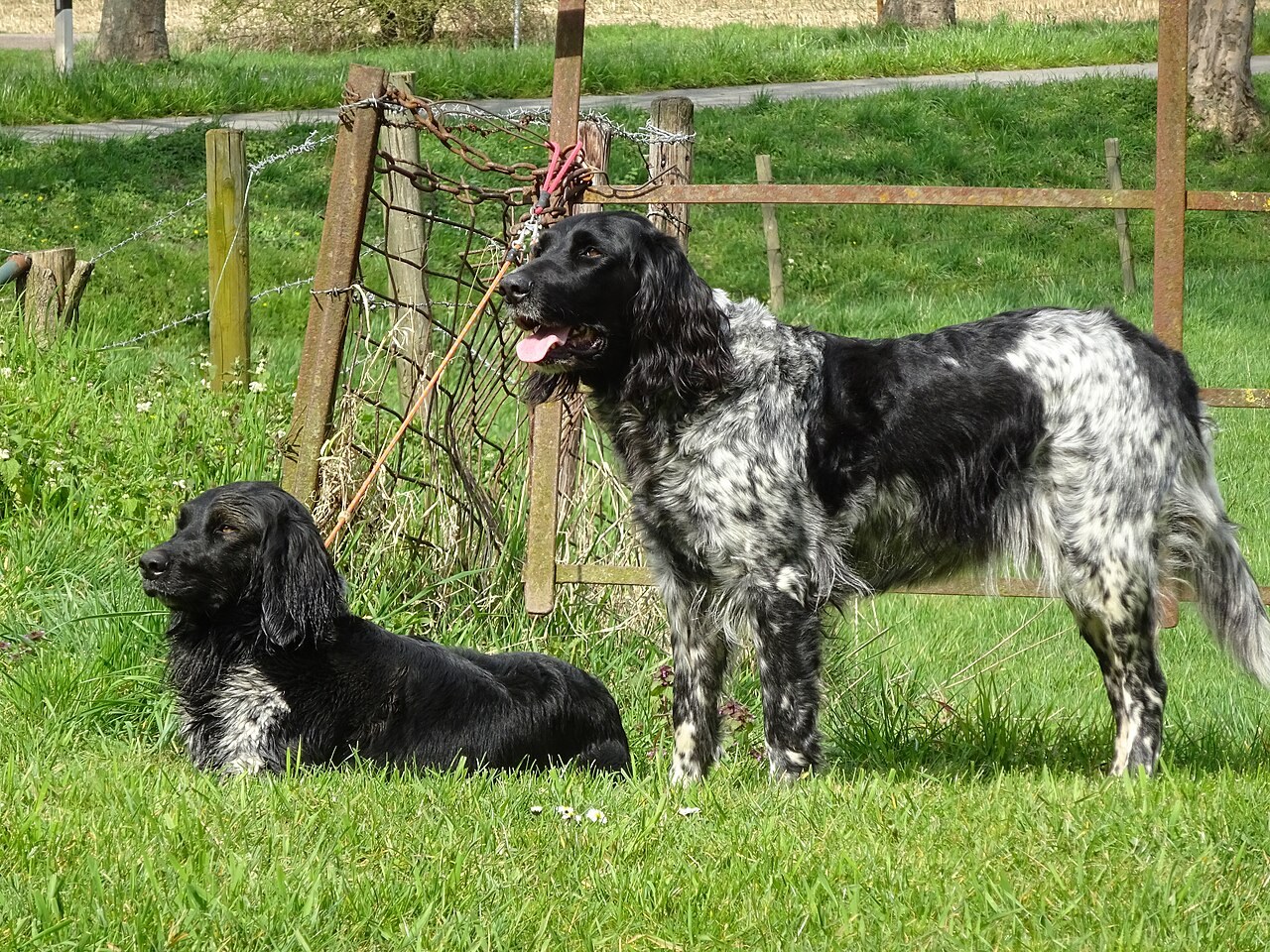
Long, dense, slightly wavy coat with feathering; white with a black head and black patches, flecks or roan
Job
German versatile gundog that searches, points, tracks and retrieves on land and in water (FCI Group 7, pointing dogs)
Temperament in one minute
Large Münsterländer temperament: what they are like at home
Short answer: Large Münsterländers are gentle, loyal and affectionate dogs that are usually friendly with people and other dogs. They are German hunting dogs with a strong nose, a love of carrying things and a lot of stamina, so they can follow a scent and ignore recall, pull on the lead, steal items and struggle to settle. They need one to two hours of activity a day with a real job for the nose, a long line until recall is reliable, kind training and calm house rules.
Are Large Münsterländers affectionate?
Very, and most like to stay near their people. Practise short absences from the start so time alone is no shock.
Are Large Münsterländers easy to train?
Bright and keen, but a scent can win over you. Use short, friendly lessons; a hand target and a name check-in are good first steps.
Are Large Münsterländers friendly with strangers?
Usually friendly and polite, sometimes too bouncy when young. Guests should sit first; see guest entry steps.
Are Large Münsterländers good with kids and other dogs?
Usually both, though a tall, bouncy youngster can bowl over a toddler. See children and guests.
Large Münsterländer behavior problems to expect
Most owners meet four: chasing a scent, pulling, stealing things to carry and restless evenings. Each has a guide in the table below.
Living with a Large Münsterländer in an apartment
It can work if the dog gets long runs and scent work every day. A house with a garden near open country is far easier.
Breed history
From German forest hunters to a rare all-round gundog
The history will not train your dog, but it explains the nose, the urge to carry and the soft nature.
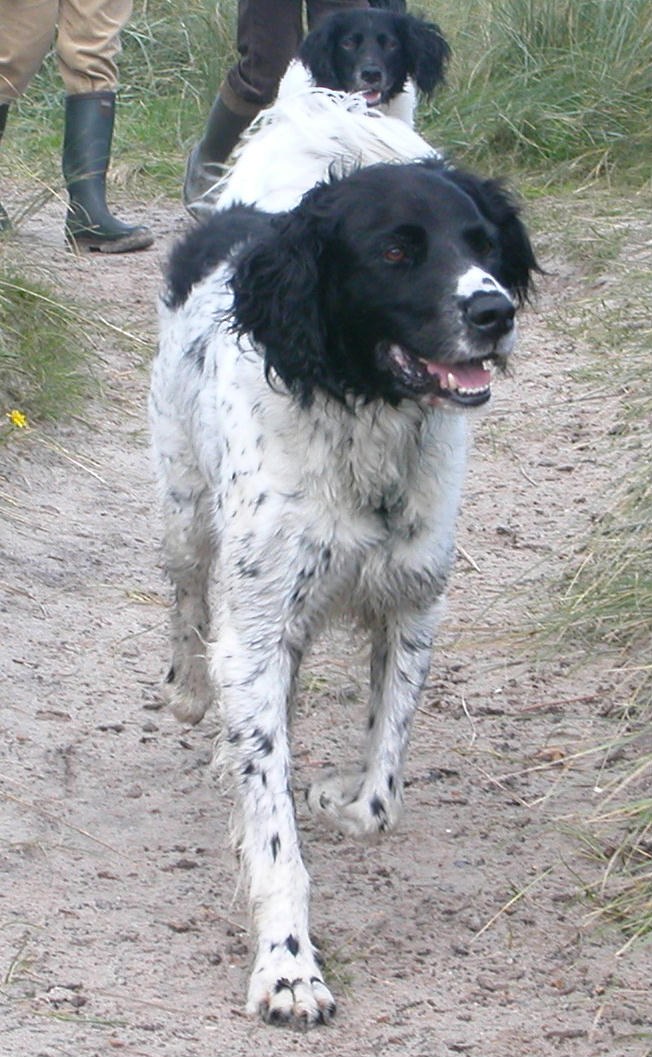
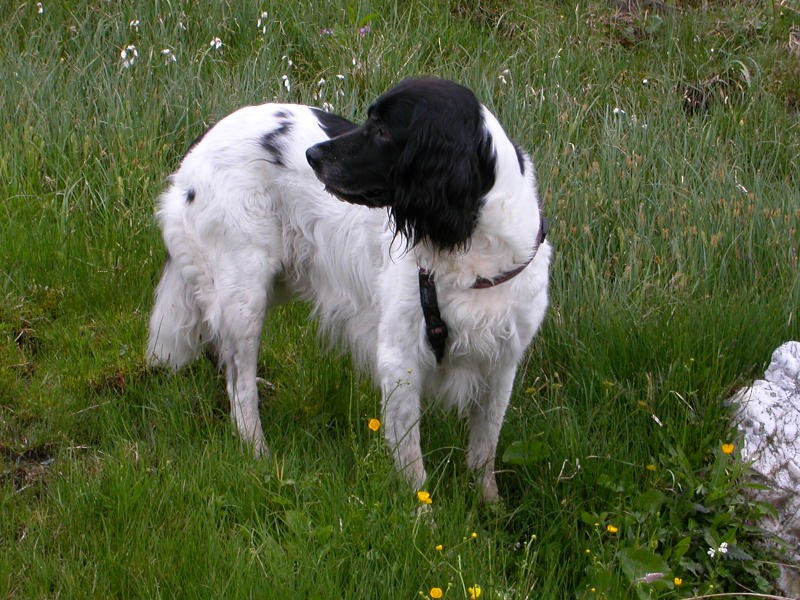
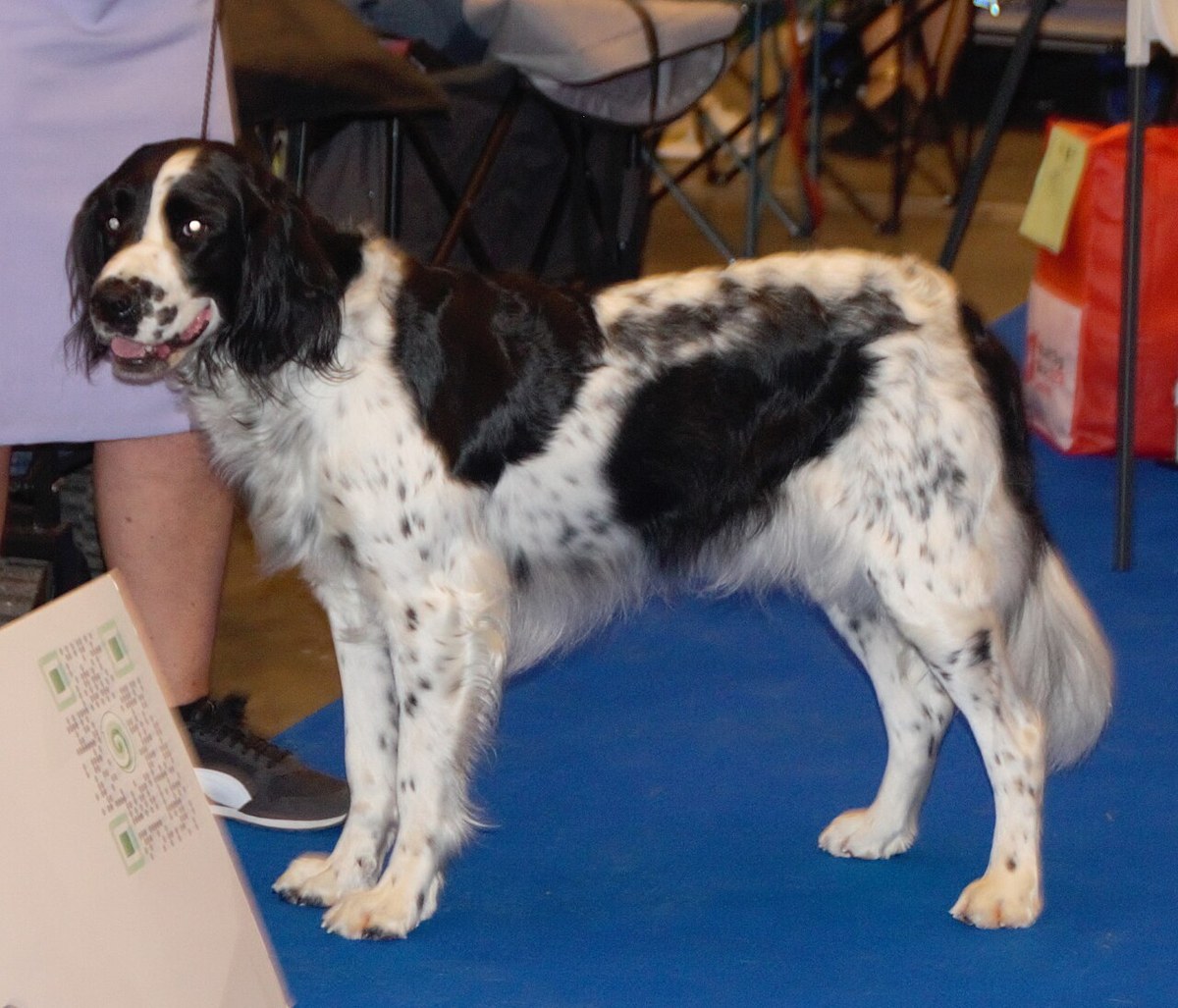
A Large Münsterländer out on a walk with its owner: the breed was made for long days in fields and woods, so daily walks need time to search and sniff.
Germany · 1800s–1919
Long-haired bird dogs of the Münsterland
German hunters in the 1800s used long-haired pointing dogs that could do every part of the hunt: search for birds, point, follow a blood track and retrieve from water. Black and white dogs were born alongside the brown and white ones.
When the German Longhaired Pointer club decided to register only brown dogs, hunters around Münster kept the black and white puppies anyway. In 1919 they set up their own breed club, and the Large Münsterländer became a breed of its own.
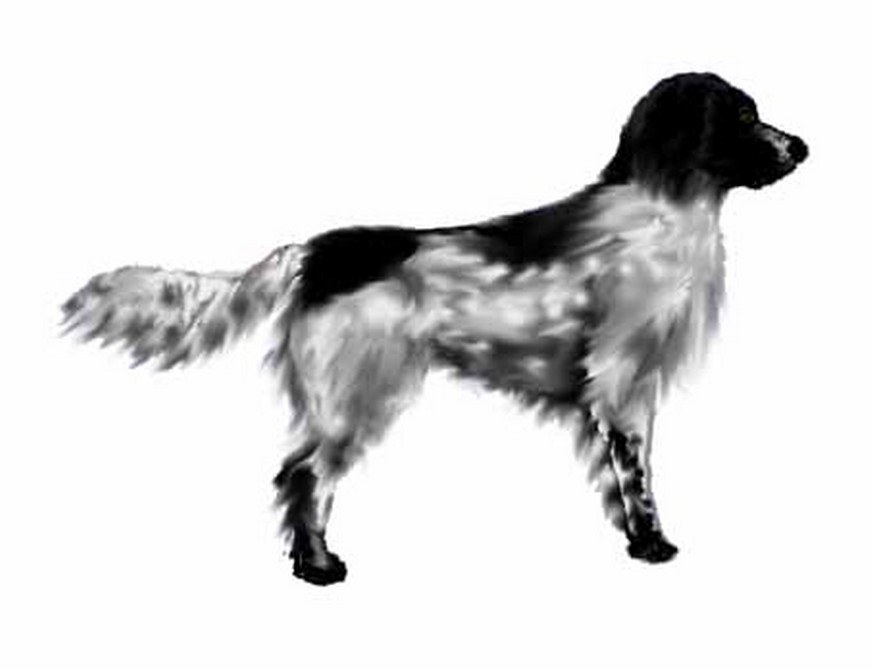
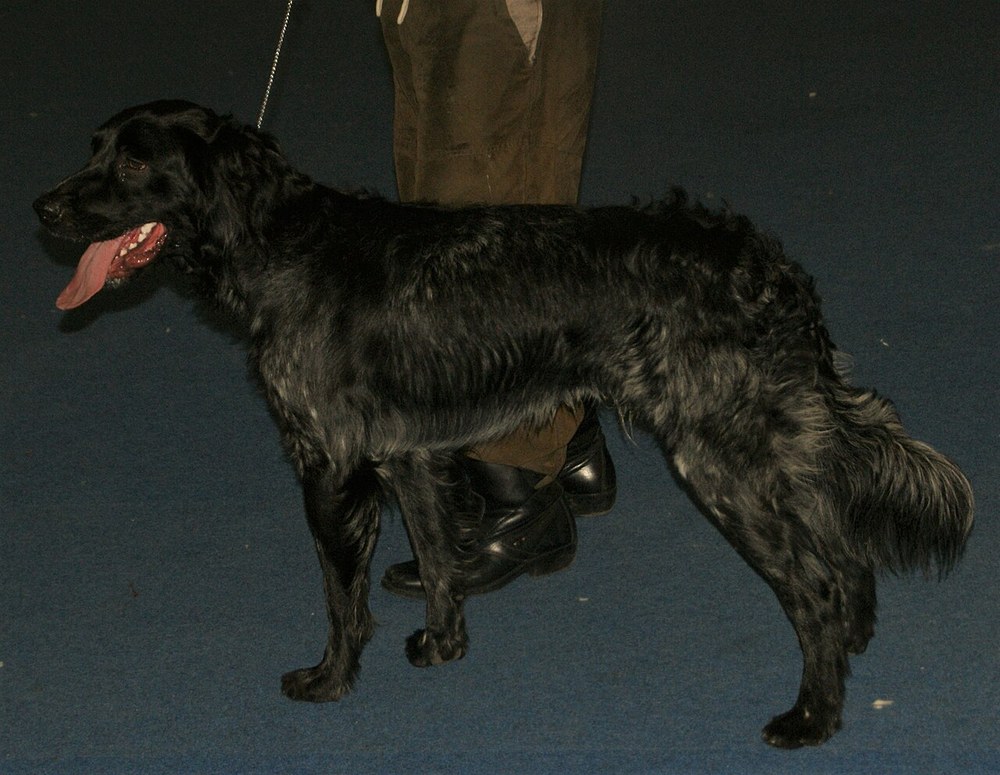
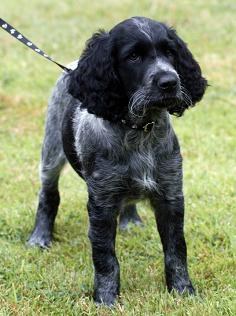
A drawing of a Large Münsterländer made from a photo: an illustration of the breed type, not a photo of a real dog.
From the 1970s
A hunter's dog that travelled
In Germany the breed club still tests dogs in the field and many breeders place puppies mainly with hunters. Dogs reached the UK in the 1970s, where the Kennel Club lists the breed in the Gundog group, and later North America.
The FCI lists the breed in Group 7 with the pointing dogs. In the US it is in the AKC Foundation Stock Service. It is still a rare breed, so puppies often mean a waiting list.
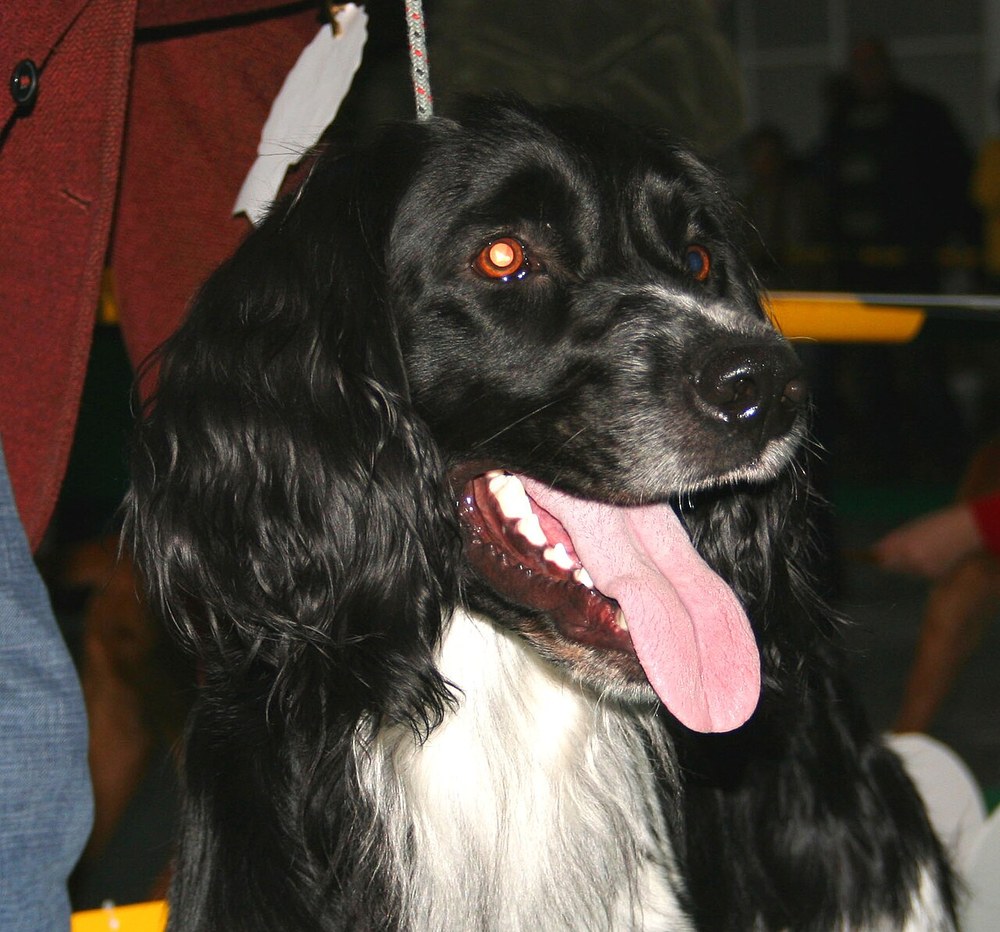
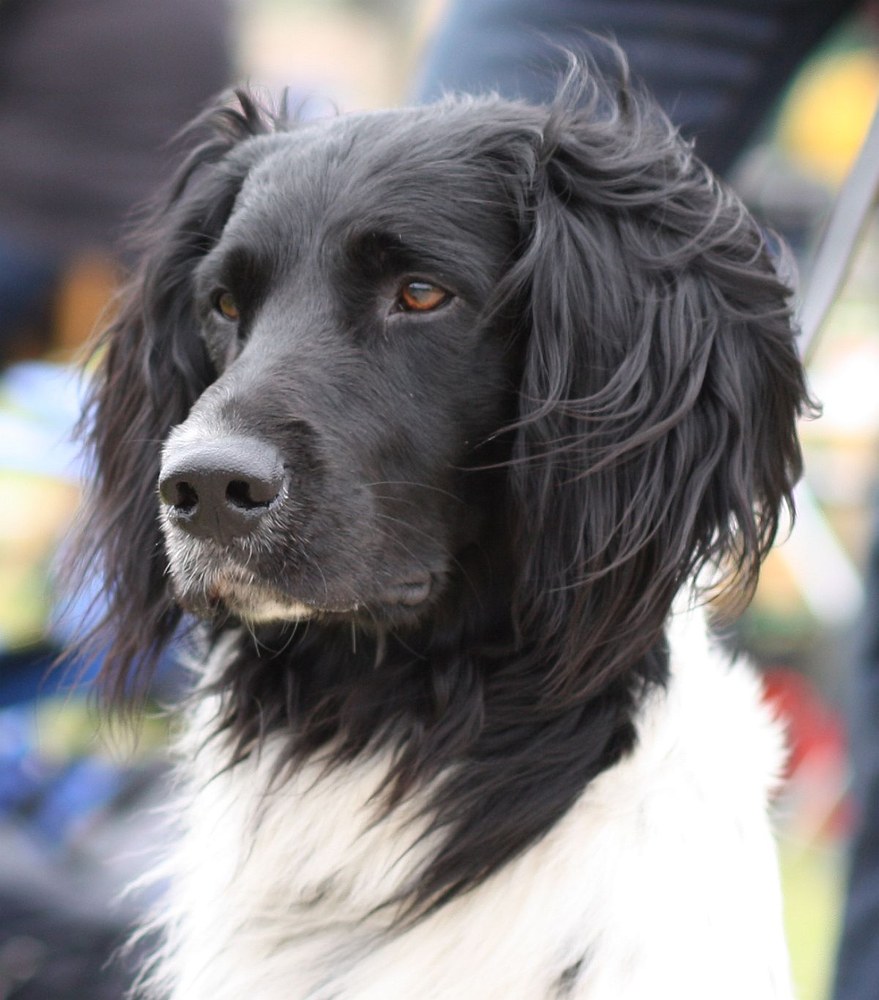
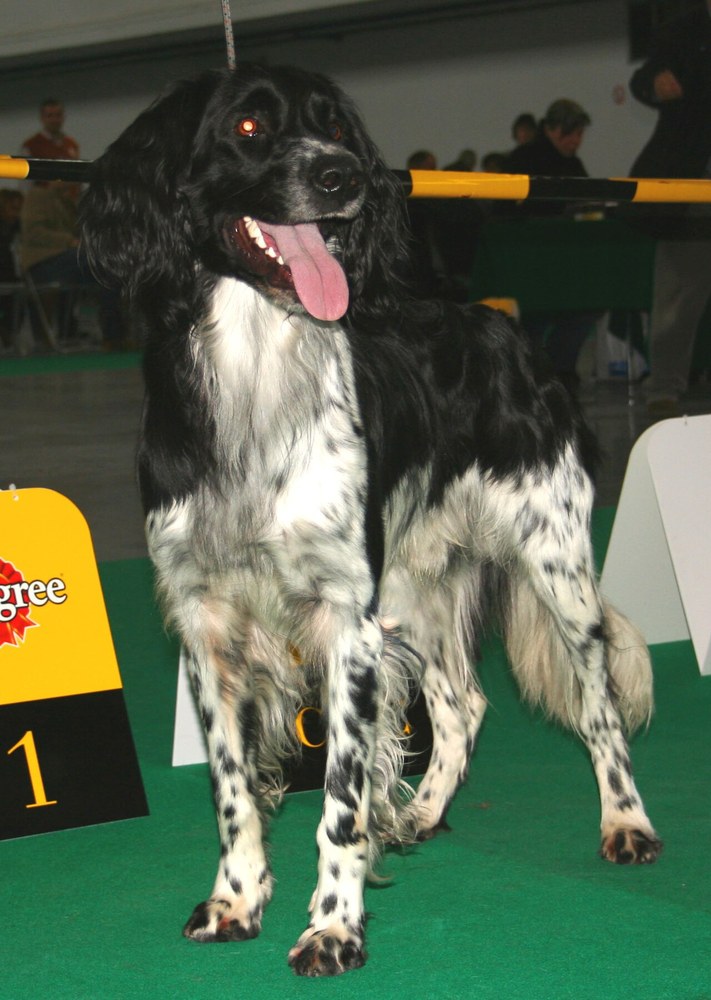
A Large Münsterländer at a dog show in Poland: the black head and long, wavy coat on the ears are typical of the breed.
What the breed was bred for
Gentle, loyal and always ready to search
At home a well-exercised Large Münsterländer is gentle, affectionate and close to its family. Most are friendly with visitors and good with other dogs, and many are softer and more sensitive than they look.
Outside the hunter wakes up. It searches wide, follows a scent and can forget its name near game. Young dogs mature slowly, so recall, lead walking and settling at home need a plan from the start.
A good day has a real search, a retrieve, a short lesson and a long nap
Most adult Large Münsterländers do well on one to two hours outdoors each day. Mix a run off the lead where that is safe, a hidden-toy search or a short track, five minutes of lessons and a proper sleep afterwards. Problems grow when every walk is a lap of the block on a short lead, when the dog is let loose before it comes back reliably, or when a bright youngster has no outlet at all.
Morning · run
A long line in open fields
Use a long line so the dog can range and sniff without the chance to vanish after a hare or deer. Call it back often, reward with food and send it off again so coming back never ends the fun.
Large Münsterländers learn fast and want to work with you, but harsh words make many of them worried. Use food and a kind voice, keep lessons to a few minutes and stop while the dog is still keen.
When the dog spots a pigeon or catches a scent, reward it with food the moment its eyes come back to you. Practise in empty streets first, then by the park, the pond and the edge of the fields.
This breed loves to hold things in its mouth. Hide a toy or treats in the garden, play a short retrieve and teach the dog to swap what it carries for food. Ten minutes of nose work settles it for the evening.
A young Münsterländer will keep going long after it should rest. Give it a mat away from the hallway, something to chew and the same wind-down every night, and it learns that the outdoor day has ended.
General awareness only. I am not a veterinarian. With a Large Münsterländer, owners often notice trouble first as stiffness after a big day in the woods, small cuts on the legs from brambles, warm or smelly ears under the feathered flaps, seeds stuck in the coat, or a dog that flinches or growls when you touch one spot. For red flags, leave this page and open
when to call the vet.
Long coat
Brush once or twice a week and run your hands through the feathering, feet and ears for burrs and grass seeds after every walk.
Ears
Those heavy, hairy ears hold water, so lift and towel them after a swim or a rainy outing.
Growing joints
A tall puppy grows fast; save long runs and leaps from the car for the adult dog. See walk length by age.
Weight
You should feel the ribs easily under the coat. See BCS check at home.
Handling for the vet
Make touching feet, ears and teeth a daily treat game from the first week.
Ask the breeder
Find out which tests the national breed club asks for in breeding dogs and look at the parents' papers. Leave diagnosis to your vet.
Lines and types
Choose a steady, healthy dog, not just a pretty coat
No bloodline selling. Nearly every Large Münsterländer comes from working stock, and many breeders ask whether the dog will hunt or do serious scent work. Spend time with the dam, see how she reacts to you, to a sudden sound and to another dog, and ask which health checks and field tests both parents passed.
Hunting homes
Regular days in the field.
Training for pointing, tracking and retrieving.
Rest days between hard outings.
A calm place to switch off at home.
Suits hunters who want one dog that can do every job on a shooting day.
Active family homes
One to two hours of activity a day.
Tracking, scent work or gundog classes.
Recall practice on a 10 m line.
Time and humour for a slow-growing youngster.
Suits an active family that will give the nose a real job, not just walks around the block.
Socialization windows
What to introduce — and what not to overload — by age
AVSAB-aligned in spirit: short, clean exposures at a distance the puppy can still eat,
with hygiene while vaccines finish. See the
puppy socialization schedule.
2–4 months
First weeks at home
Introduce: new people sitting quietly, daily handling, one toilet spot, short drives, a minute or two alone, soft toys to carry, a calm older dog to meet.
Do not overload: long hikes, jumps from the car boot, free chasing of birds.
~6 months
Busy puppy
Introduce: name check-in, recall games on a 10 m line, swapping items for food, walking on a slack lead, a mat cue, short toy searches.
Do not overload: hunting alone in the garden or fields, endless repeats of one exercise.
~9–24 months
Gangly teenager
Introduce: recall in fresh places with the line still on, leaving bird and deer smells, polite hellos, a tracking or gundog course.
Do not overload: unclipping in the woods because it worked once, expecting grown-up calm.
~2–3 years
Growing up
Introduce: longer tracks, retrieves from water, more free running where it is safe.
Do not overload: dropping lessons once the dog looks adult.
~3 years+
Maintenance
Introduce: a daily search and a run, weight checks, yearly vet visits.
Do not overload: skipping the nose work on busy days.
Before you buy
Who a Large Münsterländer usually fits
Fit comes down to time, places to run, whether the dog will have a job for its nose, and whether you can train recall around game.
Good match
More likely a good fit if you…
You hunt, or want to do tracking or gundog training
You can give one to two hours of activity every day
You have safe places for free running
You want a gentle, loyal dog at home
You are patient with a slow-growing teenager
Mismatch risk
A Large Münsterländer may be a poor choice if…
You want an adult-calm dog from week one
Your days leave little room for long outings
You hope a gundog will come back in the woods untrained
You need a guard dog
You prefer correction-based or force training
If you are torn between breeds
Large Münsterländer vs German Shorthaired Pointer and English Setter
All three are pointing gundogs with strong noses. The German Shorthaired Pointer is also a German hunt, point and retrieve dog, with a short coat and usually even more drive. The English Setter is a bird dog with a long silky coat and a softer, calmer manner. The Large Münsterländer sits in the middle: a versatile German worker in a long coat, often a little gentler than the shorthair.
Coat
Large Münsterländer
Long, wavy, white with a black head and patches.
German Shorthaired Pointer
Short and easy; liver or liver and white.
Energy
Large Münsterländer
High; needs a job for the nose.
German Shorthaired Pointer
Very high; often even busier.
Work
Large Münsterländer
Searches, points, tracks and retrieves.
English Setter
Mainly finds and points birds.
Recall
Large Münsterländer
Needs a long line near game.
Both compares
All three need recall work and running.
Ownership without surprises
Where a Large Münsterländer owner’s budget goes
Costs depend on country, city and your choices. These are themes to plan for, not quotes.
Veterinary
Yearly check-ups, the vaccines your vet advises and the health tests the breed club asks for.
Food
A tall, busy dog eats a fair amount, plus a steady supply of training treats.
Training
Puppy class first, then a tracking, scent or gundog course.
Gear
A 10 m line, a harness, a crate for the car, canvas dummies, a slicker brush and old towels.
Finding a puppy
Few litters are born each year, so expect to wait and to travel.
A few months of recall work and daily scent games cost far less than trying to fix a teenager that already hunts for itself.
Before day one at home
What to prepare for a Large Münsterländer puppy
A Large Münsterländer puppy is soft, sociable and nearly always holding something in its mouth, and its legs seem to grow overnight. Set up gates, a crate, chews, carry toys and a light long line before day one.
A few seconds on each paw, ear and the mouth every day, rewarded with food. See puppy handling.
03
Carrying
Swap shoes and socks for a toy and food instead of chasing. See drop it.
04
Naps
A puppy this size needs set sleep times in a crate or pen. See enforced naps.
05
Alone for a minute
Step out for seconds at a time, many times a day. See first absences.
06
Toilet trips
Outside straight after waking, eating and play. See potty training.
If the dog is already yours
Training a Large Münsterländer means a job for the nose, a long line and patience
Daily life rests on five skills: looking back when you say its name, coming back on a long line, ignoring game smells on cue, handing over what it carries, and lying on a mat to rest.
Large Münsterländers learn with food, play, retrieves and a soft voice. They are clever and willing, but a scent can pull them away fast. Harsh handling tends to make this sensitive breed worried or slow.
Be realistic about recall. A Münsterländer on a fresh deer or hare track may be gone before it hears its name. Train it properly and leave the line clipped on in each new place until the dog has shown you it comes back there.
Load balance
Searching and carrying count as exercise
Puppies should not do long runs or big jumps; those wait for adulthood. If you see a limp, a change in mood or sudden dislike of being touched, see the vet before you train more.
Long line runFind it gameThree-minute lessonRetrieve that endsQuiet nap
For this breed, twenty minutes of tracking or searching often tires the dog more than an hour on a short lead.
A Münsterländer that has searched and carried is a gentle dog at home; one that has not will invent its own work.
Recall
How to teach a Large Münsterländer to come back
Teach the cue indoors with top treats, take it to open ground on a long line, reward each return with food or another chance to search, raise the difficulty with game smells one step at a time, and keep the line clipped on in woods and near wildlife.
01
Start at home
One cue, then top treats.
02
Long line in fields
Open ground, line clipped on.
03
Reward each return
Food or a release to search again.
04
Add game smells slowly
Raise the difficulty a little at a time.
05
Keep the line in woods
Until the dog has shown you it comes back there.
One scene close-up
Why Münsterländer recall needs a long line
A Large Münsterländer was bred to search on its own and follow a track to the end. Once its nose is down on a fresh scent, it can stop listening. Every chase that works out for the dog makes the next one more tempting.
Build the cue indoors first with your best treats. Move to fields with the line on and reward each return with food or a release to search again. Raise the difficulty slowly and keep the line on until the dog has shown you it comes back in that place.
A dog that cannot settle, bites when handled or seems frightened needs a qualified professional; a vet check helps rule out pain.
“With a Large Münsterländer, I begin with a daily job for the nose, a long line and a swap game for everything it carries. Give this gentle hunter real work and clear house rules, and you get a loyal, easy friend.”
We look at your real week: walks, recall, bird and deer smells, carrying, visitors and evenings at home. I am a trainer, not a veterinarian.
Andrew DarovProfessional dog trainer and instructor
Note the dog's age, how many hours it runs and searches, what it does when it hits a scent, and which thing breaks down first: recall, pulling, stealing or settling. Opens WhatsApp to Andrew.
For an outdoor family, often yes. It is gentle, loyal and usually kind with children. It needs plenty of exercise and scent work, and a tall youngster can bowl over a toddler.
Is a Large Münsterländer a good first dog?+
For a first-time owner who loves being outdoors and will put real work into recall, it can be. For someone who wants a short stroll round the block, it is too much dog.
Do Large Münsterländers bark a lot?+
Usually not much. Some whine or bark when bored or left alone. Enough exercise and nose work make a big difference.
How big does a Large Münsterländer get?+
FCI: males 60–65 cm (about 23.5–25.5 in), females 58–63 cm (about 23–25 in). Most adults weigh roughly 25–32 kg (about 55–70 lb).
Do Large Münsterländers shed?+
Yes, a moderate amount. Brush once or twice a week and check the feathering for burrs after walks.
Large Münsterländer vs German Shorthaired Pointer: what is the difference?+
Both are German hunt, point and retrieve dogs. The shorthair has a short coat and is often even more driven; the Large Münsterländer has a long coat and is often a little softer.
Large Münsterländer vs Small Münsterländer: what is the difference?+
Despite the names, they are separate breeds. The Small Münsterländer is smaller, usually brown and white, and comes from different dogs.
Can a Large Münsterländer be off lead?+
Yes, in safe open ground once recall is solid, and free running matters for this breed. Near woods, deer, roads or sheep, leave the long line on until the dog has shown you it comes back there.
Are Large Münsterländers good with other dogs?+
Usually very good. Some young dogs greet too fast and too close, so teach calm meetings.
How much exercise does a Large Münsterländer need?+
Most adults need one to two hours a day, including a run off the lead where it is safe and a search, track or retrieve.
What health themes should I ask about?+
Ask which tests the national breed club wants in breeding dogs and look at the parents' results. Tell your vet the breed. This is general awareness, not a diagnosis.
How long do Large Münsterländers live?+
Public breed references usually give about 11–13 years. Individual dogs vary.
If a Large Münsterländer seems like more work than your life allows
Many people fall for the black head, the soft eyes and the feathered coat. Be sure first that you want the daily scent work, the hunting drive and two years of a gangly teenager.
A Dutch duck-decoy spaniel-type with a quick mind and soft family manners. Needs gentle stranger practice, games that end and a settle after excitement.
A gentle, clever German gundog that searches, points, tracks and retrieves. Loving at home, led by scent outside; needs real work, a long line for recall and kind training.
A gentle, patient Frisian farm gundog. Calm and loving at home, independent and keen on small animals outdoors; needs kind training, a leave it and a long line for recall.
Training problems Large Münsterländer owners ask about
Step-by-step guides for the issues that come up most with this kind of dog.
Dog stealing socks, underwear or laundry? Why dogs take worn clothes, how to stop the chase game, and how to teach a trade so your dog brings things back.
Teach leave it on walks for street food and rubbish: start on a short lead or long line, cue once, add distance, and know when to pick up instead.
Need a read on your exact situation?
Tell me about your Large Münsterländer: how old it is, how much free running and scent work it gets, what it does on a fresh track and where things fall apart first. We check for health issues first, then choose one skill to start with.