Expert Advice · Puppy · 14 min read
Puppy socialization schedule for weeks 8–16
Socialization is short, clean exposures you can still pay. A festival of dogs is rehearsal, not a schedule.
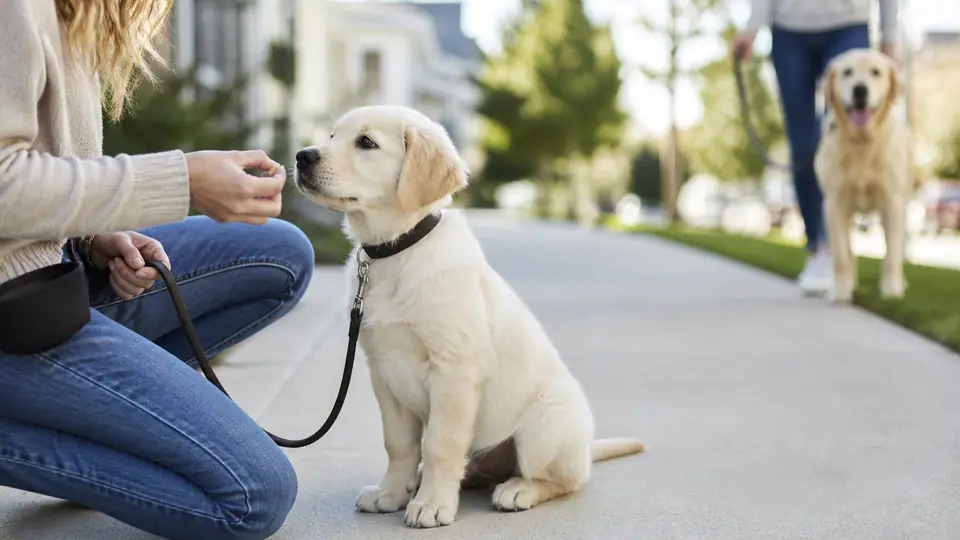
Socialization in weeks 8–16 is a schedule of short, clean exposures, not a personality festival. You introduce people, surfaces, sounds, and carefully chosen dogs while the vaccine series is still finishing, you pair novelty with food at a distance the puppy can still eat, and you rest them afterward. Waiting at home until the last injection is how you miss the working window. Flooding a garden centre, a busy pavement, or a dog park is how you rehearse panic.
This is a puppy protocol. Public veterinary behaviour guidance — see the AVSAB position on puppy socialization — treats early, careful social exposure as compatible with vaccination when hygiene is managed. That sentence is the standard behind this page. It is not a copy of their PDF, and it is not a licence to let a ten-week-old collect every stranger dog in the car park. If the crate, toilet, or nap loop is still broken, fix those first on the day map and enforced naps. An overtired mouth will look “unsocial,” and more novelty will not fix sleep debt.
What is a puppy socialization schedule for weeks 8–16?
A plan you can run on a weekday without turning the house into a visitor centre.
I treat the weeks as three blocks. Ages are working labels from birth, not a promise that your litter matches the chart.
Weeks 8–10 (arrive and name the world). Decompress for a day or two. Toilet pattern and open crate come first. Then add one quiet new thing a day: a different floor (tile, rubber mat, metal threshold), a parked car with the engine off, a person who is not you standing still, a pushchair or suitcase at a distance. Carry the puppy across dirty ground if you need the outing and the vaccine series is incomplete. Food in the pouch. Session under five to ten minutes. Then home and rest.
Weeks 10–12 (raise variety, keep criteria cheap). Add light traffic sound from a distance, a lift or stair landing if you live in a UK flat, a US suburban pavement with space to step off, a person in a hat or with a mobility aid, a calm known adult dog on parallel paths. Puppy class is useful when the trainer controls greetings and the floor is clean. Skip the free-for-all playpen if the room is already screaming.
Weeks 12–16 (prove recovery, not volume). Lengthen walks a little. Add brief urban corners, a hardware aisle you leave before overload, a café outdoor table where the puppy rests on a mat and watches. Keep dog meetings selective. One clean parallel walk beats three chaotic face-to-face hellos. By sixteen weeks you want a puppy who can notice novelty, take food, and recover in the crate — not a puppy who has “met a hundred dogs.”
US yards and UK flats change the furniture. A back garden is not a socialization schedule by itself. A third-floor landing with a lift is a surface lab if you use it. The criterion is the same: short, paid, recoverable.
If they cannot eat, you are not socializing. You are flooding.
Can you socialize a puppy before all vaccines are done?
Yes, with hygiene and selection — not with hope and a dog park.
The old advice to keep a puppy locked indoors until the last injection traded infectious risk for a behaviour risk. AVSAB’s public socialization position is the reason trainers stopped treating the living room as the only legal world. You still do not let the puppy sniff unknown faeces, drink puddles, or wrestle unknown dogs in a park. You carry them across high-risk ground. You choose clean class floors and known vaccinated dogs. You ask your veterinarian about local disease pressure; this site is not veterinary advice and will not invent a titre chart.
A garden centre on Saturday at noon is usually the wrong lab. One quiet weekday aisle, puppy in arms or on a short lead, food ready, exit planned — that can be a session. A pet-shop doorway with ten dogs stacked at the entrance is a festival. Leave.
How do you run one socialization session?
One new thing. Watch the mouth and the food. End early.
- Write the exposure before you leave: “metal grate at the station entrance,” “person with a pram,” “calm Labrador on a parallel path.” Not “go downtown and see what happens.”
- Toilet first. A full puppy cannot learn.
- Arrive at a distance where the puppy can still take food. Mark and feed while they notice the thing. Soft eyes and a wagging body that can still eat are legal. A freeze, a scream, or a closed mouth means you are too close.
- If food dies, increase distance or end. Do not drag them closer “so they get used to it.” Habituation without a pay-off at a winnable distance is how you build a flinch.
- Quit while it is still cheap — often three to ten minutes. Then toilet again and put them down for a real nap. See enforced naps if the evening mouth is already late.
Sounds can be started at home: a recording of traffic or thunder at a volume that still allows food, then real sound at a distance later. People can be staged: one guest who ignores the puppy until the puppy approaches and can take food on the floor. Children are a separate criterion. See children and guests. Do not use a child as the first loud moving object.
What about other dogs and puppy classes?
Other dogs are a line item on the schedule, not the whole curriculum.
Prefer parallel motion: two dogs walking the same direction with space, handlers paying their own dogs. Face-to-face greetings on a narrow pavement teach straining and rude front-end contact. A structured class with a trainer who stops pile-ons is worth more than a free playgroup where one rude adolescent rehearses hunting the small one.
Known vaccinated adult dogs who already ignore puppies are gold. Unknown dogs in a park are a lottery. If you cannot brief the other handler, you do not need that meeting today. Surfaces, people, and sounds will carry more of the week than dog-to-dog reps.
If your puppy already stiffens, growls, or cannot recover after a dog sighting, you are not on a “more socialization” ladder. You are on management and professional help. Distance work belongs with threshold ideas on on-leash threshold, even for a young dog — the food test is the same.
When is “socialization” the wrong project?
Use a fence you can see.
This ladder: notices novelty, takes food, softens, recovers in the crate between days, can end a session without a meltdown.
Not this ladder: freezes or screams at wide distance, cannot eat for the whole outing, gets worse across the week, shows diarrhoea, fever, lethargy, or a puncture, or lives with an adult dog who hard-stares and corrects the puppy into panic. Pain and illness are veterinary first. Fear that does not recover is not fixed by a louder Saturday market.
True panic and a puppy who cannot leave the house are not a DIY weekend. Manage the environment. Get a veterinarian when the body changed. Get a qualified trainer or veterinary behaviour professional in your country for fear work. Dogmindlab will not invent a triage inbox to stand in for that.
What are the usual failure modes?
- You waited for the last injection. The living room stayed safe and small. Start careful outings with hygiene now, not after the window has narrowed.
- You ran a festival. Garden centre, dog park, five new dogs in one hour. Volume is not a schedule. Cut to one exposure and watch food.
- You ignored the closed mouth. No food means too close. Backing up is the skill. Dragging forward is flooding.
- You skipped the nap after. Evening biting is often the bill for an afternoon of “socialization.” Put them down.
- You used every dog as a training prop. Rude greetings teach rude greetings. Parallel and selective beats quantity.
- You stacked criteria. New place plus new dog plus hungry children plus missed toilet. One variable per session.
Sources
AVSAB position statement on puppy socialization; AVSAB position statements on humane dog training. Paraphrased as public standards, not quoted as a substitute for reading the originals. avsab.org/resources/position-statements/
Questions on this page
What is a puppy socialization schedule for weeks 8–16?
A week-by-week plan of short, clean exposures to people, surfaces, sounds, and carefully chosen dogs while the vaccine series finishes. Pair every new thing with food at a distance the puppy can still eat. Hygiene matters. Flooding a garden centre or a busy dog park is not the schedule.
Can you socialize a puppy before all vaccines are done?
Yes, with hygiene. Public veterinary behaviour bodies treat early, careful social exposure as compatible with vaccination when you manage risk — carried into class, clean floors, known vaccinated dogs, no sniffing unknown faeces. Waiting at home until the last injection is how you miss the working window. This is not a licence to run free in a dog park.
How do you run one socialization session?
Pick one new thing. Keep the session short. Watch whether the puppy can still take food. If they cannot eat, you are too close or too loud — back up, pay, end. Then crate rest. A session that leaves the mouth frantic is sleep debt plus overload, not “more socialization.”
What about other dogs and puppy classes?
Choose known, vaccinated, calm adults or a structured class with a trainer who controls greetings. Parallel walks beat face-to-face pile-ons. A dog park at ten weeks is usually a festival, not a lab. One rude jump from a stranger dog can teach the wrong picture for months.
When is “socialization” the wrong project?
When the puppy freezes, screams, or cannot eat even at a wide distance; when diarrhoea, fever, or a puncture shows up; when an adult dog is rehearsing hard stares. Manage, get veterinary care if the body changed, and see a qualified professional for fear that does not recover between sessions. This page is not a clinic.
Work with me
A $150 consultation or $500 monthly curatorship. Opens WhatsApp to Andrew.