Expert Advice · Puppy · 16 min read
Enforced Naps for Puppies: Nap Schedule by Age
Enforced naps for puppies: put them down on purpose. The day map owns the clock. The mouth page owns teeth. This page owns the nap.

Short answer
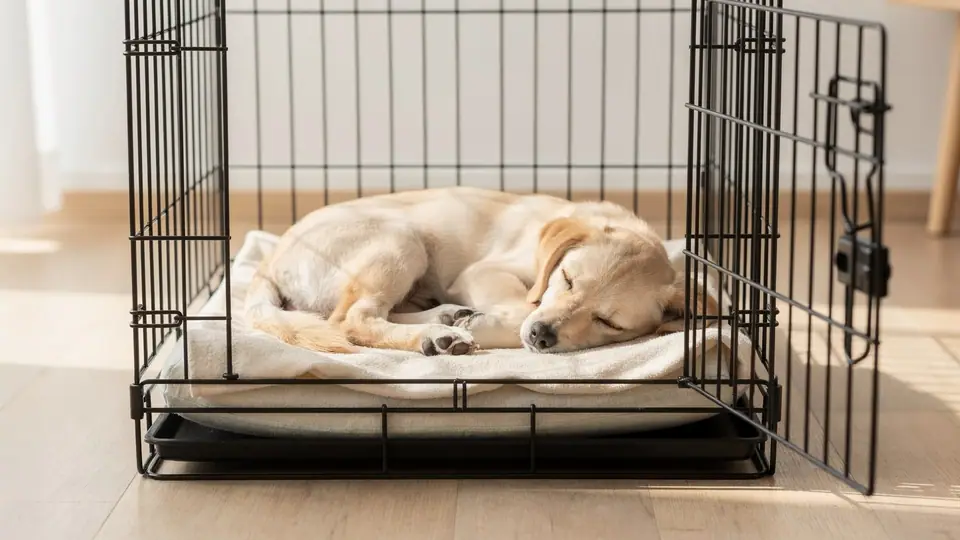
An enforced nap means you put your puppy down to sleep on a schedule instead of waiting for a crash. Young puppies need around 18–20 hours of sleep a day, so at 8–10 weeks most do best with 45–60 minutes awake, then a nap of one to two hours in a crate or pen. Overtired puppies bite and zoom more, so naps fix behaviour too.
Enforced naps for puppies are rest you start on purpose — before the mouth blows — because an overtired puppy bites more when the brain runs out of inhibition, not because you failed as a leader. The witching hour is a missed nap wearing a mouth — the 6–9 pm evening plan lives on puppy witching hour. Protocol in one line: end the party, toilet, then crate or pen with a legal chew. You cannot train through sleep debt. Hands-as-toys and another hallway chase will not spend the arousal down. Rest will.
This page owns the nap: spotting the stop cue, closing the wake window, and putting the puppy down. Wake windows by age live below. The clock loop sits on the puppy day schedule. Teeth on skin sit on biting and nipping. Crate introduction, duration, and nights already have homes — if the crate is still a fight, fix that first, then come back and run the nap. Dry mornings after nights 1–7 are on when do puppies sleep through the night.
Why does an overtired puppy bite more?
Because tired animals lose the off-switch before they lose the motor.
A puppy in a new house does not self-regulate sleep. You skipped a rest, you stacked people, you ran a yard or a lift trip, and now it is the household’s loudest hour. The mouth that was a play nibble at 11 a.m. is a sleeve hunt at 6 p.m. Owners call this “the shark hour” or “he went crazy.” I call it late.
What it looks like on the floor:
- zoomies that do not end in a flop
- land-sharking — air snaps, clothes, heels, hands that were legal an hour ago
- a glazed, over-bright eye and a body that will not take a chew
- food refused, or food grabbed and spat
- a puppy who “won’t settle” on a mat you just put down
- children being used as moving toys
That picture is usually sleep debt plus rehearsal. The nipping ladder still applies when teeth hit skin: the game ends. The missing piece is often not a better yelp. It is a nap you should have started forty minutes ago.
Arousal is not the same as exercise debt. A twenty-minute walk does not replace rest. A UK flat with a lift commute can spend the whole wake window on the toilet trip and then wonder why the puppy detonates in the hallway. A US house with a yard can do the same thing with “just five more minutes of fetch.” The furniture changes. The physiology does not.
If the mouth is getting louder, the session is already over. You are late for a nap.
What is an enforced nap?
A rest you start. The puppy does not vote.
Enforced means you close the picture on purpose: toilet, crate or pen, chew, door. It is not a scolding. It is not “go think about what you did.” Public crate overviews treat the box as a rest and safety tool. If “get in there” follows a chewed shoe, you poisoned the nap. Use a gate for the shoe. Keep the crate boring and fed. See crate training.
What it is not:
- a work shift (duration lives on crate duration)
- night one (that is first night and nights 1–7)
- an ignore-crying contest
- a substitute for a toilet
- a way to hide a puppy from guests while you skip the last rest of the day
A pen counts if the puppy actually sleeps there. A pen that is a toy arena with a child in it is not a nap. A crate in the room you live in is better than a crate in a distant utility space. US hall, UK landing — same rule. Put the box where the household already is, then make the household quieter for the nap, not the other way around.
You enforce the nap before the explosion when you can still see the signs. You also enforce it after the explosion, because the mouth will not come down in the hallway. Either way, the party ends first.
- Name the stop cue. Mouth going up, zoomies that do not flop, glazed eye, food refused. That is the end of wake, not a request for one more retrieve.
- End the party. Hands fold. Voice goes quiet. Guests wait or the puppy is gated. No hallway chase “to tire them out.” You already tried that. It failed.
- Toilet commute. Lead or carry to the named surface. Stand still. Pay the toilet. A full bladder makes every nap a lie. US yard through one door, or a UK pad on a tray — same commute, named place. The lift does not cancel the nap; it shortens the wake window you have left.
- Crate or pen, already introduced. Puppy inside with a legal chew. Door closed. You sit in the room. Open before panic, not after twenty minutes of screaming. Build the closed door on the crate page if this step is still a fight.
- Wake to a toilet, not a rematch. Open, commute, pay the toilet, a little freedom in a room you can see. Do not dump an exploded brain into children.
How long should a puppy nap, and how long is a wake window by age?
Working ceilings I actually run. Not medical dogma. Not a research paper. The tank in front of you can undershoot every number.
A wake window is how long the puppy is up between rests. It includes the toilet commute, the meal, the short training picture, and the play. It does not include “and then guests, and then the garden centre.”
Rough daytime picture for a puppy who just emptied and is ready to rest:
- Eight to ten weeks. Wake about 45–60 minutes. Then a nap. Closed-door naps often 30–60 minutes once the introduction is honest. Total sleep is most of the twenty-four hours. Overnight is a different clock — plan get-ups.
- Eleven to fourteen weeks. Stretch wake toward 60–90 minutes if the mouth stays usable and the puppy still takes a chew. Daytime naps can build toward an hour or two if the puppy is actually sleeping, not screaming-then-sleeping.
- Fifteen to sixteen weeks. 90–120 minutes awake can be legal. Many still need a midday rest you would rather skip. Two to three hours closed can be a nap ceiling. It is still not a work shift.
These sit under the duration ceiling on crate duration: age in months plus one, in hours, for a rested, emptied puppy — a cap, not a target. An eight-week-old is not a three-hour project. Do not steal an hour on day two because a tea-towel chart said you could.
The day map is how those windows sit on a clock. This page is the emergency brake: when the mouth tells you the window is already over, you do not finish the window. You close it.
Evening is where households lie. The last wake of the day should be shorter than the best one, not longer. Guests at 7 p.m. do not get a puppy who skipped 5 p.m. rest. Gate the dog or reschedule the people. See children and guests.
A UK after-work landing and a US open-plan kitchen use the same rule. The loudest hour is the nap hour you protect, or it is the bite hour you scheduled.
How do you put a puppy down without making crate crying worse?
You do not invent a second crying protocol on this page. Protest versus panic already has a home.
Do this: empty first. Close the door on a puppy who is already inside with a chew. Stay in the room. Build minutes, not an exile to the utility closet. That is the daytime crate introduction. If closed-door rest is still a fight, you do not have an enforced-nap problem. You have an introduction problem. Fix that.
Protest is rhythmic fuss that fades if you stay boring and nearby. The puppy can still take the chew. The body is not ricocheting.
Panic climbs. Volume up, gaps gone, thrashing, claws, overheating, food refused. Panic is a stop cue. Open, reset, drop criteria. Waiting it out teaches that the crate is where the world ends. The classifier for nights — including the thing people mean by “ignore crate crying” — lives on crate training at night. Do not run a night ignore-plan as a Tuesday afternoon nap.
Useful setup so the nap does not start a fight:
- crate already paid with meals, door open, in the room you live in
- divider fitted so extra floor is not a toilet corner — crate size owns the tape
- last toilet was real, not a distracted sniff
- chew the puppy can actually digest, not a stuffing festival
- household volume down for the first minutes (TV, children, the other dog)
- you stay. Then you step out for seconds. Then minutes.
If you need the puppy contained so you can cook tonight and the crate still predicts panic, use a pen or a gated kitchen for that hour and keep crate closed-door work honest. Stealing duration you have not trained is how naps get poisoned.
Heat is a stop. A crate in a sun-room or a parked car is not a nap protocol.
When is the frenzy not just sleep debt?
Use a fence you can see. A missed nap is common. It is not every mouth.
This protocol: bouncy, getting louder as the wake window ran long, able to take a chew once the room went quiet, coming down after a real rest, no freeze before the bite, no guarding, no punctures.
Not this protocol:
- stiff body, hard stare, a snap that lands and holds
- a child being chased, heel-nipped, knocked as prey
- guarding a bowl, a bed, a person, a doorway
- punctures, clustered bruises, a bite to the face
- a puppy who cannot rest even in a quiet, emptied, already-introduced crate
- sudden change: last week slept, this week frantic, or screaming plus diarrhoea, vomiting, a swollen belly, or pain when touched
The last two are veterinary first. Training notes are not veterinary advice. US owners can use ASPCA Animal Poison Control if a toxin is on the table. UK owners use their practice or a 24-hour service. See when to call the vet.
True aggression and a child who has been punctured are not a weekend DIY nap. Gate the dog. End unsupervised contact. See a qualified trainer or a veterinary behavior professional in your country. The ASPCA’s puppy mouthing notes treat play mouths as training and true aggression as a reason to get qualified help. The AVSAB position statements sit behind the reward-based, management-first method on this site. Read them as public standards. This page is the kitchen version: put the puppy down, then look again.
If the picture is mixed or you are frightened, you do not need a second internet opinion. You need management and a pair of eyes on the actual dog.
What does an enforced nap schedule look like? (sample day)
Here is a sample day for a puppy of about 8–10 weeks. Shift the clock to your household; keep the pattern of awake, toilet, nap.
| Time | What happens |
|---|---|
| 7:00 | Wake, straight out to toilet, breakfast, short play |
| 8:00–10:00 | Nap in crate or pen |
| 10:00 | Toilet, 5 minutes of training, sniffing in the garden |
| 11:00–13:00 | Nap |
| 13:00 | Toilet, lunch, gentle play, a chew |
| 14:00–16:00 | Nap |
| 16:00 | Toilet, short walk or new-sounds outing, play |
| 17:00–18:30 | Nap |
| 18:30 | Toilet, dinner, family time on a lead or in the pen |
| 20:00–21:30 | Nap or quiet chew next to you |
| 22:00 | Last real toilet, then bed |
The awake blocks get longer as the puppy grows: roughly an hour at 8–10 weeks, 60–90 minutes around 12 weeks, and up to two hours by four months. If you want to time naps on paper, the enforced nap clock gives a simple daily sheet, and the puppy day schedule shows the whole day around it.
How do you know your puppy needs a nap right now?
Watch for the overtired picture rather than the clock alone:
- biting harder at hands, feet and clothes, and not letting go
- zoomies that get faster instead of fading
- ignoring cues the puppy knew an hour ago
- barking or grabbing at you when you sit down
- yawning, rubbing the face, or a glazed look between bursts
When you see two or more, skip the extra game. Toilet first, then into the crate or pen with a chew, lights low, and you nearby and boring. Most puppies are asleep within ten minutes once the routine is familiar. If biting is the main issue, the biting and nipping page covers the mouth itself, and the witching hour page covers the evening crazies.
Not sure whether the puppy is short of sleep or just wound up by a busy hour? Overtired vs overstimulated puppy shows how to tell the two apart and what changes in the fix.
What are the usual failure modes?
- You added another game. The mouth was already late. Fetch is not a nap. End the party.
- You skipped the toilet. A full bladder turns the crate into a bathroom. Empty, then rest.
- You closed a crate the puppy does not know. That is exile, not an enforced nap. Run the introduction. Stay in the room.
- You treated panic as protest. Waiting it out taught frantic. Open, reset. Nights have their own classifier. Do not import it as a daytime character test.
- You let evening guests write the schedule. The last wake should be shorter. Gate the puppy or move the people.
- You spent the wake window on the commute. A UK lift or a long US yard session is not extra energy the nap can absorb. Shorten wake. Protect rest.
- You called a freeze-and-stare bite “overtired.” Wrong protocol. Manage. See a qualified pro.
There is no product on this page that will sandpaper sleep debt off a puppy. A crate, a pen, and a chew are tools. They are not listed as affiliate URLs. The gear lab is empty of sponsors on purpose.
Run real naps for a week — wake windows you can actually see, toilets that happened, a crate that already pays — before you decide enforced rest “doesn’t work.” If the mouth is still a hunt after honest sleep, you are no longer on this page’s ladder. If every nap still needs your lap, move rest off your body with puppy only sleeps on me.
Sources
AVSAB position statements on humane training and puppy socialisation. ASPCA overview of puppy mouthing, nipping, and biting. Paraphrased as public standards, not quoted as a substitute for reading the originals. This page is trainer protocol on the training floor. It does not borrow a veterinary diagnosis. avsab.org/resources/position-statements/ · aspca.org — puppy mouthing
Questions on this page
Why does an overtired puppy bite more?
Because a tired brain loses inhibition. The mouth gets louder as the session gets longer. Zoomies, land-sharking, and a glazed stare at 6 p.m. are usually a missed nap, not a personality. You cannot train through sleep debt. Put the puppy down.
What are enforced naps for puppies?
A rest you start on purpose, before the mouth blows, in a crate or pen the puppy already knows. It is not a scolding and not a work shift. Toilet first, chew in, door closed on a nap you can finish. The puppy does not vote. You do.
How long should a puppy nap, and how long is a wake window by age?
Working ceilings, not research statistics. Eight to ten weeks: about 45–60 minutes awake, then a nap. Eleven to fourteen weeks: stretch toward 60–90 minutes if the mouth stays usable. Fifteen to sixteen weeks: 90–120 minutes is often legal. Total sleep is most of the day. A ceiling is not a dare.
How do you put a puppy down without making crate crying worse?
Empty first. Close the door on a puppy already inside with a chew, in a crate you have already introduced. Stay in the room until closed-door rest is cheap. Protest is not panic. Panic is a stop. Do not invent an ignore-crying protocol here. That classifier lives on crate training and nights.
When is the frenzy not just sleep debt?
When the body is stiff, the bite has a job, a child is being hunted, or the puppy cannot rest even in a quiet room. Pain, a sudden change, guarding, and punctures are not a nap problem. Manage, and see a veterinarian or a qualified trainer. This page is not a clinic.
How many hours a day should a puppy sleep?
Young puppies commonly sleep around 18–20 hours in 24, counting night sleep and daytime naps. Older puppies sleep a little less. If your puppy is awake most of the day and biting more by the evening, missing sleep is the first thing to check.
Should I wake my puppy from a nap?
Usually let a nap finish. Wake the puppy only to keep the toilet plan on track (for example, a long nap right before bedtime) or to protect night sleep. When the puppy wakes, take them straight out to toilet.
Work with me
A $150 consultation or $500 monthly curatorship. Opens WhatsApp to Andrew.