
Expert Advice · Skills · 8 min read
Nose work games for dogs at home: the find it game
The find it game turns your dog's nose into a calm indoor activity. Start with scattered treats on the floor, move to cups and boxes, then hide treats in other rooms, and finish every game with the same end word.

The easiest nose work game for dogs at home is “find it”: say the words, drop a few treats on the floor in front of your dog, and slowly make the search harder, from scattered treats to cups, cardboard boxes and other rooms. Keep games to three to ten minutes and end each one with the same word. If your dog already hoovers up rubbish outside, start with scavenging on walks, which owns that problem; this page is about planned searching at home.
I am Andrew Darov, a dog trainer. I am not a veterinarian. This is a skills page about a simple game you can play indoors.
Why play sniffing games with your dog?
Searching with the nose tires a dog in a calm way. Ten minutes of find it can settle a dog better than a fast game of fetch.
Sniffing is how dogs explore. A short search uses the brain and the nose, slows breathing down and often ends with a dog who wants to lie down. That makes find it useful on rainy days, for dogs resting after an injury (ask your vet what is allowed), for puppies, and for older dogs who cannot walk far.
It also helps with manners. Find it gives you a quick way to move a dog’s attention to the ground when something exciting goes past, and it gives a busy dog something to do while you cook or answer the door.
How do you teach find it step by step?
Use small, soft treats or part of the dog’s meal. Start in a quiet room.
- Drop treats in front of the dog. Say “find it” once, then drop three or four treats right by your dog’s front paws. Let it eat them. Repeat five times. Soon the dog’s nose goes down as soon as it hears the words.
- Scatter wider. Say “find it” and toss a small handful over a rug, a towel or the lawn. The dog has to slow down and sniff. A snuffle mat or a rolled-up towel with treats inside works the same way.
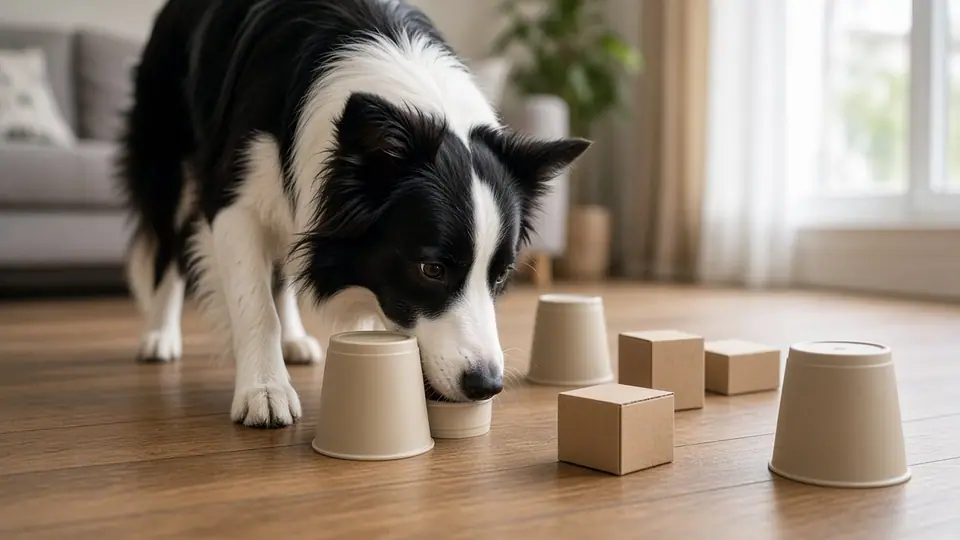
- Hide treats under cups. Put three plastic cups upside down. While the dog watches, put a treat under one. Say “find it”. When the dog nudges or paws the right cup, lift it. Later, swap the cups around before you say the words.
- Use boxes and other rooms. Put treats in two or three open cardboard boxes among some empty ones. Then ask the dog to wait or have someone hold it while you hide treats in easy spots in another room: on the floor, behind a door, beside a chair leg. Start easy and only make it harder when the dog finds everything fast.
- End on a clear word. Finish every game with the same word, such as “all done”, show your empty hands, and give a chew or a calm cuddle. The dog learns that searching starts and stops on your words.
How do you make it harder without frustrating the dog?
Change one thing at a time: more boxes, a higher spot like a low shelf, a treat inside a folded towel, or a room the dog knows less well. If the dog gives up, stares at you or starts barking, the search is too hard. Go back a step and make the next few easy.
For dogs who love toys, you can hide a favourite toy instead of treats. Keep the toy for the game so it stays special.
Is find it safe for every dog?
Mostly yes, with a few care points. Do not hide food where the dog could knock things over or chew furniture. If you have more than one dog, play with one at a time, especially if any of them guards food. Use part of the daily food for dogs who need to watch their weight. If your dog has a health condition, ask your vet whether searching games are fine.
Searching should not turn into eating things off the floor all day. Teach leave it alongside find it, so the dog learns both “search now” and “leave that”.
What are the usual mistakes?
- Making it hard too early. Easy wins keep the dog trying.
- Helping too much. Point once if you must, then let the dog work it out.
- Long sessions. Stop after three to ten minutes, while the dog still wants more.
- No end word. Without one, the dog keeps searching the house for an hour.
- Saying “find it” when nothing is there. The words should always mean food or a toy is near.
Find it is a calm, short indoor game that works for puppies and older dogs alike. Pair it with leave it, use the ideas in scavenging on walks outside, and use a sniff game in the evening if your puppy goes wild during the puppy witching hour. More on the skills hub.
Questions on this page
What are nose work games for dogs?
Nose work games are searches where the dog uses its nose to find treats or a toy. At home they can be as simple as treats scattered on the floor or hidden under cups, and they get harder as the dog learns.
How do I teach my dog find it?
Say "find it" and drop a few treats on the floor right in front of your dog. Repeat until the dog looks down as soon as it hears the words. Then scatter treats wider, hide them under cups, in boxes and finally in other rooms.
How long should a find it game last?
Three to ten minutes is plenty for most dogs. Searching is tiring, and short games keep the dog keen. Stop while the dog still wants more.
Are sniffing games good for puppies?
Yes. Easy scatter games are a calm way to fill a puppy's awake time indoors. Keep them very short, use part of the meal instead of extra treats, and let the puppy nap afterwards.
Will find it make my dog scavenge on walks?
It usually helps, because the dog learns that searching happens when you say so. Pair it with a solid "leave it" and an end word, and only play find it in the places you choose.
Work with me
A $150 consultation or $500 monthly curatorship. Opens WhatsApp to Andrew.