Expert Advice · Skills · 12 min read
Place / settle on a mat: teach a dog to park and stay there
Four paws on the mat is the start. A down that holds while you cook is the job.

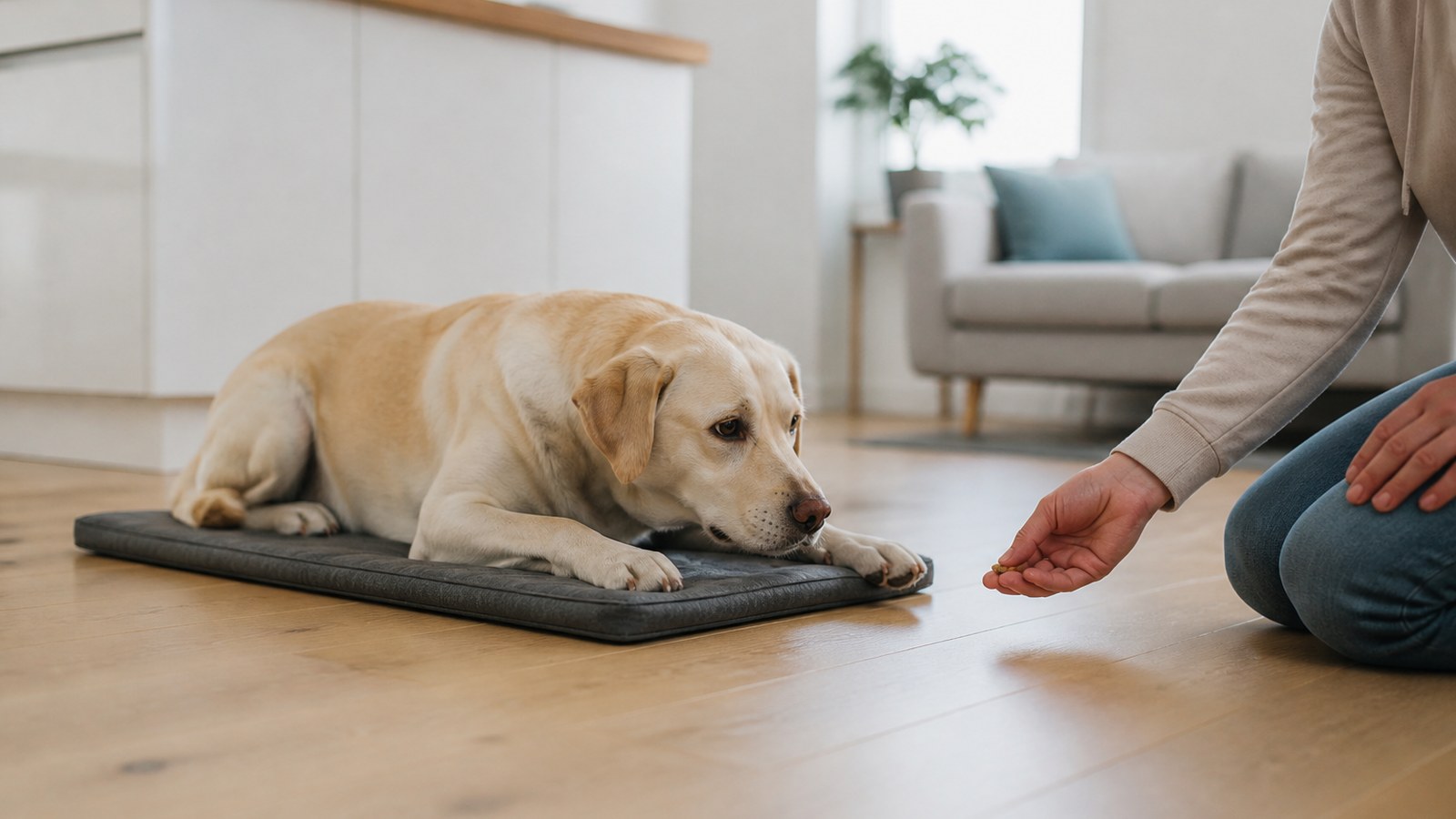
Place is a dog who goes to a mat, parks there, and stays until you release. The working picture is four paws on a defined surface, usually a down, paid on the mat. A sit that drifts into the hallway is not place. A crate with the door shut is a different protocol. You want a portable station you can drop beside a US kitchen island or against a UK flat wall while you cook.
This is a skills page. Crate training owns the box. Wait at the door owns the sill. Jumping up owns four paws on people. I run month-plus residential work as a trainer from Russia. I am not a veterinarian, and this page will not invent a US address or a fake client diary.
What is place or settle on a mat?
Name the chain or you are wishing.
- A mat or low bed is on the floor in a known spot.
- You cue once, or you walk the dog to it while you are still teaching.
- All four paws land on the mat.
- The dog downs (or holds a sit you actually want) and stays.
- You mark and feed on the mat. You release with one word when the job ends.
“Place,” “bed,” “mat,” and “settle” are all fine labels. Pick one word for the whole house and stick to it. Stacking “place, bed, down, stay, stay, stay” on a dog who already left the mat teaches noise.
A settle is the soft body on that station. Place without a settle is a dog who parks and then vibrates toward the door. Build the park first. Softness comes from rest, clear criteria, and enforced naps when the puppy is late for sleep. Place does not replace sleep debt.
If you pay off the mat, you paid leaving.
How do you teach place to a dog?
You start with a mat the dog can already win.
Quiet room. Mat flat on the floor. Food from the day’s ration. See food as a reinforcer. A harness and lead helps if the dog bolts past the mat. The lead is management, not a yank onto fabric.
- Point or lure toward the mat. When all four paws are on, mark. Drop food on the mat.
- Ask for a down on the mat. Mark. Feed on the mat again. If the down is new, teach it off the mat first, then bring it onto the station.
- Release with one clear word (“free,” “ok,” “break”). Stand up the dog and walk them off. The release ends the job. Do not drip-feed forever and then wonder why they never leave cleanly.
- When the park is cheap, say your one place cue as the dog is already moving onto the mat, then pay on the mat. The word attaches to a park that exists.
- Add a few seconds of stay. Mark and feed on the mat before the dog chooses to leave. Then release.
Raise one variable at a time: a longer count, one step away, a soft kitchen sound. Not all three. If they leave early, you were too far or too long. Drop criteria. Same rule as the recall ladder and markers and criteria.
A shove onto the mat, a collar haul, or a shout of “place” at a dog already in the hallway can force a park and teach that the station predicts pressure. The AVSAB position on humane training is the public standard behind paying the park instead of punishing the wander.
Place versus crate versus down?
Three tools. Different jobs.
| Tool | What it pins | Typical use |
|---|---|---|
| Place / mat | Location on an open surface | Cooking, guests, TV, a work call |
| Crate | Enclosed rest box | Naps, nights, travel, unsupervised minutes |
| Free down | Body position anywhere | A pause that can drift unless you also pin location |
Use the crate when you need a door. Use place when you need the dog in the room but not under your feet. A free down in the middle of a US open-plan kitchen will migrate to the fridge. A mat with paid duration stays put.
UK flats with a narrow galley still get a mat. Fold it against the wall opposite the hob. The furniture changes. The criterion does not: on the mat until release.
Do not run place as a substitute for crate duration you have not taught. If the dog cannot rest in a box, the mat will not magically hold a two-hour unsupervised stretch.
How long should a dog stay on place?
Duration before distance. Distance before doorbells.
Count what you can already win. Ten paid seconds beat an unpaid five minutes. Feed on the mat during the stay so leaving is not the only way to restart the slot machine. Then walk one step. Then open a drawer. Then stage a knock while the dog is already on place and on a leash.
Dinner for guests is a late exam. Brief the guests or keep the dog on a leash to the mat. See children and guests. Children do not become unpaid releasers. They do not wave pizza over the mat.
If the dog leaves early:
- Reset. Walk them back or cue again once.
- Shorten the stay.
- Pay on the mat.
- Do not chase and scold. Chase pays motion.
A puppy who cannot hold thirty seconds after 19:00 is often overdue for a nap, not “stubborn about place.” Put them down. Try the mat again after rest.
When is place not a DIY skill?
Use a fence you can see.
This ladder: soft or neutral body, takes food on the mat, can be released and sent again, recovers after a small noise.
Not this ladder: panic pacing on the mat, refusal of food, frantic scanning, a hard stare or freeze when you approach the station, or a dog who only “settles” when pinned by a heavy hand. Pain, true anxiety, and a child who has been snapped at near the bed are not a weekend DIY project.
Gate the dog. End unsupervised experiments. See a qualified trainer or a veterinary behavior professional in your country. See when to call the vet if the body changed overnight. Dogmindlab will not invent a triage inbox to stand in for that.
What are the usual failure modes?
- You paid off the mat. Food in the hallway taught leaving. Deliver on the station.
- You named place before the park existed. Attach the word to a dog already stepping on.
- You asked for dinner-party duration on day one. Seconds first. Guests last.
- You mixed place with wait-at-the-door. Sill is one skill. Mat is another. Train both. Use the right one.
- You used a child as the first releaser. Children move and squeal. Adult kitchen first.
- You treated an overtired puppy as a place problem. Sleep first. Then the mat.
Sources
AVSAB position statements on humane dog training. Paraphrased as a public standard for reward-based work, not quoted as a substitute for reading the originals. avsab.org/resources/position-statements/
Questions on this page
What is place or settle on a mat?
A defined station. The dog goes to a mat or bed, parks (usually a down), and stays until you release. It is not a sit at your feet. It is not crate training. The mat is a portable rest spot you can put in a kitchen, a US hallway, or a UK flat landing.
How do you teach place to a dog?
Put the mat down. Lure or shape the dog onto it. Mark when all four paws are on. Feed on the mat. Add a down. Build short stays, then release. Name one cue only after the park is cheap. Raise to walking away, cooking noise, and a real doorbell last.
Place versus crate versus down?
A crate is a closed rest box with its own intro. A free down can wander off the picture. Place pins the location: this mat, this room corner. You can run place beside a crate nap plan. Do not pretend they are one cue.
How long should a dog stay on place?
Start in seconds you can already win. Add duration before distance. Dinner prep is a late exam, not the first lesson. If the dog leaves early, you raised too soon. Reset the mat, shorten the stay, pay on the mat again.
When is place not a DIY skill?
Panic on the mat, frantic pacing, a dog who cannot take food, or a stiff freeze when you approach the station. Manage, check rest and pain, and get qualified help. This page is kitchen manners, not a clinic.
Work with me
A $150 consultation or $500 monthly curatorship. Opens WhatsApp to Andrew.