
Expert Advice · Expert Advice · 13 min read
How to manage dogs around children and guests
Management first: a rest place, a gate, a briefing. Greetings are trained after the room is safe, not instead of safety.

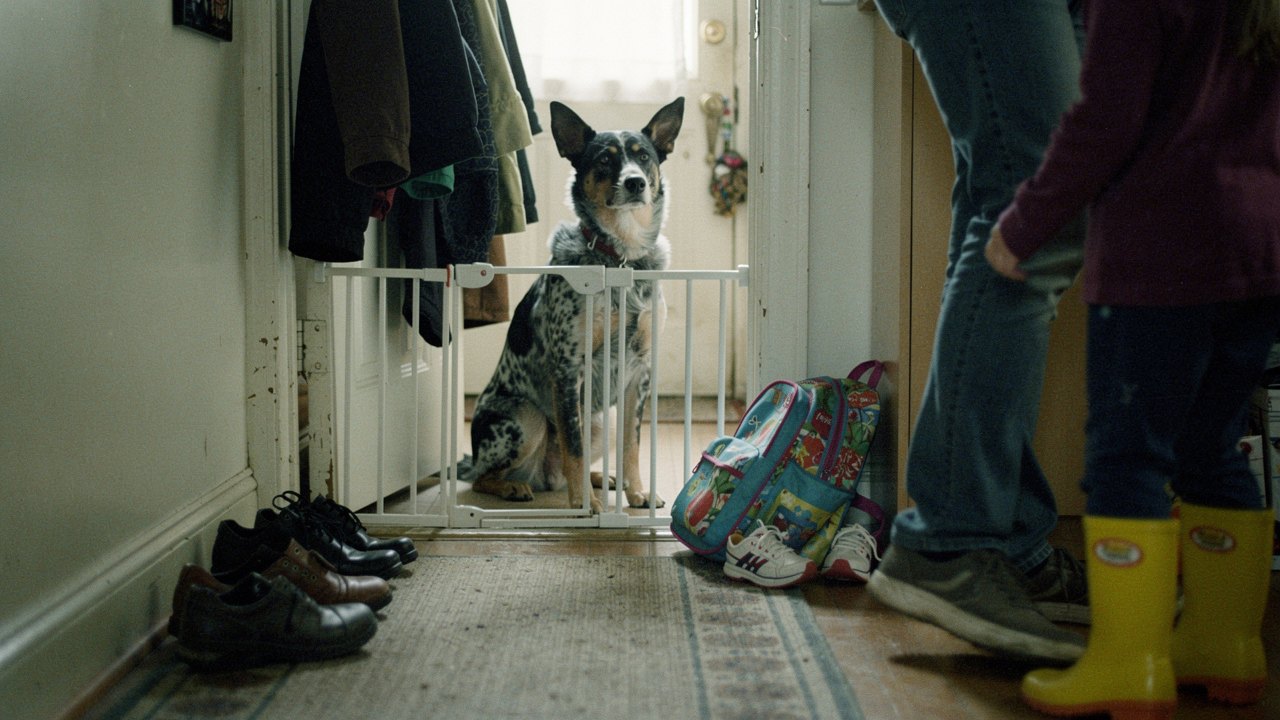
Children and dogs share a house with management, not with a breed story. Guests enter through a plan. An adult watches. Gates are not unkind. They are how you avoid a bite you will not get to retrain.
This is a life protocol. Jumping has its own ladder on jumping up. Nipping lives on biting. This page is the furniture and the guest plan that make those ladders possible. For a French Bulldog in a family with children, see are French Bulldogs good with kids. No page here will claim a breed nannies a toddler. I take dogs for residential correction in a boarding setting. I do not invent a household with a child I have not seen. There are no fake family diaries on this site.
Can children and dogs share a house without a bite?
They can share space if you treat the house as a set of rooms with jobs, not as an open-plan hope.
The working rules:
- A dog has a rest place children do not enter. A crate, a pen, a room with a gate.
- A child has a floor the dog is not on when the adult is cooking, on a call, or in another room.
- Food, toys, and beds are not a shared pile. Guarding starts as a look. It does not need to become a bite to count.
- Play is on the floor, slow, with a toy that is not the child’s hands. Running and squealing is a nipping machine.
An overtired puppy plus a toddler in a hallway is how people start calling play “aggression” at 7 p.m. Put the puppy down. See crate training and the night protocol. Sleep is a safety variable.
US open-plan kitchens and UK narrow halls fail in different geometries. The learning is the same: you cannot supervise two rooms. If you cannot see both bodies, they are not together.
The ASPCA’s dog-bite prevention notes say, in public language, to supervise children and dogs and never leave a baby or young child alone with a dog. Their dogs and babies page is the same standard in a household with an infant. Read them as sources. This page is the household version, not a copy.
If you cannot see both the child and the dog, they are not in a session. They are in a risk.
How should guests enter a house with a dog?
The latch is a trigger. Treat it like one.
Before anyone knocks, the dog is already on a leash, behind a gate, or in a crate that predicts food and rest, not exile. You open the door. The guest comes in. The dog does not get a free run at knees, bags, or children who arrived with the guest.
Brief the guest in one sentence: we say hello when four paws are down; please do not lean over the dog; please do not mind if the dog stays behind the gate. People who “love dogs” are often the worst unpaid trainers. They reach, they baby-talk, they say it is fine when it is not.
Then you run the greeting you have actually trained (four paws, mark, food, a hand at the chest) or you do not greet. A guest who cannot follow the brief does not get access. That is your house.
Delivery people are not guests. The dog does not need to meet the courier. A closed door or a room is enough. Many bite reports start as a door gap and a dog who was “just saying hello.”
If the dog is already over threshold at the knock (screaming, unable to eat), you are on on-leash threshold logic even inside the house. Distance first. A sit shouted at the door is not a plan.
What management do you need before you train greetings?
Furniture, then criteria.
You need:
- A door the dog cannot rush. A gate in the hall, a leash already clipped, a second person if the layout is a landing.
- A rest place that already pays. If the crate is still a fight, you do not use it as a guest dump. You use a room and a baby gate, and you build the crate on its own page.
- A way to split a running child from the dog in one movement. That is a gate, not a speech.
- Food you can deliver without turning your back on the child.
Only then do you train. Short sessions. Child standing still, or sitting, with a parent’s hands on the child. Dog on a leash. Four paws. Pay. End. If the child runs, the dog’s session ends (into the rest place) and you try again later with a stiller picture.
Guests with children are two problems. You do not use someone else’s toddler as your first criterion. You train with your own still child, or with adults, then you add a guest child behind a gate.
Should a child be left alone with a dog?
No.
Not a baby in a bouncer. Not a toddler “they adore.” Not a seven-year-old who is “so responsible.” Not five minutes while you take a call in the garden. The public prevention pages say the same thing because the injury reports say the same thing: children are the usual victims, and “they have never done it before” is how the first time arrives.
Watching means eyes on both bodies. A phone in the same room is not watching. A baby monitor pointed at a crib while a dog is loose in that room is not watching.
Teach children (when they are old enough) to leave a resting dog, to leave a bowl, to ask an adult before they touch an unknown dog. Do not teach them that every dog wants a hug. Many dogs want a dog to be left alone.
If a child has already been knocked, scratched, or bitten, you do not run this page as a pep talk. You manage, you see a veterinarian for the person and the dog if needed, and you see a qualified professional. Dogmindlab is not a triage desk.
When is this not a manners project?
When the body is stiff. When there is a freeze, a hard stare, a growl over a toy or a lap. When the dog hunts the child as moving prey (heel-nipping, knocking, chasing shrieks). When a guest is lunged at as they enter. When anyone is frightened.
Those pictures are safety. Gate. Separate. Get help in your country. A trainer who can see the dog, or a veterinary behavior professional if your vet is concerned. Pain can sit under a sudden change. A dog who was fine with the baby last month and is not this month may need a table, not a sit. See not veterinary advice.
I am not a veterinarian. I will not invent a “good with kids” certificate for a type of dog.
What are the usual failure modes?
- You used a breed story as a gate. There is no nanny breed on this site. There is a room plan.
- Guests were allowed to train you. “He is fine” is not a protocol. Brief them or keep the dog out.
- The crate was only used when people arrived. Then the crate predicts chaos. Feed it on ordinary days.
- A child was the first criterion. Train adults and a still body first.
- You watched from another room. If you cannot see both, they are not together.
- You treated a snap as a manners gap. A snap is a stop cue. Manage and get help.
Sources
ASPCA, “Dog Bite Prevention”: supervise children and dogs; never leave a baby or young child alone with a dog. ASPCA, “Dogs and Babies.” AVSAB position statements on humane training and on dominance, as the public standard against a “nanny breed” story. Paraphrased as public standards, not quoted as a substitute for the originals. aspca.org — dog bite prevention · aspca.org — dogs and babies · avsab.org/resources/position-statements/
Questions on this page
Can children and dogs share a house without a bite?
They can share space with management. Gates, a rest place, and an adult who is actually watching. No breed “nannies” a toddler. A child left alone with a dog is not a training plan. If you cannot see both bodies, they are not together.
How should guests enter a house with a dog?
The dog is leashed, gated, or crated before the latch turns. Guests are briefed: no hands in the air, no “it’s fine.” Four paws on the floor, then a hello. Delivery people are not guests. The dog does not need to meet the courier.
What management do you need before you train greetings?
A door the dog cannot rush, a rest place that already pays, and a way to split children from the dog when arousal climbs. Training starts after that furniture exists. You do not use someone else’s toddler as your first criterion.
Should a child be left alone with a dog?
No. Not a baby, not a toddler, not “they are so good together.” The ASPCA’s public bite-prevention notes say the same thing in their own words: supervise, and never leave a young child alone with a dog. A phone in the same room is not watching.
When is this not a manners project?
A stiff body, a freeze, guarding, a snap, or a child who has already been knocked or bitten. Gate the dog. See a qualified professional. This page is not a clinic. I will not invent a “good with kids” certificate for a type of dog.
Work with me
A $150 consultation or $500 monthly curatorship. Opens WhatsApp to Andrew.