
Expert Advice · Puppy · 15 min read
Potty training a puppy: schedule and supervision
One learning rule, two architectures. Outdoor grass in the US, pad or balcony tray in a UK flat, then the garden when you have one.

House training is a schedule plus supervision plus a single named toilet, not a scolding after you find the puddle. In a US house that toilet is usually a patch of yard through the same door. In a UK flat it is often a pad or a balcony tray first, then outdoor when stairs, rain, and lifts allow. Same learning. Different surface. Both belong on this page so you do not have to choose a nationality of advice.
A correctly sized crate helps because it removes unsupervised floor. It does not teach the garden by itself. Nights are the interval problem. Run them with the night crate protocol.
What actually house-trains a puppy?
Three loops, repeated until they are cheaper than the carpet:
- You commute to the toilet on a clock and after the obvious triggers (sleep, play, food).
- You pay the toilet the moment it happens. Food, then a little freedom in the room you can watch.
- You prevent the unsupervised rehearsal of the wrong floor.
If you did not see the accident, you missed the teaching moment. Cleaning is hygiene, not communication. Rubbing a nose in it is how you get a puppy who toilets behind the sofa.
A crude daytime ceiling is the puppy’s age in months plus one, in hours, between toilets, for a pup who just emptied. Treat it as a ceiling. An eight-week-old after a meal is not waiting two hours because a chart said so.
Public housetraining notes from the AKC and the ASPCA say the same skeleton in their own words: schedule, supervise, pay the success, do not scold a puddle you found later. Read them as sources. This page is the US-yard and UK-flat version, not a reprint.
How do you run a US outdoor toilet or a UK pad?
Pick one surface and one commute. The furniture changes. The learning does not.
United States · outdoor
Pick one door and one patch. Grass, gravel, or a dedicated dirt square. Consistency beats a tour of the whole yard. Lead on, walk to the patch, stand still. When they toilet, mark and feed there, then a short sniff as the bonus, not the main event.
If nothing happens in a few minutes, go back in and contain. Try again shortly. A ten-minute garden party with no toilet is how the puppy learns that outdoors is for play and indoors is for peeing.
Winter: a coat on you and a cleared path still counts as the same patch. Do not invent a bathroom rug “just for ice days” unless you are willing to train two toilets on purpose, the way a pad household does.
United Kingdom · pad then outdoor
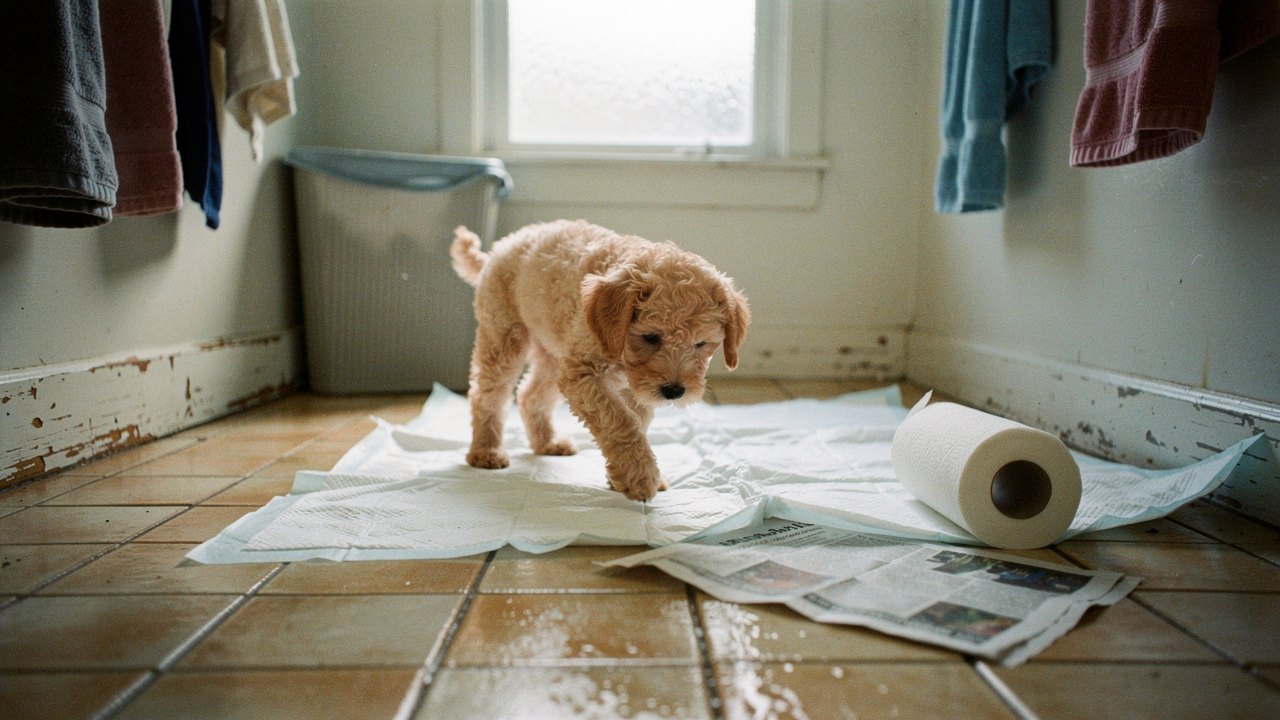
Flats, shared stairs, and rain make a pure outdoor-only plan fail at 2 a.m. Put a pad on a tray in one corner. A tray so the pad does not migrate under the sofa. That tray is the toilet. Not the whole kitchen lino.
Commute to the tray on the same clock you would use for a garden. Pay on the pad. When you have reliable access to a yard or a quiet kerb, add outdoor trips after pad success, then fade the pad by moving the tray toward the door and skipping some indoor commutes when you can honestly get out.
Do not scatter pads in every room “so they have options.” Options are how you train the entire floorplan as a bathroom.
EU apartment households can use the UK column. US apartment households without a yard can too: a balcony tray is a named toilet, not a failure to be American.
How often does a young puppy need to go out?
After sleep, after play, after meals, and on a clock in between. An eight-week-old is a frequent commute, not a four-hour hold.
A workable skeleton for a new pup (adjust to the actual bladder, not the wish):
- Toilet commute first thing, last thing, after every nap, after every meal, after hard play.
- Timer in between. Start more often than you think, then lengthen when the patch stays dry.
- Eyes on the puppy, a tether to your waist, a pen, or a crate between trips.
- Freedom in the house is earned in square metres, not granted as a house tour on day one.
Sniffing circles, sudden stopping, heading to the door you named. Those are your cue to commute now. A puppy who circles on the rug and is told “no” then put outside too late has already practised the rug.
Should you crate, pad, and outdoor all at once?
Yes, as roles, not as three competing toilets:
- Crate / pen: cannot toilet here (size it so they cannot). See crate sizing.
- Named toilet: must toilet here (yard patch or pad tray).
- Living floor: not yet. Supervise or pick the puppy up.
If the crate is too large, you have accidentally installed toilet number two. If pads cover the hallway, you have installed toilets three through nine.
What are the failure modes?
- Scolding the puddle you found later. The puppy learns that you are dangerous when urine is present. They will hide the next one.
- The sniff tour with no criterion. Outside was interesting. The toilet happened on the kitchen tiles afterwards.
- Free run of a US open-plan ground floor on week one. You cannot supervise 40 square metres. Gate it.
- Pad plus rug plus puppy pads in the crate. Three maps. Pick one legal surface.
- Punishment in the crate for an accident. Now you have a housetraining problem and a crate problem. Clean, shrink, shorten the interval.
- A sudden regression with diarrhoea, straining, or blood. That is veterinary. Stop the detective work on “dominance.” Read not veterinary advice and call a vet.
Ammonia-based cleaners can smell like a toilet invitation to a dog. Use an enzymatic cleaner on accidents. That is husbandry, not a brand recommendation. There is no product URL on this page. Gear has empty affiliate slots on purpose.
Sources
AKC, “How to Potty Train Your Puppy.” ASPCA, “House Training Your Dog or Puppy.” Crate-as-management, not punishment, follows the AKC and Humane World crate overviews cited in crate training. AVSAB’s socialisation position is relevant only in the background: keeping a puppy inside for weeks “until shots are done” also delays toilet generalisation to the actual outdoor world. Manage hygiene. Do not skip the commute. akc.org — potty train a puppy · aspca.org — house training · avsab.org/resources/position-statements/
Questions on this page
What actually house-trains a puppy?
A timetable, eyes on the puppy, and one toilet location that pays. Scolding a puddle you did not see teaches hiding, not the garden. You commute, you pay the toilet the moment it happens, and you prevent unsupervised rehearsal of the wrong floor.
How often does a young puppy need to go out?
After sleep, after play, after meals, and on a clock in between. An eight-week-old is a frequent commute, not a four-hour hold. Age-in-months plus one hour is a crude ceiling, not a dare. After a meal, do not wait two hours because a chart said so.
Can UK owners use pads without ruining outdoor toileting?
Yes, if the pad is a single, named toilet on a tray, not a scatter of paper across the flat. Move the tray toward the door, then replace pad with outdoor trips when access is real. Two random surfaces is two maps. US apartments without a yard can use the same tray rule.
Should you crate a puppy to house-train?
A correctly sized crate is a management tool that prevents unsupervised accidents. It is not the toilet trainer by itself. You still have to commute and pay the outdoor or pad success. See crate training for size. Nights are the interval problem on the night crate page.
What if the puppy toilets in the house after being outside?
The outdoor trip was a sniff tour, or you unsupervised the aftermath. Next time, stay at the spot until something happens or the clock says try again soon. Then supervise or contain. A ten-minute garden party with no toilet is how indoors becomes the bathroom.
Work with me
A $150 consultation or $500 monthly curatorship. Opens WhatsApp to Andrew.