
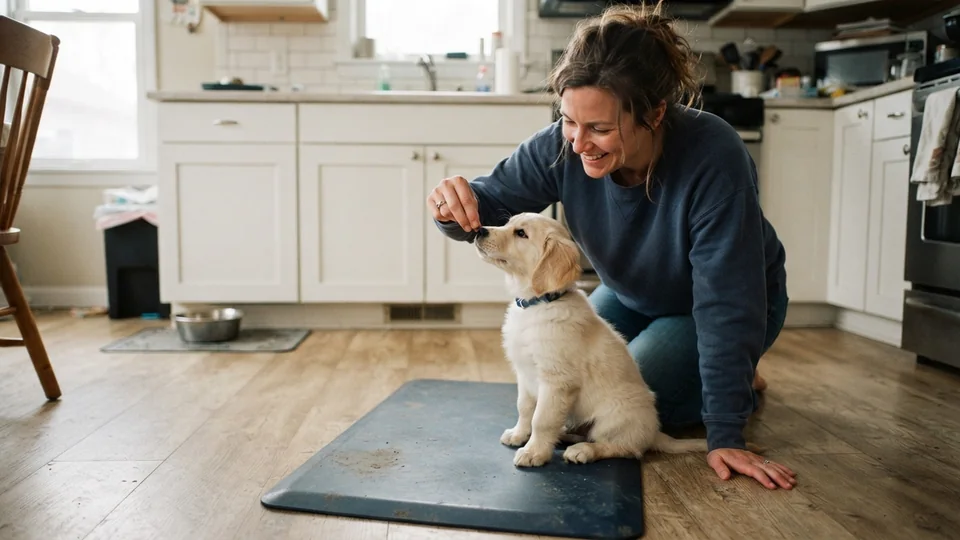
Expert Advice · Puppy · 7 min read
How to Train a Puppy: Where to Start and What to Teach
A practical order for the first months: daily care, house training and rest first, then short reward-based sessions for name, recall, sit, settle and walking.

Short answer
Start with a routine for sleep, toilet and meals, then add short, reward-based training sessions: name response, come, sit, settling on a mat, hand target and walking on a loose lead. Socialise at your puppy’s pace and manage biting with redirection and rest. Avoid punishment and aversive tools.
Looking for the cue list? Basic dog commands sets out ten everyday cues, the order to teach them and how to add the word.
Start with the day, not with tricks
The first weeks of training are mostly about the daily routine. A puppy who sleeps enough, has a toilet plan and a safe rest place learns faster and is easier to live with. Short skill sessions fit around that routine. You do not need a long list of commands in week one.
This page is the overview: what to teach, in what order, and how. Each step links to a detailed guide. For an age-by-age plan, see the puppy training schedule by age and the 8–12 week training priorities.
How puppies learn
Puppies repeat what works for them. If sitting gets a reward, sitting happens more. If jumping gets attention, jumping happens more. Reward-based training uses this: you mark the moment the puppy does the right thing and follow it with something they value. AVSAB recommends reward-based methods for all dog training and advises against tools and techniques based on pain, fear or intimidation.
- Marker: a short word such as “yes” or a clicker, used the moment the puppy does the right thing. See markers and criteria.
- Reward: small food pieces from the daily allowance, a suitable treat, a toy or praise. Adjust meals so treats do not overfeed.
- Small steps: make each step easy enough that the puppy succeeds most of the time.
- Management: gates, a pen and supervision prevent the puppy practising things you do not want while they learn.
What to teach, in what order
This order is an editorial plan, not a fixed curriculum. Puppies learn at different speeds, and you can work on several items in the same week.
| Stage | Focus | Detailed guide |
|---|---|---|
| First days home | Toilet routine, rest place, safe space | Potty training · Crate training · First week home |
| First weeks | Name response and coming to you | Name game · Recall ladder |
| First weeks | Calm handling and gentle socialisation | Puppy handling · Socialisation plan |
| Early skills | Sit, hand target, settle on a mat | Teach sit · Hand target · Place |
| Everyday manners | Mouthing, jumping up, waiting at doors | Biting and nipping · Jumping up · Wait at the door |
| Outdoor skills | Lead walking, leave it, recall outdoors | Loose-lead walking · Leave it · Long-line recall |
| Growing independence | Brief time alone, settling with less help | Puppy alone-time steps · 12–16 week impulse map |
How to run a training session
- Pick a calm moment when the puppy is awake, has toileted and is not overtired.
- Choose one skill and the easiest version of it.
- Prepare small rewards before you start.
- Repeat a few times, marking and rewarding each success.
- Stop while the puppy is still keen, often after a few minutes.
- Make the next step slightly harder only when the current step is easy.
Several short sessions spread through the day usually work better than one long one. If the puppy loses focus, starts biting or wanders off, the session was too long or too hard. See training session length.
First skills, step by step
Name response
Say the puppy's name once in a quiet room. When they look at you, mark and reward. Repeat a few times a day. Avoid using the name to tell the puppy off, so it stays a good thing to hear. The name game builds this into a habit.
Coming when called
Start indoors at a short distance. Say your recall word once in a happy voice, move backwards a step and reward the puppy generously when they reach you. Never call the puppy to something unpleasant. Outdoors, use a long line in a safe place before trusting recall. See the recall ladder.
Sit
Hold a small reward at the puppy's nose and move it slowly up and back. As their bottom touches the floor, mark and reward. After a few successful repeats, use a hand signal, then add the word. Do not push the puppy's back end down. See teach sit.
Settling on a mat
Put a mat on the floor and reward any interaction with it, then lying down on it, then staying relaxed for a little longer. Settling is one of the most useful skills for everyday life and helps with barking, jumping and evening zoomies. See place.
Socialisation at the puppy's pace
Socialisation means helping the puppy experience everyday sights, sounds, surfaces, people and handling in a way they find manageable and positive. It is not about meeting as many dogs as possible. Let the puppy watch from a distance, keep experiences short, and leave if they become worried. Ask your vet about outdoor access while vaccine protection is developing; see when puppies can go outside and socialisation without the dog park.
Biting, chewing and rest
Puppies explore with their mouths. Redirect mouthing to a toy, stop play briefly if teeth land on skin, and offer appropriate chews. Mouthing often gets worse when a puppy is tired, so frequent naps matter as much as training. See puppy biting and nipping, enforced naps and puppy chewing furniture.
What to avoid
- Shouting, smacking, alpha rolls or holding the puppy down.
- Choke chains, prong collars, shock collars, water sprays or shaker cans. AVSAB advises against these tools.
- Long, repetitive sessions with a tired puppy.
- Punishing accidents, barking or chewing found after the event.
- Expecting a skill learned in the kitchen to work at once in the park. Practise in new places in easier steps.
Reward-based training still includes structure. Clear routines, management and consistent responses from everyone in the household are what make it work.
A simple weekly rhythm
Most days need only a handful of short sessions alongside care: a name game before breakfast, a few recalls in the hallway, mat settling in the evening, and a short calm outing or garden time when appropriate. Keep a note of what is easy and what is still hard, and change one thing at a time. For a full day plan, use puppy schedules by age.
When to get help
A reward-based puppy class or trainer can help with skills and confidence. Ask about methods, class size and vaccine rules before joining; see puppy class timing. Get qualified help early for fear that does not ease, growling or snapping, distress when alone or anything you cannot manage safely. Ask your vet about sudden behaviour changes, which can be linked to pain or illness.
Sources and scope
- AVSAB — Position Statement on Humane Dog Training
- AVSAB — Position statements, including puppy socialisation
- AKC — How to Potty Train a Puppy
Public welfare and veterinary guidance informs the safety context. Tables, sample days and step lists are editorial planning aids, not research findings, diagnostic tools or a substitute for individual veterinary advice. Sources checked 12 November 2026.
Questions on this page
When should I start training my puppy?
From the day your puppy arrives, in short, gentle sessions. The first lessons are routine: toilet place, rest, a name and coming to you. Formal skills come in small steps alongside daily care.
How long should a puppy training session be?
Short: a few minutes at a time, ending while the puppy is still keen. Several brief sessions spread through the day usually work better than one long one. See training session length.
What should I teach a puppy first?
Toilet routine, rest and a safe space first, then name response, coming when called, sit, settling on a mat and a hand target. Loose-lead walking and leave it follow as the puppy grows.
What rewards work best for puppy training?
Small pieces of food from the daily allowance or treats suitable for the puppy, praise and play. Use a marker word such as “yes” to show the exact moment the puppy got it right.
How do I stop my puppy biting during training?
Keep sessions short, use calmer rewards, and give the puppy something to chew. Mouthing often increases when a puppy is tired; offer rest. See puppy biting and nipping.
Should I use a puppy class?
A well-run reward-based class can help with skills and calm socialisation. Ask about class size, methods and vaccine requirements. See puppy class timing.
Work with me
A $150 consultation or $500 monthly curatorship. Opens WhatsApp to Andrew.