
Expert Advice · Puppy · 8 min read
Puppy Separation Anxiety: Gentle Alone-Time Steps
Teach manageable distance while meeting a young puppy’s care needs. Prevention is about confidence, not leaving a crying puppy to get used to it.

Short answer
Begin with a safe comfortable space while you remain nearby. Practise tiny changes in distance only while the puppy stays comfortable, then return calmly. Meet toilet, rest and social needs and arrange care for longer absences. Persistent crying, escape attempts or panic need a lower challenge and veterinary or qualified behaviour support.
A new puppy needs security before independence
Your puppy has arrived in an unfamiliar home without the companions and routine they knew. Wanting to stay near someone is not proof of a disorder or manipulation. At the same time, repeated distress when a person moves away is useful information: the current separation may be too difficult.
This page focuses on early alone-time learning and prevention. It does not diagnose separation anxiety from one cry. For persistent, intense distress or an older dog's established difficulty, use the dog separation anxiety guide and arrange professional help.
Independence is not measured by how long you can ignore a puppy. A useful foundation is the ability to rest, explore and recover comfortably in a familiar safe area, with care needs met and gradual experiences of distance.
Before practising, check the ordinary needs
- Has the puppy had an appropriate toilet opportunity?
- Are they comfortable, not too hot or cold, and free from concerning physical symptoms?
- Have feeding and water needs been met according to individual care advice?
- Is it a suitable moment for rest rather than the middle of an overtired or overwhelming episode?
- Is the area genuinely safe, and is the puppy comfortable with it while you are present?
- Can you return and provide support immediately if the step is too hard?
Do not use exhaustion or hunger to force a longer absence. A puppy asleep after a busy outing has not necessarily learned to be alone while awake. Use the by-age schedule index for care organisation and overtired versus overstimulated when you need to simplify the day.
Make the area familiar while you are there
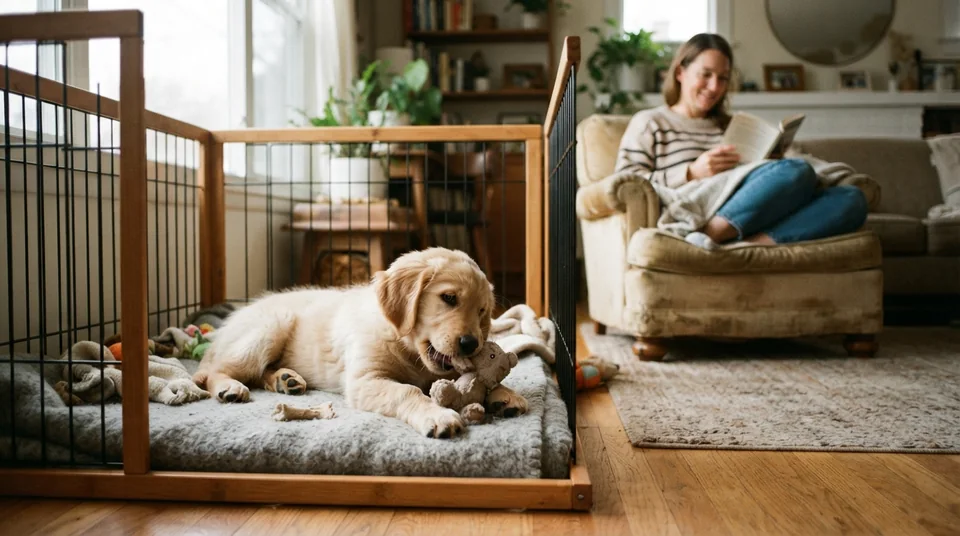
Choose a puppy-safe room, pen or other suitable space with comfortable bedding and water. Introduce it during ordinary shared time, not only when you leave. Remove chewable cords, unsafe objects and anything the puppy could climb or become caught in. Gates and pens must suit the puppy's size and abilities.
A barrier can help you remain visible, but some puppies find the barrier itself difficult. If shutting a gate causes distress even while you are alongside, start with an open arrangement and easier distance. See playpen versus crate for setup choices; neither product automatically teaches emotional comfort.
Use only toys or food items appropriate for the individual puppy and the degree of supervision. Check how they use the item before considering it for any absence. Enrichment is optional support, not a distraction that makes it safe to slip away for much longer than the puppy can manage.
A gentle learning ladder, not a countdown
The stages below are editorial planning examples. They do not prescribe a minimum time or a daily target. Some puppies need the first step broken down further. Stop or lower difficulty at early signs of worry rather than completing the list.
| Starting situation | Possible small change | Look for |
|---|---|---|
| You sit next to an open rest area | Pause interaction while remaining present | Loose posture, ordinary exploration or comfortable rest |
| The puppy is comfortable with nearby quiet activity | Shift position or take a small step | No escalating following, freezing or vocalising |
| A little distance is easy | Move briefly within sight, then return | Easy recovery and no urgent barrier approach |
| Movement and the setup are comfortable | Try a tiny out-of-sight movement where safe | Comfort continues, not simply an absence of noise |
| Brief indoor separations are established | Plan a similarly small real departure with monitoring | The puppy remains comfortable before and after you return |
Change one feature at a time. Closing a solid door, walking out of sight and staying away longer are three changes, even if the clock barely moves. Repeat easy experiences and include breaks. You do not have to train every time you move around the house.
A relaxed puppy may choose to continue chewing or resting, or may notice you and then resume ordinary activity. A puppy who stares rigidly at the exit is not necessarily comfortable. Read the full pattern and ask for help if you cannot judge it.
What to do if the puppy cries
Check needs and reduce the challenge. Return calmly if the puppy is becoming distressed; do not stay hidden while waiting for a quiet gap. Offer an appropriate toilet trip or proximity, then let them settle. Your next practice should be easier, not a repeat of the same failed absence.
You do not need to punish, scold or make a dramatic greeting. Friendly, predictable support is enough. The useful learning is that the situation is manageable. If every attempt at distance leads to escalating distress, pause progression and discuss the situation with your veterinarian or a qualified reward-based professional.
Daytime barrier crying, night-time settling and departure distress overlap but are not interchangeable. For a specific nap problem, use crying in the crate at nap time. For the first nights, use first night home and crate training at night.
Use monitoring as information, not a test
A safely placed camera can show what happens when you step away. Keep cords and equipment inaccessible and protect household privacy. Start with a separation you reasonably expect to be manageable, and be able to return promptly. If panic or unsafe escape behaviour is already known, get professional advice instead of recreating it for video.
Watch the beginning, middle and recovery, not only the moment a food toy is offered. Note whether the puppy settles, searches repeatedly, pants, drools, vocalises or approaches the exit urgently. Share short contextual clips with your professional rather than trying to diagnose from a checklist online.
Work, errands and unavoidable absences
The puppy's current training ability and your work calendar may not match. Arrange familiar responsible help for longer care gaps. A timer, crate or larger food toy cannot supply the toilet access and contact a young puppy needs.
Make a rota with the actual hours covered, the toilet plan, feeding instructions and what to do if the puppy becomes worried. The full-workday care planner and shared puppy schedule help with handovers. Check that the helper's environment is safe and appropriate rather than assuming busy day care suits every puppy.
If you suddenly need to go out longer than the puppy can manage, solve the care problem first. It is better to seek practical help than to turn the errand into an unplanned endurance session. Avoid claiming that one bad day permanently ruins training; use it as a reason to improve the next arrangement.
Common mistakes that make practice harder
- Increasing every session because yesterday went well, even when today's puppy is tired or unsettled.
- Only using the rest area for departures, making it a reliable predictor of being left.
- Confusing silence, freezing or exhaustion with emotional comfort.
- Taking away affection or sleeping proximity to enforce independence.
- Using punishment for damage or accidents found after returning.
- Expecting a successful indoor step to transfer immediately to a closed exterior door.
Following you around the home can have several explanations and is not a diagnosis by itself. Use puppy follows me everywhere for that narrower pattern while retaining the care and comfort checks here.
When to ask for individual help
Contact your vet for sudden changes, pain or illness signs, or persistent distress despite easier arrangements. Seek qualified behaviour support for repeated panic, inability to settle, escape attempts or any injury risk. If the puppy is injuring themselves or in immediate physical danger, address safety and urgent veterinary care first.
Ask for a plan that includes real-life care cover, early signs of worry and clear criteria for reducing difficulty. There is no guaranteed age at which every puppy becomes comfortable alone and no responsible promise of a cure in a fixed number of sessions.
Sources and scope
- Blue Cross — Preventing separation anxiety in puppies
- RSPCA — Recognising separation-related behaviour and anxiety
Public welfare and veterinary guidance informs the safety context. Tables, decision paths and example logs are editorial planning aids, not diagnostic tools, research findings or a substitute for individual veterinary advice. Sources checked 11 November 2026.
Questions on this page
Does crying when I leave mean my puppy has separation anxiety?
Not automatically. A new puppy may need contact, a toilet trip, rest or help with the setup. Repeated distress linked to separation still deserves attention, and intense or persistent problems need professional assessment.
Will comforting my puppy create separation anxiety?
You do not need to withhold reassurance to teach independence. Meet needs and make separations manageable. Comfort is not a substitute for gradual practice, but leaving a frightened puppy to panic is not the goal.
How long can I leave an eight-week-old puppy?
There is no universal training allowance based on age. A newly arrived puppy needs frequent care and company. Arrange coverage for absences beyond what the individual puppy can comfortably manage.
Should I ignore crying behind a baby gate?
Check toilet, pain, fear and the setup. Reduce the challenge or return calmly when needed; do not wait through escalating distress for silence. Practise an easier version later.
Can I use a crate instead of a pen?
Only if that puppy is already comfortable in it for the intended situation. A crate is not a cure for distress about separation, and escape attempts or panic require a safer arrangement and professional advice.
Work with me
A $150 consultation or $500 monthly curatorship. Opens WhatsApp to Andrew.