
Expert Advice · Puppy · 7 min read
When Can Puppies Go Outside? Before and After Vaccines
Carried outings, a private toilet area and public-ground walks are different questions. Here is how to plan the training while your vet sets the health rules.

Short answer
There is no single age that clears every puppy for every kind of outing. Ask your vet when public-ground walks and dog contacts are appropriate for your puppy and local risk. Discuss carried exposure and controlled private spaces in the meantime; do not turn a generic vaccine date into medical clearance.
When can puppies go outside? The answer depends on what “outside” means. Being carried past traffic, using a controlled private toilet area and walking on public ground are different exposures. Your veterinarian should set the ground-contact and dog-contact rules for your puppy's vaccine history and local disease risk. A birthday alone is not clearance.
You can still work on positive experiences before public walks are allowed. The practical job is to let the puppy notice the world without taking avoidable infection risks or becoming overwhelmed. This is a training and planning guide, not a vaccination schedule or medical advice.
Outside does not mean one thing
| Activity | What to discuss with your vet | Training purpose |
|---|---|---|
| Carried outing | Appropriate route and any special local precautions | Notice everyday sights and sounds without putting paws on public ground |
| Private garden / yard toilet | Whether unknown dogs or wildlife have accessed it, and whether it is suitable for your puppy | Build a consistent toilet location |
| Meeting a known healthy vaccinated dog | The particular dog, setting and puppy's protection status | A calm, controlled introduction rather than a dog-park free-for-all |
| Shared pavement, grass or communal dog toilet | When public-ground access is appropriate locally | Short supported exploration once cleared |
| Puppy class | Entry vaccine requirements and the venue's hygiene policy | Reward-based learning in a managed setting |
A patch labelled “private” is not automatically low risk: ask who uses it. A quiet-looking communal lawn may be a busy dog toilet. Carrying reduces contact with contaminated ground; it does not make every environment risk-free.
Can puppies go outside before vaccinations?
Discuss a suitable plan with your vet before putting a not-yet-protected puppy on shared ground. Blue Cross's socialisation guidance describes carrying puppies out, avoiding dogs of unknown vaccination status, and using controlled home or garden experiences before full protection. It also recommends veterinary advice for individual circumstances.
That is not permission for pavement walks after any particular injection. Ask about your puppy's actual record, whether further doses are due, the waiting period after the relevant dose, and local infection concerns. If you adopted a puppy with an uncertain history, show the vet the documents rather than filling in dates from memory.
After the second vaccination, or at 12 weeks?
Searches often ask for one age or “one week after the second jab.” There is no reliable single answer for every puppy, vaccine course and location. Even public guidance can use different example intervals. Follow your practice's instructions for the products and course your puppy received, rather than choosing the shortest interval you find online.
Ask the practice for a clear statement you can share with everyone caring for the puppy: “Public-ground walks from this date; these contacts are suitable until then.” UK and US owners should both use their own veterinarian's local guidance. This page deliberately does not publish a universal vaccine timetable.
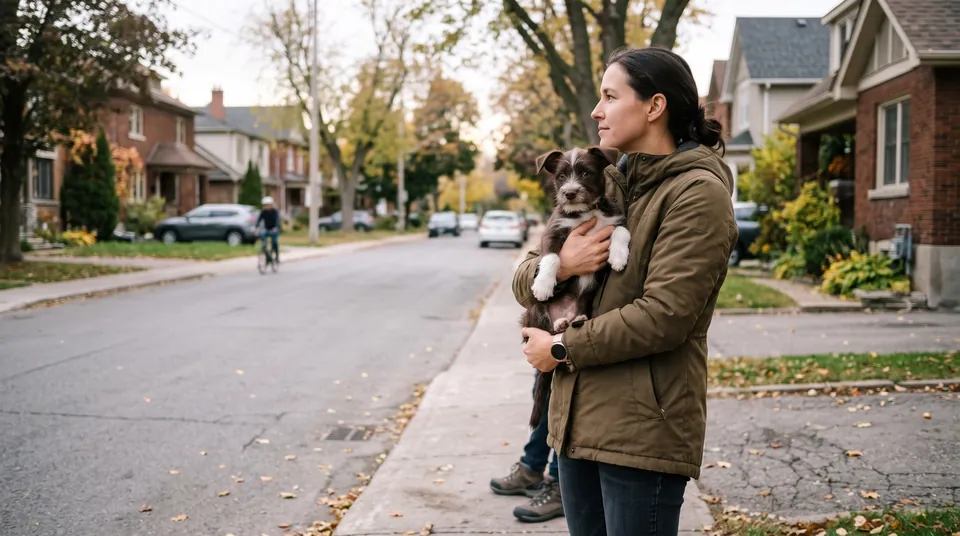
How to do a carried socialisation outing
- Choose a small experience. A quiet street with occasional traffic is a better first choice than a market or school gate.
- Support the puppy securely. Carry with the body and hindquarters supported, or use a suitable secure carrier. Do not let strangers pass the puppy around.
- Watch from a distance. Allow looking without demanding greetings. Soft posture, curiosity and an ability to disengage are more useful than the number of people met.
- Leave before the puppy needs rescuing. If the puppy freezes, hides, struggles or cannot settle, increase distance or go home. Do not stay to “get them used to it.”
- Return to the care routine. Offer the usual toilet opportunity and rest. An outing replaces part of awake time; it does not create a bonus hour of play.
If carrying is uncomfortable or unsafe for either of you, ask your vet and trainer about suitable alternatives. Looking from an open doorway in your arms or watching from a safely parked car with an adult present can offer a simpler experience. Never leave the puppy unattended in a car, and avoid conditions where it may get too hot.
What if you live in a flat with no garden?
Ask the vet about your actual toilet route: stairs or lift, lobby, shared pavement and the nearest available surface. Do not assume communal grass is equivalent to a private garden. Until the agreed ground plan is available, you may need a consistent indoor toilet option, a controlled tray setup or another arrangement the practice approves.
Choose one clear location rather than scattering pads through the flat. Keep it separate from the sleeping and feeding area. The potty-training guide covers reinforcing the correct spot; moving an indoor toilet outdoors covers the later transition. This is management for your circumstances, not a claim that every puppy should start on pads.
Can my puppy meet other dogs?
A familiar, healthy, appropriately vaccinated dog in a controlled setting is a different proposition from unknown dogs at a park. Ask your vet which contacts are appropriate before arranging them. Then choose a dog known to be comfortable with puppies, provide room to retreat and stop before play becomes rough or one dog cannot get away.
Socialisation is not a greeting quota. Your puppy can learn that other dogs exist without meeting them all. A well-managed puppy class may help; ask about health entry rules, cleaning, small-group management and whether a puppy can opt out. Avoid sessions that are simply uncontrolled wrestling.
The first walk after veterinary clearance
Pick a quiet time and a simple route with an easy way home. Let the puppy sniff and stop; do not pull them toward traffic or other dogs. Use a comfortable harness and a light lead, with supervision throughout. A short enjoyable exploration is more useful than completing a route for the sake of it.
For the lead itself, see first puppy lead steps. For exercise planning use walk length by age alongside your vet's advice, not the wake-window length as a walking target. The socialisation plan covers choosing experiences after the access question is settled.
Questions to take to your vet
- Is this puppy's vaccine record complete enough to plan from, or is anything uncertain?
- Which private toilet surface can we use now?
- Which carried outings and known-dog contacts are appropriate?
- On what date can we use public ground, and which places should we still avoid?
- What should we do if the puppy contacts a risky surface or an unwell dog?
If your puppy becomes unwell, contact your vet rather than trying to diagnose it from an outing. Vomiting, diarrhoea, marked lethargy or a puppy that will not eat or drink need professional advice. Urgent concerns belong with a veterinary service, not a training timetable.
Sources and scope
Blue Cross — Socialising your puppy. Public guidance informs the safety context; sample clocks and support plans are editorial examples, not research results.
Questions on this page
Can I carry my puppy outside before vaccinations are complete?
Discuss appropriate carried outings with your veterinarian. Blue Cross describes carrying puppies to experience the world while avoiding contaminated ground and unknown dog contacts before full protection.
Can an 8-week-old puppy go in a garden?
Ask your vet about the particular garden, including access by unknown dogs and wildlife. A controlled private toilet area is not the same exposure as a communal dog lawn.
How long after the second vaccination can a puppy walk outside?
Use the date and restrictions given by your own veterinary practice for your puppy’s actual course and local risk. This guide does not give one universal waiting interval.
How can I socialise a puppy without public walks?
Use suitable carried observations, quiet home experiences and any controlled contacts your vet approves. Keep experiences short and optional, and leave if the puppy is overwhelmed.
Does socialisation mean meeting lots of dogs?
No. Positive observation and learning to disengage matter too. Choose suitable individual dogs and controlled settings rather than forcing greetings or using a busy dog park.
Work with me
A $150 consultation or $500 monthly curatorship. Opens WhatsApp to Andrew.