
Expert Advice · Puppy · 11 min read
How to Stop Puppy Biting: Hands, Feet, Ankles and Clothes
Most hard puppy biting comes from a tired puppy or a game that pays teeth. Fix rest first, then make skin, feet and clothes boring and toys worth it.

Short answer
Check sleep first: many puppies bite hardest when overtired, so a toilet trip and a nap often ends it. When teeth touch skin, keep still, pause, then restart with a toy. For feet and ankles, stop moving and offer a tug toy, as ASPCA suggests. Get qualified help if bites come with a stiff body, guarding or broken skin.
First check: is your puppy overtired?
Before you change how you react to teeth, look at the clock. Young puppies need a lot of sleep, and a puppy who has been awake too long often looks more energetic, not less: zoomies, grabbing sleeves, biting harder and refusing a chew. Dogs Trust lists being overtired as a common reason for mouthing and recommends planned naps through the day; AKC also notes that a biting puppy is sometimes simply a tired puppy who needs a quiet space.
So the first question during a biting spell is not “how do I stop this?” but “when did this puppy last sleep, eat and go to the toilet?”
| What you see | Likely cause | What to do first |
|---|---|---|
| Biting gets harder after a long play or visit; the puppy cannot settle with a chew | Awake too long | Toilet trip, then a nap in the crate or pen. The wake window chart gives about 45–60 minutes awake at 8–10 weeks |
| Wild biting just after guests, a car trip or a busy walk | Too much going on | A quiet room and a sniffing or licking activity, then rest. See overtired vs overstimulated |
| Same thing every evening between dinner and bedtime | Missed afternoon or early evening nap | Protect an early evening nap. See puppy witching hour |
| Chewing everything, sore-looking gums, interest in cold or soft items | Teething | Offer suitable chews more often. See the teething timeline |
| Biting feet, trouser legs or the lead as you move | Chase game | Stop moving, then redirect to a toy; manage with a pen or gate during busy times |
| Biting when lifted, brushed or touched in one area | Handling worry or discomfort | Pause handling; ask your vet if one area seems sore. See puppy handling |
A rested puppy is easier to teach. You cannot train your way through a puppy who needs sleep.
Play biting or something else?
Most puppy biting is play. The ASPCA describes mouthing as normal puppy behaviour that needs teaching, with the first goal being gentle pressure on human skin. A small number of puppies show biting that does not fit play, and those need a different plan.
| Usually play | Needs a closer look |
|---|---|
| Loose, wiggly body; play bows; bouncing in and out | Stiff or very still body, weight forward, a hard stare |
| Bites move around and stop when the game stops | A quick snap that lands and holds, or repeated bites to keep someone away |
| Play growls with a relaxed face | Growling or freezing over food, toys, a bed or a resting place |
| Easy to swap for a toy | Biting when touched in one area, lifted or woken suddenly |
If the right-hand column sounds familiar, or you feel frightened, keep everyone safe with gates and supervision and get help from a qualified professional. Ask your vet first if the biting started suddenly or comes with handling, because pain can change behaviour. See resource guarding, puppy growling and when to call the vet.
What to do when teeth touch skin
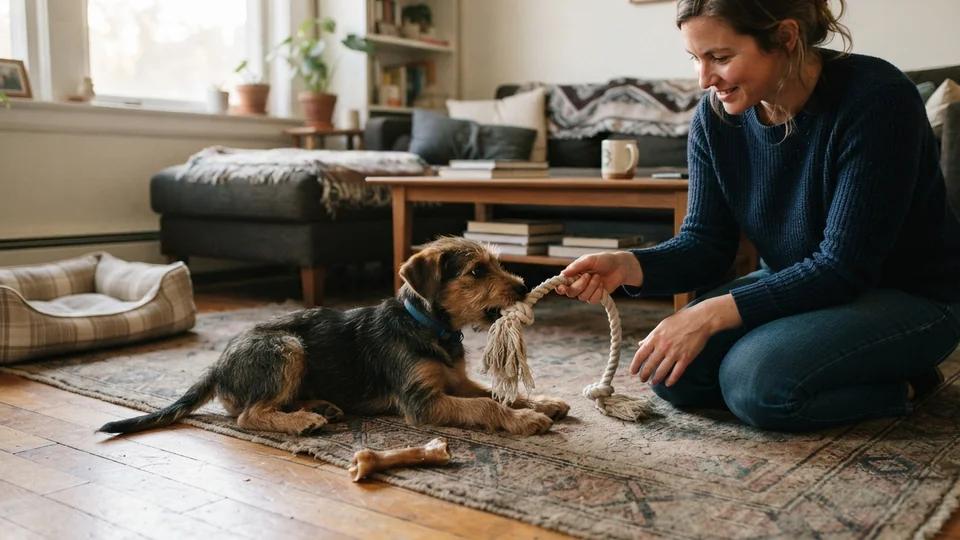
The aim is for your puppy to learn that teeth on skin make the fun pause, while teeth on a toy keep it going. Keep your response small, calm and the same every time.
- Keep your hands still. Pulling your hand away fast turns it into a moving toy. Dogs Trust advises staying still rather than snatching hands, arms or legs away.
- Pause the game. Fold your arms or turn away for a few seconds. No scolding: AKC points out that yelling can act as attention and can make a puppy wary of hands.
- If the teeth come back, step away. Step over a gate or out of the pen area for ten to thirty seconds, then come back calmly.
- Give the mouth a job. Return holding a long tug toy or put a chew on the floor. Reward your puppy for taking it.
- End early if it keeps happening. Three quick returns to your skin usually means the puppy is too tired or wound up. Offer a toilet trip and a nap.
A short “ow” works for some puppies and excites others. Use it only if your puppy pauses after hearing it. The pause, not the noise, is the lesson.
Puppy biting by situation
Most homes see a few repeat patterns. Each has a small management change and a skill to build.
| Situation | Manage now | Teach over time |
|---|---|---|
| Hands during play | Play only with a toy in your hand; no wrestling or tickling games | Tug with clear start and stop. See tug rules |
| Feet and trouser legs as you walk | Stop walking; use a pen or gate during busy times of day | Reward walking next to you; scatter food behind you |
| Sleeves, dressing gowns, coats | Do not pull fabric away; take the item off if needed | Swap to a toy, then drop it when the puppy grabs an item |
| Lead biting on walks | Carry a toy to swap; keep early walks short | Treats near your leg for walking beside you. See loose-lead walking |
| Handling, brushing, putting on a harness | Short sessions with food; stop before the puppy struggles | Gradual handling steps and a chin rest |
| Greeting people | Toy ready at the door; gate for visitors | Four paws on the floor first. See jumping up |
| Children running and squealing | Adult supervision every time; gates when you cannot watch | Children stand still and walk away; play with toys only |
For breed-specific mouthing patterns, see German Shepherd puppy biting and Golden Retriever puppy mouthing. If an older herding-type dog chases and nips children, use herding nips with children.
Puppy biting feet, ankles and clothes
Moving feet, trouser legs, dressing gowns and dangling sleeves are chase toys to a puppy. ASPCA notes that puppies often bite and mouth hands, limbs and clothing during play with people. The fix is to make moving feet boring and to give the chase somewhere else to go.
- Stop moving. ASPCA advises that when the puppy ambushes your feet, you instantly stop moving, and if you have no toy to hand, freeze and wait for the mouthing to stop. Dogs Trust likewise suggests staying still and redirecting in a brief pause.
- Carry the alternative. ASPCA suggests keeping a favourite tug toy in your pocket and offering it the moment the puppy goes for your feet.
- Pay walking beside you. AKC suggests holding a high-value treat next to your leg as you walk, so the puppy learns to walk nicely alongside instead of pouncing.
- Manage the busy minutes. Mornings, coming home and the evening are when feet get ambushed. Use a pen or gate, or give a chew before you start moving around.
- Change what you wear. Swap long dressing gowns and loose laces for closed shoes and shorter layers for a few weeks. Do not play tug with clothing; if a puppy grabs a sleeve, go still and swap to a toy, or take the item off.
ASPCA also warns against waving fingers or toes in a puppy’s face to start a game, as that can encourage biting of hands and feet. If foot biting comes with a stiff body or hard bites during handling, read mouthing vs aggression.
A day that prevents most biting
Training works best when the day already limits the triggers. Dogs Trust recommends short activities spread through the day, rest after exciting events and calming outlets such as sniffing, licking and chewing.
- Run the loop: toilet, a short awake spell with play and a chew, then rest. The puppy day schedule shows how this looks by age.
- Keep toys within reach. A toy in every room means you can redirect before teeth land on you.
- Plan the hard times. If biting peaks at 6 p.m., start a chew or food toy at 5.45 and an early nap after dinner.
- Calm down after excitement. After visitors or a walk, offer a lick mat, a stuffed toy or a sniffing game before rest.
- Reward calm. Quietly drop a piece of food when your puppy is lying down or chewing their own toy.
- Use barriers, not chases. A pen, a gate or a short indoor house line stops rehearsal without a struggle.
Teething, age and how long biting lasts
Teething increases the urge to chew, and the mouthing that comes with it often looks like a step backwards. It is usually temporary, and it is a reason to offer more suitable chews and more rest, not to drop the rules. Mouthing typically fades gradually as adult teeth arrive and the puppy learns other ways to play. The biting age timeline covers what to expect month by month.
AKC's chief veterinarian advises consulting an experienced trainer or behaviour specialist if play biting is not easing by around six months. Do not wait that long if bites are hard, injuries happen or you feel unsafe.
What not to do
- Hitting, holding the mouth shut or pinning the puppy down. AVSAB advises against methods based on pain, fear or intimidation. They can lead to fear and defensive biting.
- Rough hand games. Wrestling with bare hands teaches that skin is a toy.
- Chasing the puppy to take something back. That turns stealing into a game. Trade instead.
- Bitter sprays as the whole plan. They may protect one item but do not teach what to bite instead.
- More exercise for an overtired puppy. A long walk or more play can make biting worse. Offer rest.
- Letting a crowded day push naps back. Busy weekends are when biting often peaks.
When biting needs more than this plan
Get help from a qualified trainer or behaviour professional, and talk to your vet, if any of these apply:
- bites break skin or leave bruises, especially on a child;
- biting comes with a stiff body, freezing or a hard stare;
- your puppy guards food, toys, resting places or people;
- biting happens mainly when the puppy is touched, lifted or woken;
- biting is getting harder rather than softer after a few weeks of consistent rest and redirection.
Early, careful socialisation supports good manners with people and dogs. AVSAB's position on puppy socialisation recommends starting it early with appropriate health precautions. A reward-based puppy class is a good place to get feedback.
Sources and scope
- AKC — How to Stop Puppy Biting and Train Bite Inhibition
- ASPCA — Mouthing, Nipping and Biting in Puppies
- Dogs Trust — Mouthing, nipping and biting
- AVSAB — Position Statement on Humane Dog Training
- AVSAB — Position statements, including puppy socialisation
Public welfare and veterinary guidance informs the safety context. Tables, sample days and step lists are editorial planning aids, not research findings, diagnostic tools or a substitute for individual veterinary advice. Sources checked 13 November 2026.
Feet, ankle and clothing steps follow ASPCA, AKC and Dogs Trust. Sources checked 23 November 2026.
Questions on this page
Why does my puppy bite so much?
Puppies explore and play with their mouths, and their teeth are sharp. Biting gets worse when a puppy is overtired, overexcited, teething or has learned that hands and moving feet start a game. Look at what happened in the last hour before you look for a training fix.
Should I yelp when my puppy bites?
It is optional. AKC notes that a short “ow” makes some puppies pause but winds others up. If your puppy bites harder after a yelp, stop using it and rely on still hands and a brief pause in the game.
Is it OK to put a biting puppy in the crate?
Yes, if the crate is already a comfortable rest place and you do it calmly. Often the puppy simply needs a nap. Do not use the crate after shouting or as a punishment, or it starts to predict trouble. See crate training.
When do puppies stop biting?
Mouthing usually eases gradually as adult teeth come in and the puppy learns alternatives, rather than stopping on a set birthday. The biting age timeline covers what to expect. AKC suggests getting help from an experienced trainer or behaviour specialist if play biting is not easing by about six months.
My puppy bites my children. What should I do?
Supervise every interaction, use gates when you cannot watch, and teach children to stand still, fold their arms and walk away calmly rather than run or squeal. Children should hold a toy for play, not offer hands. See children and guests.
Is my puppy aggressive?
Most puppy biting is play. Stiff, still body language, a hard stare, guarding food or toys, or bites that break skin outside play are different and need a qualified professional. Ask your vet first if biting appears with pain or handling.
How do I stop my puppy biting my feet and ankles?
Stop moving the moment the puppy grabs, offer a tug toy you carry in your pocket, and reward walking beside you with a treat held by your leg. ASPCA and AKC both suggest these steps.
Why does my puppy bite my clothes?
Moving fabric is a chase toy. Do not pull it away; go still, swap to a toy, and for a few weeks avoid long dressing gowns and loose laces during busy times.
Work with me
A $150 consultation or $500 monthly curatorship. Opens WhatsApp to Andrew.