
Expert Advice · Puppy · 9 min read
7 Month Old Puppy Schedule: Sample Day, Naps and Walks
A sample day for a seven-month-old: the same shape as six months, with notes on adolescence, alone time and the second chewing phase.

Short answer
A 7 month old puppy schedule keeps the six-month pattern: toilet on waking, a walk, rest, short training, a long midday rest and a calm evening. Most seven-month-olds eat two meals, manage awake spells of about two to three hours and still need two or three daytime rests. Adolescence often starts around now, so protect sleep before you add exercise.
Next: the 8 month old puppy schedule covers eight and nine months, with chew slots for the second chewing phase and a plan for adding freedom.
What changes at seven months?
Seven months is one step past the 6 month old puppy schedule. The clock barely moves. The dog does. Many puppies start adolescence around now. Dogs Trust describes the teenage phase as usually starting at about six to twelve months and possibly lasting up to 24 months. AKC says it may begin at about eight months and continue until two years. In daily life that looks like cues that work in the kitchen and fail outside, more pulling, and doors and counters getting tested.
Most of what changes this month is small:
- Awake spells. About two to three hours between rests for most puppies, the same as at six months. Some softer, smaller dogs are done sooner.
- Rests. Usually two or three daytime rests. Many puppies are finishing the move from timed naps to rests they take on their own. Most make that move somewhere between about five and seven months (see enforced naps).
- Meals. Two a day for most. AKC suggests moving to twice-daily feeding from about six months. If your puppy still eats three meals, drop to two over a week and keep the times fixed.
- Toilet. Most seven-month-olds are dry overnight and hold for longer by day. They still need a toilet trip after waking, eating and play.
- Chewing. Most adult teeth are in, but AKC describes a second chewing phase at about eight to ten months, as the adult teeth settle in the jaw. Keep safe chews within reach now, before it starts.
What does not change: your puppy still spends a large part of the day resting, and still learns badly when short of sleep.
Sample day for a 7 month old puppy
This sample assumes one adult at home for most of the day and a 6:30 start. Shift the times to fit your household. Keep the pattern: toilet, awake block, toilet, rest.
| Time | What happens |
|---|---|
| 6:30 | Wake, straight out to the toilet spot, breakfast. |
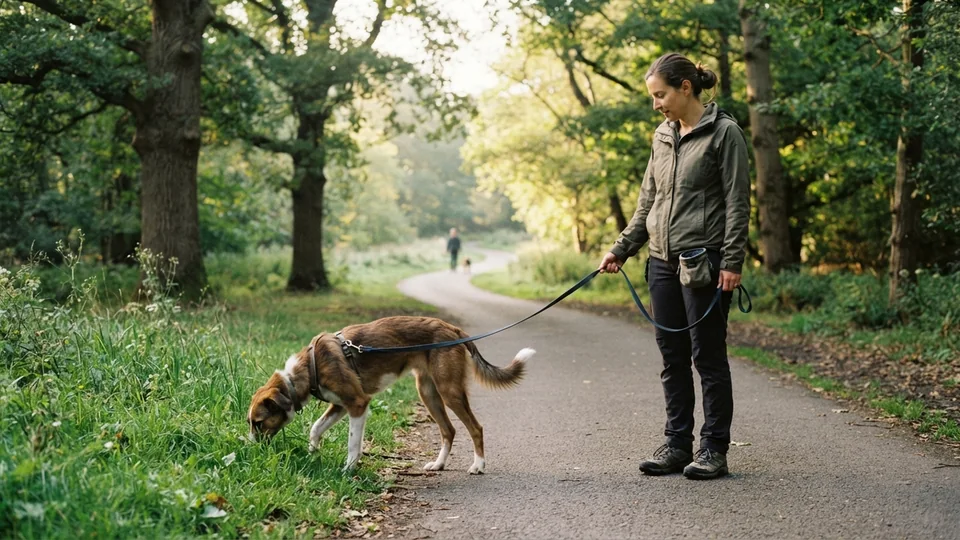
| 7:00–7:45 | Walk: 20–30 minutes of sniffing and loose-lead walking, with a minute or two of one known cue on the way. |
| 8:00–11:00 | Rest in the crate, pen or bed with a chew. Most of this should be sleep. |
| 11:00 | Toilet. Five to ten minutes of training at home, then a find-it game. |
| 11:30–14:00 | Long midday rest. |
| 14:00 | Toilet, then a short outing: a quiet new place, or a sniff on a long line. |
| 15:30–17:00 | Rest, or a quiet chew in the room with you. |
| 17:30 | Toilet, dinner, short evening walk. |
| 19:00–21:30 | Calm time: a chew, settling on a mat, a short game with clear rules. No rough play late in the evening. |
| 22:00 | Last toilet, then bed at the same time each night. |
This is almost the same day as six months, and that is the point. If the six-month day already works, keep it. You do not need a new schedule every month. Change one thing at a time, and only when the current day is calm.
Working away from home? The full workday puppy schedule keeps the same blocks around a midday visit, and puppy daycare vs home alone compares the cover options. Working from home? See the WFH puppy schedule.
How long should a 7 month old puppy be awake?
About two to three hours between rests for most puppies. That counts everything: the toilet trip, the meal, the walk, the training and the play. Treat it as an upper limit, not a target. Watch for signs the spell is over:
- mouthing or grabbing sleeves again
- zoomies that do not wind down
- chewing furniture or skirting boards
- ignoring cues your puppy knew this morning
When you see them, end the game, offer a toilet trip and take your puppy to the rest place with a chew. Stay quiet nearby for the first minutes if that helps.
How many rests? Usually two or three. Protect the long midday rest. If you want to drop one, drop the shortest, replace it with a calm hour on a bed near you, and keep the change for a week before you judge it. If evening biting or destruction comes back, put the rest back. The 6 month page covers fading a nap in more detail.
AKC notes that dogs in general spend as much as half the day asleep, about 30% awake but relaxing and only around 20% active. A seven-month-old is still growing, so expect at least that much rest. A puppy who rarely settles is usually doing too much, not too little. If you are not sure which, read overtired vs overstimulated.
How much exercise does a 7 month old puppy need?
For most puppies, two or three walks of about 20–30 minutes, mostly sniffing on a loose lead, plus short training and play, is plenty. That is the same range as at six months. The age ceilings and recovery checks are on walk length by age.
PDSA explains that a puppy's joints and growth plates are still maturing, and that too much high-impact exercise can damage them, while too little can lead to boredom and frustration. It says most dogs are fully grown by one year, but larger breeds can take 18 months to two years. PDSA also says the popular "five minutes per month of age" rule has no scientific evidence behind it. So use the dog in front of you: can your puppy come home, eat, and settle within a reasonable time?
What tires a seven-month-old without winding them up:
- a slow sniff walk on a long line in a quiet place
- a few minutes of loose-lead practice where pulling stops the walk
- a find-it game indoors
- a chew after the walk, instead of more play
- settling on lead at a bench or café
Save long runs, repeated ball chasing and lots of jumping for later. For large and giant breeds, ask your vet what is sensible while your dog is still growing.
Crate, time alone and nights at seven months
Crate. For most puppies the crate is still where they rest and sleep, with the door open more often. AKC suggests keeping a crate around as your puppy gets older, even when it is no longer needed for house training, as a safe place to relax. Seven months is not a crate-free birthday. The signs that your puppy is ready to sleep without it are on when to stop crating. Starting the crate now? Use crate training an older puppy instead of the eight-week plan.
Daytime crate stays. The crate duration table gives about three to four hours, with breaks in the day, as the ceiling for puppies over six months. That is a maximum, not a plan for a whole morning.
Time alone. The RSPCA advises that dogs are left for no longer than four hours, so they have chances to exercise, go to the toilet and spend time with people. Many seven-month-olds are not ready for that yet. Build up in small steps with first absences. If your days are longer, plan cover.
Nights. Most seven-month-olds sleep through to a normal household morning. If yours wakes at 5 a.m., the fix is usually the evening and the bedroom, not the morning. See puppy wakes up early.
What should you train at seven months?
Keep sessions short, five to ten minutes, a few times a day, inside awake spells. AKC's advice on adolescent puppies is to keep practising the basics several times a week, keep rewarding good choices and teach self-control cues such as "leave it" and "drop it". Dogs Trust says early, consistent training helps puppies through this stage.
Good priorities this month:
- recall on a long line, not off-lead in the park yet (recall ladder)
- loose-lead walking in slightly busier places (loose-leash walking)
- leave it and drop it before the second chewing phase
- settling on a mat while the house is busy (place)
- waiting at doors (wait at the door)
When a cue fails outside, make it easier and pay it again. That is normal for this age, not a sign that training failed. The methods on this site follow reward-based, management-first standards, as set out in the AVSAB position statements. The wider behaviour picture is on adolescent dog, 6–12 months.
When is it not a schedule problem?
A schedule helps a bouncy puppy who gets louder late in the day and settles after a real rest. It does not fix these:
- a stiff body, a hard stare, or a bite that lands and holds
- guarding food, a bed, a toy, a person or a doorway
- a puppy who cannot rest even in a quiet, familiar room
- howling, destruction or toileting only when left alone (see puppy separation anxiety)
- a sudden change, or any vomiting, diarrhoea, limping or pain when touched
Health changes go to your vet first: see when to call the vet. Guarding and aggression need a qualified trainer or veterinary behaviour professional.
Common mistakes at seven months
- Adding exercise instead of rest. A longer walk builds fitness, not calm. Sniff more, rush less.
- Dropping two rests at once. The evening falls apart and you cannot tell why. Change one thing per week.
- Removing the crate on a date. Use the signs, not the calendar.
- Testing the hardest place first. Off-lead at a busy park is the last step, not the first.
- Letting weekends drift. A 9 a.m. Saturday after a 6:30 weekday shifts the toilet clock and the evening.
- Calling guarding "just a teenage phase". Manage it and get qualified help.
Next on the age ladder: the 10 month old puppy schedule and the 1 year old dog schedule.
Sources and scope
- Dogs Trust — The teenage phase: understanding your adolescent dog
- AKC — Your Adolescent Puppy and Changes to Expect
- AKC — Puppy Feeding Fundamentals
- AKC — Why Do Dogs Sleep So Much?
- PDSA — Exercising your puppy
- RSPCA — Training your dog to be left alone
- AVSAB — Position statements on humane training
Public welfare and veterinary guidance informs the safety context. Tables, sample days and step lists are editorial planning aids, not research findings, diagnostic tools or a substitute for individual veterinary advice. Sources checked 15 November 2026.
Questions on this page
How long should a 7 month old puppy be awake?
About two to three hours between rests for most puppies, counting the walk, meal, training and play. Treat it as an upper limit and end the spell early if mouthing, zoomies or chewing start.
How many naps does a 7 month old puppy need?
Usually two or three daytime rests. Protect the long midday rest. If you drop one, drop the shortest and replace it with a calm hour, and keep the change for a week.
How many times a day should a 7 month old puppy eat?
Two meals for most. AKC suggests twice-daily feeding from about six months. Keep the meal times fixed, because meals anchor the toilet clock.
How far should I walk a 7 month old puppy?
For most, two or three walks of about 20–30 minutes, mostly sniffing on a loose lead. PDSA says there is no scientific evidence behind the five-minutes-per-month rule, so watch how your puppy recovers. See walk length by age.
How long can a 7 month old puppy be left alone?
The RSPCA advises no longer than four hours for dogs, and many seven-month-olds are not ready for that yet. Build up slowly with first absences and plan cover for longer days.
Why is my 7 month old puppy suddenly naughty?
Adolescence often starts around six to eight months. Cues may fail outside, pulling and jumping may return, and chewing may rise. Make training easier, pay it again and protect sleep. See adolescent dog, 6–12 months.
Work with me
A $150 consultation or $500 monthly curatorship. Opens WhatsApp to Andrew.