
Expert Advice · Puppy · 9 min read
10 Month Old Puppy Schedule: Sample Day and Routine
A sample day for a ten- or eleven-month-old: close to an adult routine, with a teenager’s rules for rest, chewing, food and time alone.

Short answer
A 10 month old puppy schedule looks close to an adult day: two meals, two walks with plenty of sniffing, a few minutes of training and two long quiet blocks, one in the morning and one in the afternoon. Most dogs this age rest when the house is calm rather than needing timed naps, but many are still adolescents, so keep the evening quiet and the rules consistent. The same plan works at eleven months.
What changes at ten and eleven months?
By ten months most dogs are close to their adult routine. The day has fewer, longer blocks, and most rest happens when the house goes quiet, not because you set a timer. But many ten-month-olds are still in adolescence. Dogs Trust says this teenage phase can last up to 24 months, and AKC says most dogs reach emotional maturity between 12 and 18 months, with smaller breeds often maturing sooner than larger ones. So the plan is an adult-shaped day with a teenager's rules: steady times, a calm evening and consistent cues.
- Rest. Most dogs this age no longer need timed naps. Schedule two long quiet blocks instead, one in the morning and one in the afternoon, and let the dog sleep through them.
- Meals. Two a day. AKC suggests twice-daily feeding from about six months.
- Food type. Some dogs move to adult food around now. AKC says small breeds can switch at about seven to nine months and larger breeds at about 12 to 14 months. Ask your vet when, and change gradually over a few days.
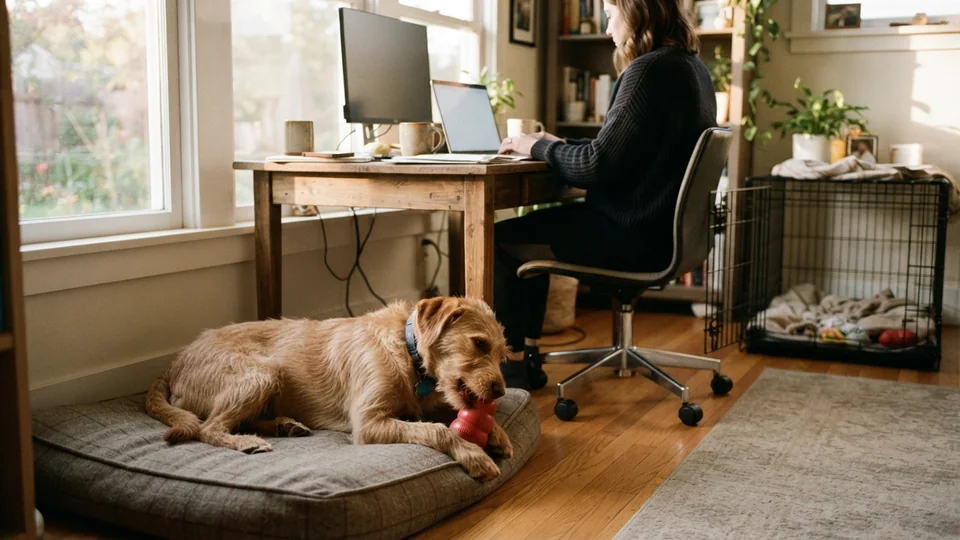
- Chewing. AKC describes a second chewing phase at about eight to ten months, as adult teeth settle in the jaw. Keep safe chews in reach and keep tempting items out of reach.
- Nights. AKC notes that after nine or ten months many dogs can wait 10 to 12 hours overnight. That is a sleeping figure. It does not mean a dog can be left alone for that long by day.
Eleven months changes very little. The same day works. The main jobs at eleven months are to book the first-birthday vet visit and to plan the next step on the 1 year old dog schedule.
Sample day for a 10 month old puppy
This sample assumes a 6:30 start and someone home or a midday visit. Shift the times to fit your household. Keep the order and the quiet blocks.
| Time | What happens |
|---|---|
| 6:30 | Wake, toilet, breakfast. |
| 7:00–7:45 | Morning walk: plenty of sniffing, some loose-lead practice, a few known cues along the way. |
| 8:00–11:30 | Quiet block: rest in the crate, pen or bed with a chew while you work or get on with the morning. |
| 11:30 | Toilet, garden or short outing, five to ten minutes of training. |
| 12:00–15:00 | Long quiet block. Most dogs sleep through much of it. |
| 15:00 | Toilet, a play session with rules (tug that ends on cue, fetch that ends) or a find-it game, short outing. |
| 16:00–17:30 | Rest or a chew near you. |
| 17:30 | Dinner, toilet, evening walk of about 20–30 minutes. |
| 19:00–21:30 | Calm evening: chew, settle on a mat, a short training game. |
| 22:00 | Last toilet, bed. |
The day has two walks, one or two short training blocks, one play session and two long quiet blocks. Exercise in the plan is modest on purpose. A ten-month-old who gets more running but less rest often has a louder evening, not a calmer one.
If you are out at work, swap the 11:30 slot for a walker, sitter or daycare visit. Puppy daycare vs home alone helps you choose.
How much rest does a 10 month old puppy need?
Still a lot. AKC notes that dogs spend as much as half the day asleep, about 30% awake but relaxing and around 20% active. A ten-month-old is not yet an adult, so do not treat every hour awake as time to fill.
Signs your dog needs more structured rest:
- the evening is the loudest part of the day
- mouthing, grabbing or zoomies come back after a busy afternoon
- chewing furniture when the house is quiet
- cues fall apart after visitors or a long outing
If you see these, put a set rest back into the afternoon for a week: toilet, rest place, chew, house goes quiet. The method is on enforced naps. It works for teenagers too.
How much exercise does a 10 month old puppy need?
Many ten-month-olds do well with two walks a day, a short play session and a few minutes of training, with most of the walking spent sniffing. Breed and energy matter. PDSA says some breeds need at least one to two hours of exercise a day, and working breeds need a lot more, but it also says fitness should be built gradually.
Growth still matters at this age. PDSA explains that most dogs are fully grown by one year, but larger breeds such as Labradors and Great Danes can take 18 months to two years. Until they are fully grown, their joints and growth plates can be damaged by too much high-impact exercise. Before you start running together, agility jumps or long hikes, ask your vet. PDSA suggests introducing running slowly, with short bursts of gentle jogging inside a normal walk.
A balanced week mixes:
- slow sniff walks, which PDSA describes as good for mental health
- a brisker walk on easy ground
- short training on loose-lead walking and long-line recall
- play with rules, such as tug that ends on cue
- rest after each of them
The adult picture is on how much exercise a dog needs.
Crate and time alone at ten months
Crate at night. Some ten-month-olds are ready to sleep without a closed crate. Others are not ready until well past their first birthday. The live guide on when to stop crating sets out the signs to look for, including dry mornings, chewing only their own things and settling on their own. Start with door-open nights in the same room, and step back if chewing or accidents return. AKC suggests keeping the crate around even after it is no longer needed for house training, so your dog keeps a safe place to rest.
Time alone. The RSPCA advises leaving dogs for no longer than four hours. A ten-month-old who has been trained to be alone may manage that. One who has not will not suddenly cope because of age. Build the time in small steps with first absences and read how long a dog can be left alone.
Meals and food at ten months
Keep two meals at fixed times. Meals anchor the toilet clock and the rest blocks after them. AKC's guidance:
- feed twice a day from about six months
- small breeds can move to adult food at about seven to nine months, larger breeds at about 12, 13 or even 14 months
- when in doubt, staying on puppy food a little too long is better than switching too early
- make the switch gradually over a few days, and talk to your vet about timing
If your dog starts waking at night to toilet, look at meal times first. A late dinner often means an early wake.
Training at ten and eleven months
This is a maintenance age, not a starting-over age. AKC's training advice for adolescent dogs stresses consistency: the same word for the same cue every time, and practice in the places where the dog will need it, not only in the living room. Dogs Trust lists jumping up, pulling on the lead and trouble with impulse control as normal parts of this phase.
- Pick two skills for the month, such as recall and greetings.
- Practise them where they fail, at an easier level, with good rewards.
- Keep sessions short: a few minutes, a few times a day.
- Refresh door and greeting rules: lead or gate before the door opens, reward four paws on the floor (jumping up).
Rewards and management stay the method. The AVSAB position statements are the public standard behind that approach.
When is it not a schedule problem?
- guarding, a hard stare or a bite that lands: get a qualified trainer or veterinary behaviour professional
- distress, destruction or toileting only when alone: see separation anxiety
- accidents after months of being clean, drinking much more, limping or pain: vet first (when to call the vet)
Common mistakes at ten months
- Treating ten months as adult. Many dogs are still teenagers. Keep the rules.
- Swapping rest for running. More miles rarely buy a calmer evening.
- Switching food overnight. Change it over a few days, at the age your vet suggests.
- Removing the crate and the rules together. Change one thing at a time.
- Using overnight holding as a guide for days alone. Sleeping through is not the same as coping alone for a long day.
Coming from younger ages? See the 7 month old puppy schedule. Next: the 1 year old dog schedule.
Sources and scope
- Dogs Trust — The teenage phase: understanding your adolescent dog
- AKC — A Puppy Growth Timeline: Transitions in Puppyhood
- AKC — Your Adolescent Puppy and Changes to Expect
- AKC — When Training Falls Apart: Does Your Dog Need to Go Back to School?
- AKC — Puppy Feeding Fundamentals
- AKC — Why Do Dogs Sleep So Much?
- PDSA — Exercising your puppy
- PDSA — Exercise for dogs
- RSPCA — Training your dog to be left alone
- AVSAB — Position statements on humane training
Public welfare and veterinary guidance informs the safety context. Tables, sample days and step lists are editorial planning aids, not research findings, diagnostic tools or a substitute for individual veterinary advice. Sources checked 15 November 2026.
Questions on this page
How much should a 10 month old puppy sleep?
Still a lot. AKC notes that dogs spend as much as half the day asleep and about 30% relaxing. Plan two long quiet blocks a day and add a set afternoon rest back if the evening gets loud.
Does a 10 month old puppy still need naps?
Most no longer need timed naps, but they still need planned quiet time. If evenings fall apart, put a set rest back into the afternoon for a week using enforced naps.
When should a 10 month old puppy switch to adult food?
It depends on size. AKC says small breeds can switch at about seven to nine months and larger breeds at about 12 to 14 months. Ask your vet and change gradually over a few days.
Why is my 10 month old puppy chewing again?
AKC describes a second chewing phase at about eight to ten months, as adult teeth settle in the jaw. Keep safe chews in reach and tempting items out of reach.
Can a 10 month old puppy sleep without a crate?
Some can, if mornings are dry, they chew only their own things and they settle on their own. Start with door-open nights. See when to stop crating.
Is an 11 month old puppy schedule different?
Very little changes between ten and eleven months. Keep the same day, book the first-birthday vet visit and look ahead to the 1 year old dog schedule.
Work with me
A $150 consultation or $500 monthly curatorship. Opens WhatsApp to Andrew.