
Expert Advice · Puppy · 7 min read
Work From Home With a Puppy: Daily Schedule
Working from home does not make you a full-time playmate. Put naps under meetings, use gates and a pen for calls, and practise short absences every day.

Short answer
A work from home puppy schedule puts the puppy’s naps where your meetings are: toilet, a short awake block, then a nap in a crate, pen or gated room while you work. AKC describes puppy naps of 30 minutes to two hours. Practise short absences every day, as RSPCA advises building time alone gradually, so the first office day is not a shock.
Working from home does not mean the puppy has a full-time playmate. Puppy day schedule owns the toilet–play–train–rest loop. Enforced naps owns sleep as a training variable. This page owns the WFH conflict: laptop versus puppy, closed doors for meetings, and micro-absences while you are still in the flat — without treating your presence as free entertainment all day.
I train on month-plus residential stays. I am not a veterinarian.
This is a puppy schedule page. Cross-link first absences for the longer alone ladder, crate training and playpen vs crate for furniture jobs, and crate duration so rest boxes stay sane.
Why does “I am home” create worse manners?
Because the puppy learns that human presence equals continuous access.
Meetings start, the puppy mouths the chair, you push them away mid-call, and the mouth gets intermittent pay. That is not bonding; that is a messy contingency. Rest first. Social later. Your calendar is part of the training plan.
Home presence is not a twelve-hour play shift.
How do you structure a WFH day without cloning the day-schedule page?
Use the day schedule for the loop. Use this page for doors and screens.
- Morning toilet and a short wake window, then a nap before the first meeting block.
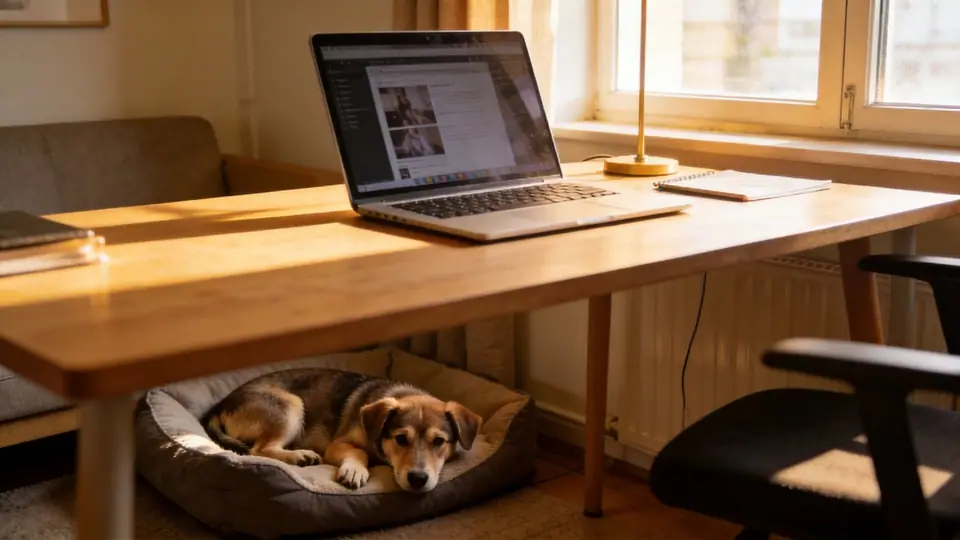
- Deep work: puppy in crate, pen, or gated room with a legal chew — not under the rolling chair.
- Calls: door closed. Release only for quiet or for a planned toilet break, not for barking jackpots.
- Micro-absences: bathroom and kettle with the puppy behind management walls so “you left the room” is boring.
- Lunch: toilet, short training or sniff walk, then another rest block before the afternoon screen.
If you need the full alone-day plan when you actually leave the house, see full workday puppy schedule. Do not stretch a WFH pen into an illegal crate marathon — crate duration sets honest ceilings.
Sample work-from-home day with meetings
A 9:00–17:30 desk day for a puppy of about 3–5 months. Meetings go where the puppy would be asleep anyway. For a younger puppy, shorten each awake block and add a nap; the wake-window chart has the ranges by age.
| Time | Puppy | You |
|---|---|---|
| 7:00 | Wake, toilet, breakfast, short walk | Before work |
| 8:30 | Toilet, chew, nap in the crate or pen | Start work |
| 9:30–11:00 | Asleep | Calls and focused work |
| 11:00 | Wake, toilet, five minutes of training, a food toy | Short break |
| 12:00 | Toilet, nap behind a gate or in the pen | Back to work |
| 13:00 | Wake, toilet, lunch-time sniff walk | Lunch break |
| 14:00–16:00 | Long afternoon nap; a five-minute practice of you leaving the room or the flat | Calls |
| 16:00 | Wake, toilet, chew on a mat near your desk | Email and lighter work |
| 17:00 | Toilet, short nap or quiet pen time | Wrap up |
| 17:30 onwards | Walk, dinner, training, early-evening nap, last toilet, bed | Off work |
AKC describes puppy naps as lasting anywhere from 30 minutes to two hours, and suggests toilet trips every one to two hours while young puppies are awake. Built that way, the day fits more meetings than most owners expect. Put the long nap where your longest calls are.
US spare-room office versus UK flat desk?
US (typical): crate or pen in a spare room during video calls; baby gate on stairs. Micro-absences are cheap because doors exist.
UK (typical): desk in the living room, pen ring or gated kitchen. Same jobs, less square footage. A playpen vs crate split often works better than free roam of the only room.
Why practise alone time when you work from home?
Because one day you will leave. RSPCA advises teaching dogs from the start that being alone is fine, by increasing time alone very gradually, and notes studies finding that dogs introduced to being alone gradually are less likely to have problems later. A WFH puppy who has never been alone is untrained for the first office day, the dentist or the school run.
- Once or twice a day, during a calm awake block, leave the room for a few seconds, then minutes, with the puppy behind a gate with a chew.
- Several times a week, step out of the front door for a short errand while the puppy rests.
- Keep returns dull. If the puppy cries and the noise climbs, the step was too big; go back.
- Keep crate stays inside the limit: Humane World for Animals advises no more than three or four hours at a time for puppies under six months.
The full staged plan is on the puppy alone training schedule. If you go back to the office on some days, the full workday puppy schedule shows what cover each age needs.
What are the usual failure modes?
- Cloning puppy-day-schedule or enforced-naps wholesale. Loops live there; WFH doors live here.
- Free roam under the desk all day. Unpaid chewing and overtired mouths.
- Opening the door mid-bark. Pay for protest.
- Skipping micro-absences because “I am home anyway.” Then real absences explode.
- Ignore-crate-crying as blanket advice. Not this site’s protocol.
Sources
AVSAB position statements on humane dog training. Management, enforced rest, and reward-based absence practice are standard. Paraphrased as public training standards. avsab.org/resources/position-statements/
- AKC — How to Make Sure Your Puppy Gets Enough Sleep
- AKC — How to Potty Train Your Puppy and Prevent Accidents Indoors
- RSPCA — How to train your dog to stay home alone
- Humane World for Animals — How to crate train your dog or puppy
Nap length and toilet frequency come from AKC; alone-time training and crate limits from RSPCA and Humane World for Animals. The sample day is an editorial planning aid from household training, not veterinary advice. Sources checked 18 November 2026.
Questions on this page
How is a WFH schedule different from a puppy day schedule?
The day schedule owns toilet–play–train–rest loops. This page owns the conflict between your laptop and the puppy: meetings, doors, and not treating your presence as unpaid entertainment from 09:00 to 18:00.
Should the puppy free-roam the office all day if you work from home?
No. Overtired mouths and unpaid chewing follow “I am always available.” Use enforced naps, a crate or playpen for rest, and gated zones during deep work. Presence without a rest plan is not enrichment.
What are micro-absences while you are home?
Short closed-door periods — bathroom, call, focus block — so the puppy learns that you can vanish for minutes without a festival. First absences owns the longer ladder. Here you rehearse small exits inside the same flat.
US home office versus UK flat desk corner?
Same rules: rest block before meetings, door closed for calls, toilet before deep work. US spare rooms make crate-in-office easy. UK flats often use pen plus gate at the living-room arch. Jobs stay the same.
What if the puppy screams the moment you open a laptop?
Likely rehearsed attention for keyboard start. Toilet and a short settle or nap first; do not open the laptop as a cue for play. Calm reinforcer and place work help once rest is scheduled.
How do I work from home with a puppy?
Schedule naps under your calls, keep the puppy in a crate, pen or gated room while you work, take toilet breaks every one to two hours of awake time for a young puppy, and practise short absences daily.
Should I leave my puppy alone even if I work from home?
Yes, in small steps. RSPCA advises building time alone very gradually from the start. A puppy that is never alone is not ready for the first day you go out.
Work with me
A $150 consultation or $500 monthly curatorship. Opens WhatsApp to Andrew.