
Expert Advice · Puppy · 8 min read
8 Month Old Puppy Schedule: Sample Day for 8–9 Months
A sample day for an eight- or nine-month-old: the second chewing phase, adolescence, recall wobbles and how much freedom to give.

Short answer
An 8 month old puppy schedule keeps two meals, two walks with plenty of sniffing, short training and two long rests, plus planned chew slots for the second chewing phase AKC describes at about eight to ten months. Many puppies are in adolescence now, so add freedom one room at a time, keep a long line outdoors and protect rest. The same day works at nine months.
What changes at eight and nine months?
Eight and nine months sit between the 7 month and 10 month schedules. The daily clock barely moves. Two things usually do: chewing and freedom.
- Adolescence. AKC says the teenage period may begin at about eight months and continue until two years. Another AKC article places the defiant phase at about 5 to 18 months. Dogs Trust says it usually starts at six to twelve months. So many dogs are in the middle of it now.
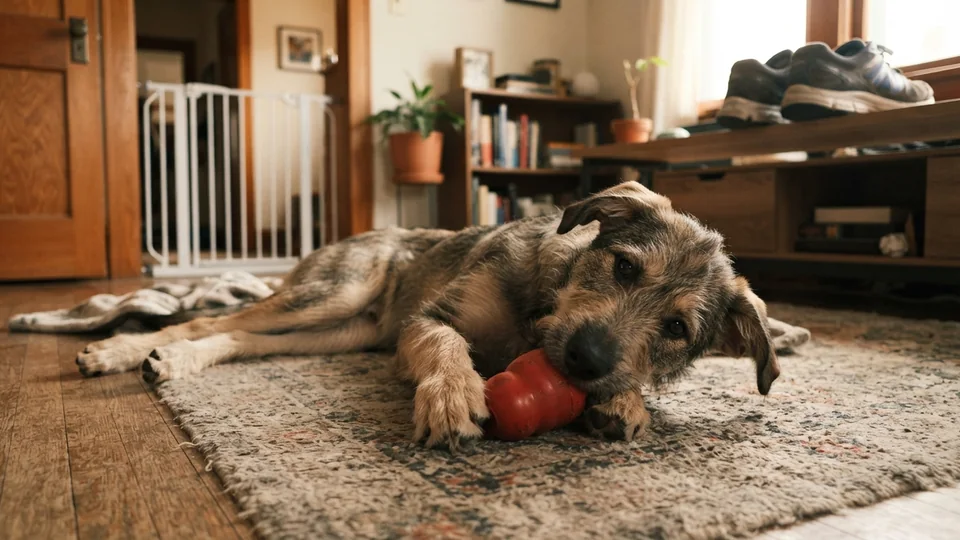
- Second chewing phase. AKC describes a second chewing phase at about eight to ten months, as the adult teeth settle in the jaw. Shoes, skirting boards and remote controls are at risk again.
- Wandering further. AKC notes that young puppies like to stay near you, which gives owners a false sense of security. As they grow more confident, many stop staying close. Recall that worked at five months may not work now.
- Rest. Usually two daytime rests, sometimes a short third one after a busy morning.
- Meals. Two a day. AKC says small breeds can switch to adult food at about seven to nine months and larger breeds at about 12 to 14 months. Ask your vet, and switch gradually over a few days.
We cover eight and nine months on one page because the day is the same. If your dog is nine months old, use this page and look ahead to the 10 month schedule.
Sample day for an 8 or 9 month old puppy
This sample assumes someone home or a midday visit and a 6:30 start. Shift the times; keep the order and the chew slots.
| Time | What happens |
|---|---|
| 6:30 | Wake, toilet, breakfast. |
| 7:00–7:45 | Walk with lots of sniffing, on a long line in open spaces. A few recalls you can win. |
| 8:00 | Chew slot: a safe chew or food toy in the rest area. |
| 8:15–11:30 | Rest in the crate, pen or bed. |
| 11:30 | Toilet, garden or short outing, five to ten minutes of training. |
| 12:00–15:00 | Long midday rest, with a chew available. |
| 15:00 | Toilet, play with rules or a find-it game, short outing. |
| 16:00–17:30 | Rest or quiet chew near you. |
| 17:30 | Dinner, toilet, evening walk of about 20–30 minutes. |
| 19:00 | Evening chew slot, then calm time: settle on a mat, short game. |
| 22:00 | Last toilet, bed. |
The chew slots are planned, not extra. A puppy in the second chewing phase will chew something. Giving a legal chew at set times, especially after walks and before rest, means it is less likely to be your furniture. See puppy chewing furniture.
How much freedom should an 8 month old puppy have?
Less than it looks like they can handle. AKC lists giving a puppy too much freedom too soon as a common mistake at this age. A practical way to add freedom:
- Open one extra room at a time, after a walk and a toilet trip, while you are home.
- Keep the crate or pen for rest and for times you cannot watch. AKC suggests keeping the crate around, even after house training, to prevent a growing puppy getting into trouble.
- Pick up shoes, cables and laundry before you add space, not after something is chewed.
- Add the next room only after a week without damage or accidents.
- Outdoors, use a long line instead of off-lead time in open spaces until recall works again (long-line recall).
If something goes wrong, go back one step for a week. That is management, not punishment.
How much rest does an 8 month old puppy need?
Still a lot. AKC notes that dogs in general spend as much as half the day asleep, about 30% awake but relaxing and around 20% active. An eight-month-old is still growing, so expect at least that. Plan two long rests and keep the evening quiet.
Signs your puppy needs more rest, not more exercise: mouthing or grabbing comes back, zoomies that do not settle, chewing the house when it goes quiet, cues that worked this morning falling apart. Put a set afternoon rest back for a week (enforced naps).
Exercise at eight and nine months
Two walks with plenty of sniffing, short training and a play session are enough for most. PDSA explains that joints and growth plates are still maturing in growing dogs. Most dogs are fully grown by one year, but larger breeds can take 18 months to two years. PDSA also says the "five minutes per month of age" rule has no scientific evidence behind it. Watch recovery instead: your puppy should come home, eat and settle.
Save long runs, repeated ball chasing and lots of jumping until your vet agrees your dog is ready. The age ceilings are on walk length by age.
Training at eight and nine months
AKC's advice for this stage is consistency. Use the same word for the same cue every time, and practise in the places where you need the behaviour, not only in the living room. AKC also suggests continuing to practise basic skills several times a week and teaching "leave it" and "drop it" for self-control.
- Recall: back to a long line and an easier distance (recall ladder).
- Leave it and drop it: perfect for the chewing phase (leave it, drop it).
- Loose lead: short sessions where pulling stops the walk (loose-leash walking).
- Settle: a mat in a busy room (place).
Keep sessions to a few minutes and use rewards your puppy really wants outdoors. Dogs Trust lists jumping up, pulling on the lead and struggling with impulse control as normal parts of the teenage phase. The AVSAB position statements set out the reward-based standard behind this approach.
Time alone and the crate
The RSPCA advises leaving dogs for no longer than four hours. Many eight-month-olds can manage some time alone if they have practised it. If yours has not, start small (puppy alone training schedule). The crate duration table gives about three to four hours with breaks as the daytime ceiling after six months. For nights, use the signs on when to stop crating rather than a birthday.
When is it not a schedule problem?
- guarding food, toys, beds or people, or a bite that lands: get a qualified trainer or veterinary behaviour professional (resource guarding)
- destruction, howling or toileting only when alone (separation anxiety)
- a sudden change, limping, vomiting, diarrhoea or accidents after months of being clean: vet first (when to call the vet)
Common mistakes at eight and nine months
- Full run of the house too soon. Add one room at a time.
- No chews in reach. The second chewing phase needs a plan.
- Off-lead in the park because it worked last month. Go back to the long line for now.
- More exercise to fix chewing. Most chewing at this age needs rest and legal chews, not miles.
- Switching food overnight. Change it over a few days, at the age your vet suggests.
Earlier: the 7 month old puppy schedule. Next: the 10 month old puppy schedule. The behaviour picture is on adolescent dog, 6–12 months.
Sources and scope
- AKC — Your Adolescent Puppy and Changes to Expect
- AKC — When Training Falls Apart: Does Your Dog Need to Go Back to School?
- Dogs Trust — The teenage phase: understanding your adolescent dog
- AKC — Puppy Feeding Fundamentals
- AKC — Why Do Dogs Sleep So Much?
- PDSA — Exercising your puppy
- RSPCA — Training your dog to be left alone
- AVSAB — Position statements on humane training
Public welfare and veterinary guidance informs the safety context. Tables, sample days and step lists are editorial planning aids, not research findings, diagnostic tools or a substitute for individual veterinary advice. Sources checked 16 November 2026.
Questions on this page
How long should an 8 month old puppy be left alone?
The RSPCA advises no longer than four hours for dogs, and only if your puppy has practised being alone. Build up gradually with the alone training schedule.
Why is my 8 month old puppy chewing everything again?
AKC describes a second chewing phase at about eight to ten months, as adult teeth settle in the jaw. Plan chew slots after walks and before rests, and puppy-proof again.
How many naps does an 8 month old puppy need?
Usually two daytime rests, sometimes a short third one after a busy morning. If evenings get loud, put a set afternoon rest back for a week.
Why has my 8 month old puppy stopped coming when called?
AKC notes that as puppies grow more confident they stop staying close, and adolescence may begin around eight months. Go back to a long line and easier recalls you can reward.
Is a 9 month old puppy schedule different?
Hardly. The same day works at nine months. Keep the chew slots and long line, and look ahead to the 10 month old puppy schedule.
When should an 8 month old puppy switch to adult food?
AKC says small breeds can switch at about seven to nine months and larger breeds at about 12 to 14 months. Ask your vet and change gradually over a few days.
Work with me
A $150 consultation or $500 monthly curatorship. Opens WhatsApp to Andrew.