
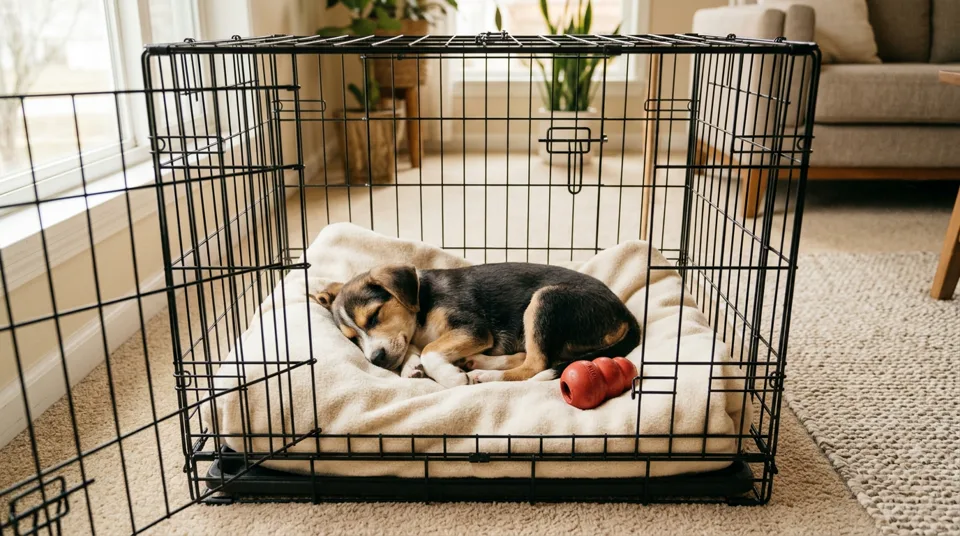
Expert Advice · Puppy · 7 min read
How Long Can a Puppy Stay in a Crate? Day and Night Table
Quiet is not the same as fine. Use cautious age caps for day and night, compare them with welfare guidance, and shorten if the puppy cannot settle.

Short answer
Keep daytime crate stays short and mostly for naps. Published limits are maximums, not targets: Humane World says no more than three or four hours at a time for puppies under 6 months, PDSA no more than three hours, and VCA says a puppy left over 3 hours needs a toilet break. Nights can be longer with planned toilet trips.
How long can a puppy stay in a crate?
How long a puppy can stay in a crate is limited by age, bladder, the job (nap vs night) and welfare. A silent puppy is not automatic proof the stay was kind. Use the table, then shorten for your dog.
Age table: day vs night
| Age | Daytime practice / nap stays (ceiling) | Night between toilet trips (starting idea) |
|---|---|---|
| 8–10 weeks | 30–60 minutes | 2–3 hours, then trip |
| 10–12 weeks | 45–75 minutes | 3–4 hours |
| 3–4 months | 1–2 hours | 4–6 hours |
| 5–6 months | 2–3 hours | 6–8 hours for many |
| 6+ months | 3–4 hours with breaks in the day | Often a full night if dry mornings are stable |
These are planning ceilings used in home programmes, not a guarantee. Always toilet before a long stretch. Cross-check hold-pee by age.
What do vets and welfare groups say about crate time?
The table above is deliberately cautious. Here is what published guidance gives as upper limits, so you can see where those ceilings come from.
| Source | Guidance |
|---|---|
| Humane World for Animals | Puppies under 6 months should not stay in a crate for more than three or four hours at a time; adult dogs not more than 4–5 hours during the day |
| PDSA | Crates should never be used for longer than three hours at a time, and less if the dog is not used to it |
| VCA Animal Hospitals | Puppies left alone for very short periods, no more than 3 hours, can usually be confined in a crate; beyond 3 hours a puppy needs a toilet break |
| AKC (potty timeline) | Age in months plus one gives the maximum hours a puppy should comfortably hold it between breaks, for example 4 hours at 3 months |
| RSPCA | Dogs should be left alone for no longer than four hours, crate or not |
All of these are maximums for a puppy that already likes its crate, not targets. Daytime stays should mostly be naps, which is why the daytime column above is shorter. A young puppy that is crated, then let out, then crated again all day is still missing the exercise and company it needs: Humane World notes that a dog crated all day and night can become depressed or anxious.
How long can a puppy stay in a crate at night?
Longer than in the day, because the puppy is asleep. Plan toilet trips rather than hoping for a full night: VCA notes that puppies may need overnight outings until about 5 months of age. Keep the crate in or near your bedroom so you hear the puppy wake; AKC suggests this so you can hear a whimper if the puppy needs to go out. Night schedules by age are on crate training at night.
Signs a crate stay was too long
- Whining or scratching to come out after a stay that used to be easy. Humane World notes that whining may mean the time was increased too quickly; PDSA advises going back to the previous stage at any sign of distress.
- A wet or soiled crate. The gap was longer than the bladder; shorten it and see puppy peeing in the crate.
- Frantic energy on release, biting and zooming, rather than a stretch and a toilet trip.
- Panic: screaming, clawing, drooling or injury. Stop crating for now and see protest, panic or crate anxiety.
Planning a workday around crate limits
An 8–9 hour day does not fit any of the limits above for a young puppy. Split it: a midday visit from you, a friend or a dog walker, a larger pen with a bed and a toilet area, or daycare. VCA describes an exercise pen or gated area with a resting spot and a toilet surface such as a pad for puppies left longer than 3 hours. AKC suggests building alone time from just 1 or 2 minutes while you are home, working up to longer periods over a few days. Sample days are on the full workday puppy schedule and crate training while at work.
Daytime rules that protect the puppy
- Naps beat warehouse stays. A tired brain needs sleep, not six silent hours alone.
- Build duration with meals and chews first — see crate training.
- Working days need a human break plan: full workday schedule.
Night is not the same clock
Overnight the puppy sleeps more and toilet trips are planned. Use crate training at night for the schedule. Do not copy a night stretch into a Tuesday afternoon.
When to end a stay early
End the stay if you see panic, vomiting, bloody stool, a limb caught, or a puppy who never settles. Rebuild value off the clock. Duration is earned, not demanded.
Sources
Age-banded confinement ceilings used alongside toilet-gap guidance on this site. Adjust down for brachycephalic, giant or medically fragile puppies with your vet’s input.
- Humane World for Animals — How to crate train your dog or puppy
- PDSA — Crate training your dog
- VCA Animal Hospitals — Housetraining for Puppies and Dogs
- AKC — Puppy Potty Training Timeline and Tips
- RSPCA — How to train your dog to stay home alone
- AKC — When Can Puppies Be Left Home Alone?
Crate and alone-time limits follow Humane World for Animals, PDSA, VCA, AKC and RSPCA. The age table is a cautious editorial planning aid used in home programmes, not a veterinary standard. Sources checked 22 November 2026.
Questions on this page
How long can a puppy stay in a crate during the day?
Young puppies often manage about one hour of daytime confinement per month of age as a rough ceiling for practice naps — and many need less. It is a cap, not a target.
How long can a puppy stay in a crate at night?
Nights can be longer because the puppy sleeps, with toilet trips as needed. Many families use a “month + 1 hour” style gap between trips as a starting idea, then adjust.
Can I crate my puppy while I work an 8-hour day?
Not as one unbroken stay for a young puppy. Split the day with a dog walker, midday break, pen zones or daycare. See the workday schedule page.
Is it OK if the puppy is quiet the whole time?
Quiet sleep after a toilet trip can be fine within age caps. Quiet shutdown from fear is not fine. Watch body language when you open.
Does the crate size change how long they can stay?
A too-large crate can invite toilet in one corner. A too-small crate is unfair. Fit matters for hygiene and comfort; it does not erase bladder limits.
When do I stop extending crate time?
When the puppy finishes calm, dry and able to settle. If stays end in panic or soiled bedding, shorten and rebuild.
What if my puppy cries before the time is up?
Use the crying pillar and nap/night guides. Do not only add minutes on a calendar.
How long can a 3 month old puppy stay in a crate?
Treat about one to two hours as a daytime nap ceiling and plan toilet trips. AKC’s months-plus-one rule gives about 4 hours as the maximum a 3-month-old should hold it; Humane World says puppies under 6 months should not be crated more than three or four hours at a time.
Is it cruel to crate a puppy while I work?
A full workday in a crate is too long for a young puppy. VCA says a puppy left more than 3 hours needs a toilet break. Use midday visits, a pen with a bed and a toilet area, or daycare.
Work with me
A $150 consultation or $500 monthly curatorship. Opens WhatsApp to Andrew.