
Expert Advice · Puppy · 8 min read
When to stop crating a puppy at night: signs and steps
Most puppies are ready for a crate-free night somewhere between about six months and two years. Readiness is about dry mornings, calm chewing and a dog that settles on its own, not a birthday. Start with the crate door open, keep the dog in one gated room, and step back for a week if chewing or accidents return.

You can stop crating a puppy at night when the dog has dry mornings, chews only its own toys and settles on its own, not on a set birthday. For most dogs that is somewhere between about six months and two years. Start with door-open nights in the same room, then swap the crate for a bed. The first weeks of crate nights are on crate training at night; this page is about the end of the crate.
I am Andrew Darov, a dog trainer. I am not a veterinarian. This is a puppy page about night sleep, not a guide to daytime crate use.
How do I know my puppy is ready to sleep out of the crate?
Readiness is a set of habits, not an age. If your puppy has all four of the signs below for several weeks, you can start.
- Dry mornings. No accidents in the crate or the house at night for at least three or four weeks. If you are still doing a planned night toilet trip, drop that first (see when do puppies sleep through the night).
- Calm chewing. While you are at home, the dog chews its own toys and leaves shoes, cables, skirting boards and furniture alone without you hovering.
- Settles on its own. In the evening the dog can lie down on a bed or mat and fall asleep without being in the crate or on your lap.
- Quiet nights. The dog sleeps through without whining, pacing or barking.
Teething puppies, adolescents who are testing everything with their mouth, and dogs that still wake to toilet are usually not ready, even if they are six months old. A dog that is ready at seven months is not ahead of a dog that needs eighteen. It is just a different dog.
Why not just take the crate away?
A crate at night does two jobs: it keeps the puppy safe from things it could chew or swallow, and it gives it a small, familiar place to sleep. If you remove both at once, many dogs wander, chew, drink a lot, play with the cushions at 3 am or toilet in a corner. Then the owner decides the dog “is not ready” and the crate goes back for months. Small steps keep the habits you already built.
How do you stop crating a puppy at night, step by step?
- Check readiness. Go through the four signs above. Keep the same evening routine you use now: walk or play, a calm hour, last toilet trip, bed. Changing the routine and the crate at the same time makes it hard to tell what went wrong.
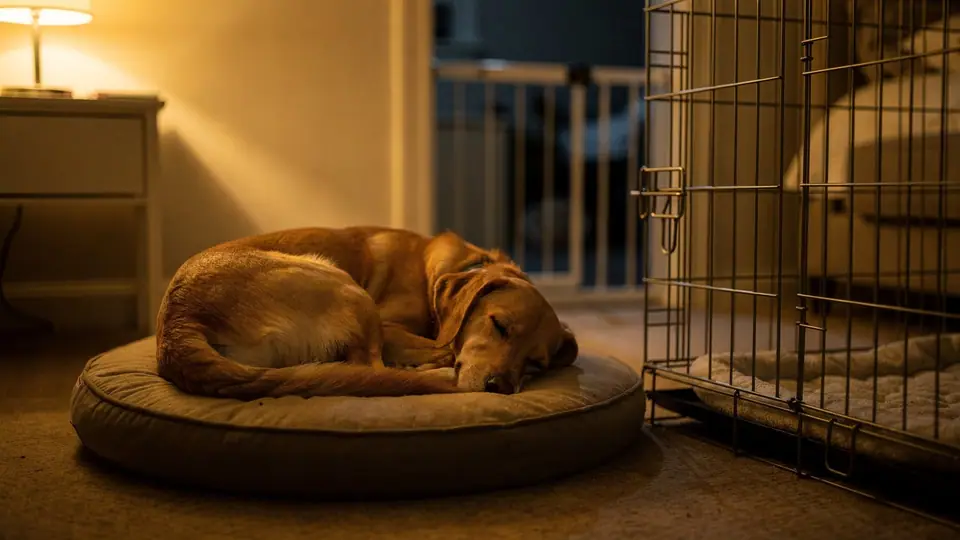
- Open the crate door at night. Put the dog to bed in the crate as usual, then leave the door open or tie it back so it cannot swing shut. Many dogs stay inside because it is their bed. Some step out, lie by your bed and go back in. Both are fine.
- Limit the space to one room. Close the bedroom door or put a baby gate across it (see baby gates for gate types and fit). Before bed, check the floor: no socks, phone chargers, kids’ toys or tissues in reach. One safe room is easier than a whole house at night.
- Add a bed in the same spot. When door-open nights have been quiet for a week or two, put a dog bed right next to the crate. After a few nights on the new bed, move the crate out of the room. The dog still sleeps in the same corner with the same smell.
- Step back if needed. If you see chewing, a wet patch or night wandering, close the crate again for a week. Then try again with a smaller space, for example a puppy pen around the bed (see playpen vs crate). A step back is normal and short. It is not starting again.
Where should my dog sleep after the crate?
Start where the crate was. If the crate was beside your bed, the dog bed goes beside your bed. If the crate was in the kitchen or the living room, put the bed in that same spot and gate the doorway. Moving the room and removing the crate in the same week is two changes at once.
Once the dog has slept well in that one room for several weeks, you can open more of the house at night if you want to. Many owners never do, and that is fine. A dog does not need the whole house at night. Whether the dog should share your bed later is a separate choice; see should my puppy sleep in my bed.
Should I keep the crate for the daytime?
Often yes. Many dogs that sleep crate-free at night still use a crate or pen for daytime naps, car trips, visits to friends or the days a builder is in the house. Daytime crate use has its own rules for how long and how to start; see crate training. A crate that the dog likes is useful for life, even if the door stays open most nights.
What if my puppy has accidents or chews at night without the crate?
Go back one step, not five. Close the crate for a week, check the basics and then try again with a smaller space.
Things to check:
- Has the last toilet trip moved earlier, or got shorter, since the crate came out?
- Is there water, food or something chewable within reach at night that was not reachable before?
- Is the dog getting enough sleep in the day, or is it overtired at bedtime?
- Did anything else change at home this month: a move, a new pet, a baby, a holiday?
If a dog that was reliably dry starts having night accidents, drinks much more than before, or asks to go out many times a night, ask your vet. That can be a health question, not a crate question. More on the crate itself on puppy peeing in crate.
What are the usual mistakes?
- Going by age only. A six-month birthday does not mean the dog is ready. The four signs do.
- Giving the whole house on night one. Start with one gated room.
- Changing the routine at the same time. Keep the walk, last toilet trip and bedtime the same.
- Leaving tempting things out. Socks, cables and kids’ toys on the floor at night are an invitation to chew.
- Giving up after one bad night. Step back for a week, then try again with a smaller space.
The end of the crate is a slow handover: door open, one room, a bed in the same spot, and a short step back if you need it. For the first weeks of crate nights see crate training at night, for daytime set-ups playpen vs crate, and for gating rooms baby gates. More on the puppy hub.
Questions on this page
At what age can a puppy stop sleeping in a crate at night?
There is no fixed age. Many dogs manage a crate-free night somewhere between about six months and two years. Busy chewers, teething adolescents and dogs that still have night accidents usually need longer. Watch the dog, not the calendar.
What are the signs my puppy is ready to stop crating at night?
Several weeks of dry mornings, no chewing of things that are not toys while you are home, a dog that settles quickly on its own bed, and quiet nights with the crate door open. If all four are true, try one room first.
Should I leave the crate door open at night first?
Yes. Door-open nights are the easiest first step. The dog keeps its familiar bed and smell, can come and go, and you can see whether it stays settled before you take the crate away.
Where should my dog sleep after the crate?
Start in the same room where the crate was, with a dog bed in the same spot and a baby gate or closed door so the rest of the house stays shut. Give the dog more of the house later, one room at a time.
What if my dog starts chewing or having accidents without the crate?
Go back to the closed crate for a week or two, check that the last toilet trip and the evening routine are the same as before, then try again with a smaller space. Sudden new night accidents in a dog that was dry are worth a call to your vet.
Work with me
A $150 consultation or $500 monthly curatorship. Opens WhatsApp to Andrew.