Expert Advice · Behavior · 14 min read
Resource guarding in dogs: when to get pro help
A stop list. Guard the people. Do not take the bowl as a rank test. Get eyes on the dog.
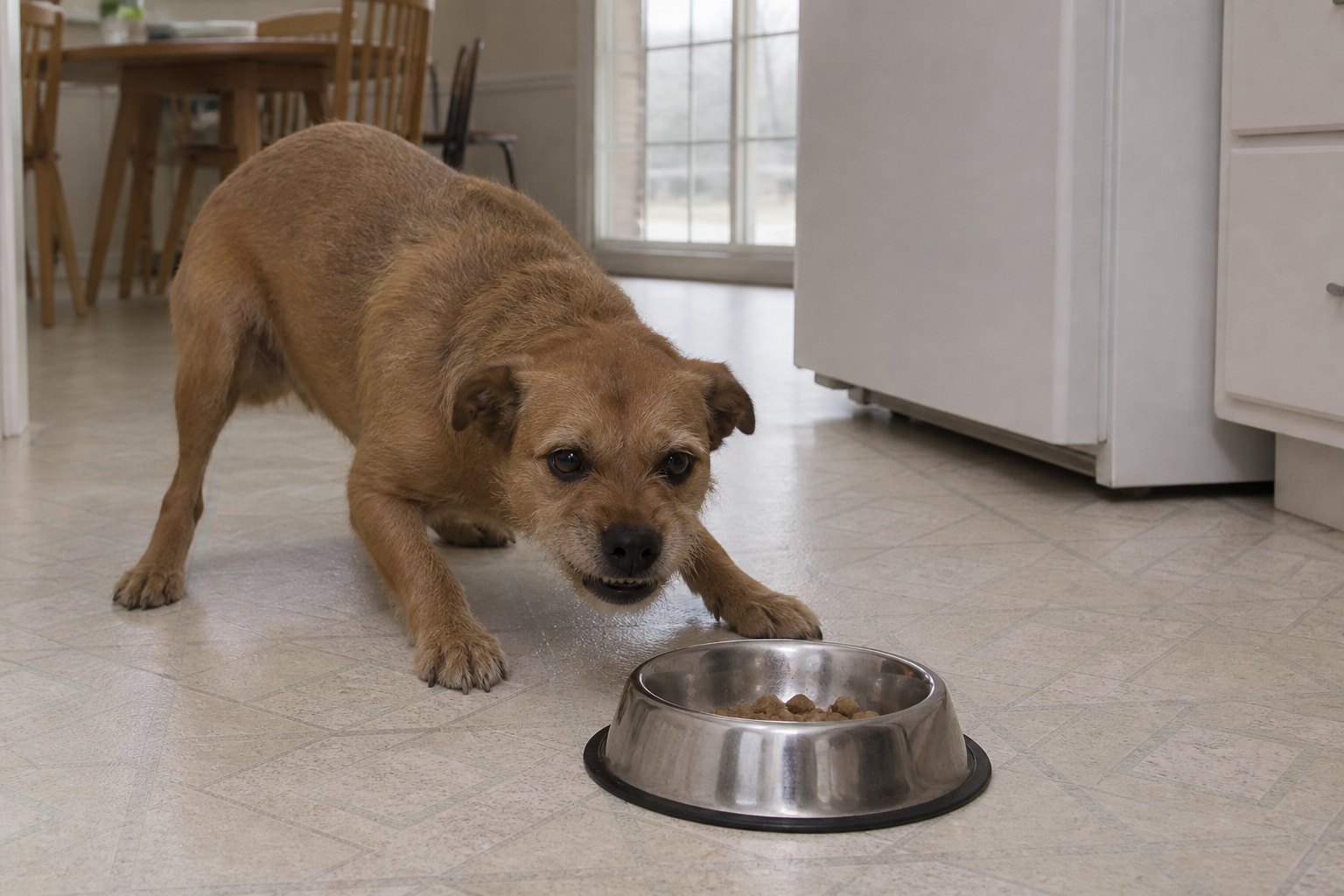
Freeze, stare, or growl over food or a person is manage plus qualified help. This page is a stop list. It is not a home course in treating guarding, and it is not a drill where you take the bowl to prove rank.
I am a professional dog trainer. I take dogs for month-plus residential correction and I publish the method. I am not a veterinarian. I will not invent a review, an academy name, or a US residency. I will not talk you through a confrontation with a dog who is already using teeth as a plan.
When is resource guarding a professional case?
When the dog is already using stillness, a hard eye, sound, or teeth to keep a prize.
The prize can be a bowl, a chew, a stolen sock, a bed, a doorway, or a person. The behavior can be small (eat faster, body-block, hover) or large (growl, snap, bite, chase a person off). Once you see freeze, stare, growl, or a snap over food or a person, you are off the DIY ladder. Manage the room. Get someone who can see the dog.
The ASPCA food-guarding overview says, in public language, to stop if you see stiffness, freeze, growl, snap, or bite, and to contact a qualified professional. Read it as a source. This page is the household stop list, not a copy of their exercises and not a replacement for their “find help” door.
A puppy who eats fast and turns away is not automatically this case. Watch the body. Loose and busy is different from still and hard. If you cannot tell, treat it as the harder picture. You do not lose points for a gate.
A growl is information. If you punish it away, you may meet the bite next, with no warning left.
What does freeze, stare, or growl over food or a person mean?
It means the dog is trying to keep something by making you farther away.
It does not mean the dog has decided to be pack leader. It does not mean you failed a dominance test. The AVSAB dominance position exists because dominance theory is a bad general guide for changing behavior. What you want is a dog who can eat and be near people without a fight. You get that by changing the setup and the feeling, not by winning a bowl.
Signs that you are in the hard picture:
- still body over the prize
- hard eye, whale eye, closed mouth
- eating that becomes a gulp when you move
- a growl, a snarl, a snap
- a person (often a child, a partner, or a guest) being held as the prize: stiff, hover, lip lift if they approach
Play growls with a wriggly body and an easy trade are a different page. See nipping. If a child is in the picture, children and guests is the furniture. Never leave a young child alone with a dog. The ASPCA bite-prevention notes say the same thing. If you cannot see both the child and the bowl, they are not together.
What is the stop list for the household?
Today, before a video, before a weekend plan.
- Stop reaching toward the bowl, the chew, or the dog who is on a prize. Give space. You are not proving a point.
- Feed apart. One dog, one room or one crate, door closed if you need it. Pick up bowls when the eaters are done and gone.
- Chews and stuffed toys exist only when nobody will walk past. If you cannot supervise, the chew does not exist.
- Children do not visit the rest place. Gates on kitchens and halls. Food in hands is managed, not trained, until a professional says otherwise.
- Guests are briefed or the dog is already in another room. A guest who “loves dogs” is often the person who reaches.
- If a bite or a snap already happened, the dog and the target are separated. You do not run a reunion to see if it was a one-off.
That is management. It is how you stop rehearsing the fight. It is not the treatment. Treatment, if it is appropriate, belongs to someone who can see the dog: a trainer who works guarding without confrontation, or a veterinary behavior professional if your clinician is concerned. Paid work on this site is a $150 consultation or $500 monthly curatorship after you apply and I send a pay link. It is not an emergency desk, not a checkout on this page, and not a substitute for local help when a child has been bitten.
contact@ is not a live mailbox for a bite. Use a local veterinarian or a 24-hour clinic.
Why do you not take the bowl as a rank test?
Because the test can teach the dog that hands near food predict loss and conflict.
“Alpha take the bowl,” roll the dog, stick your hand in the dinner, and smack a growl are confrontations. They can suppress a warning. They can also produce a faster bite next time, or a dog who will not eat when you are in the room. The AVSAB humane-training position recommends reward-based methods and does not support aversive tools as a standard. The dominance statement tells clinicians not to use rank as a general behavior-modification guide. Read them. This page will not walk you through a take-away drill.
Trading can be a skill on a different page, on a different dog, when the body is loose and the prize is dull. Leave-it is orientation off a prize you still control. If this dog is already freezing, you do not run leave-it as a brave idea over the bowl. You run the stop list.
I do not publish a confrontation you can copy from a phone.
When do you still see a veterinarian first?
When the body might be the prize, or the reason.
Sudden guarding in a dog who used to eat beside you, a dog who screams when the collar or the waist is touched, a dog who cannot settle, a swollen mouth, or a dog who guards a limb, is a veterinary question before it is a training question. Pain changes this picture. See when to call the vet and trainer and veterinarian. I will not tell you to train through a medical problem.
A suspected toxin or a swallow during a grab is a clinic, not a leave-it moment. I will not publish doses. US owners can call ASPCA Animal Poison Control, (888) 426-4435. UK owners use their practice or a 24-hour service such as Vets Now.
If you are frightened, that is enough. Gate the dog. End unsupervised contact. Get help in your country. Dogmindlab will not invent a triage inbox to stand in for that.
What are the usual failure modes?
- You took the bowl to show who is boss. You ran a rank test. Stop. Feed apart. Get help. Do not repeat the take.
- You punished the growl. The warning got quieter. The feeling did not. The next signal may be teeth.
- A child was the first person to walk past the chew. Children are not a treatment plan. Gates. An adult watches. See children and guests.
- You treated this page as a home course. There is no ladder here on purpose. If you want exercises, you want a professional who can see this dog.
- You waited to see if it grew out. Rehearsal is how it grows in. Manage today.
- You used a second dog as the test. Dog-dog guarding is still a safety problem. Feed apart. Do not let them “work it out.”
Sources
ASPCA food-guarding overview and ASPCA dog-bite prevention notes. AVSAB position statements on humane dog training and on dominance theory. Paraphrased as public standards, not quoted as a substitute for reading the originals or for seeing a qualified professional. aspca.org — food guarding · aspca.org — dog bite prevention · avsab.org/resources/position-statements/
Questions on this page
When is resource guarding a professional case?
When the dog freezes, stares, growls, snaps, or bites over food, a chew, a bed, or a person. Manage so the rehearsal cannot happen, and get qualified help. This page is not a home course and not a diagnosis.
What does a freeze, stare, or growl over food mean?
It means the dog is using distance to keep the prize. It is information, not a rank contest. Do not punish the growl. Do not take the bowl as a test. End the picture and get help you can see.
What should the household stop doing today?
Stop reaching into the bowl. Stop taking chews to prove a point. Stop leaving children unsupervised around food, toys, or the dog’s rest place. Gate, pick up, feed apart. That is the stop list.
Why not take the bowl to show who is in charge?
Because that is dominance theatre, and it can teach the dog that hands near food predict a fight. AVSAB does not treat dominance theory as a training guide. Pay safety. Do not run a rank drill.
When do you call a veterinarian first?
When guarding is sudden, when the body is painful to touch, or when a previously easy eater now freezes over the bowl. Pain changes this picture. I am not a veterinarian. Training notes are not a clinic.
Work with me
A $150 consultation or $500 monthly curatorship. Opens WhatsApp to Andrew.