Expert Advice · Nutrition · 13 min read
Food as a reinforcer: meal vs training pay
The day’s food is one pie. Training pay is a slice, not a second bakery. If food stops working, change the picture or the piece. Do not invent a lazy dog.

Food is the cleanest reinforcer most households have: already in the house, easy to deliver, easy to make smaller. The day’s ration is one pie. Training pay is a slice of that pie, not a second bakery. If food “stops working,” you usually have a picture that is too hard, a piece that is too dull for that room, a dog who is already full, or a body that does not feel like eating. The first three are logistics. The fourth is a veterinarian.
I am not going to prescribe a brand and I am not going to invent calories per kilogram. I am going to tell you how a trainer spends food so the kitchen does not quietly double the ration.
How do you split a meal from training pay?
Put the day’s food in one box. Meals and the pouch both come from that box. Richer pieces still belong to the budget. Subtract. Do not add.
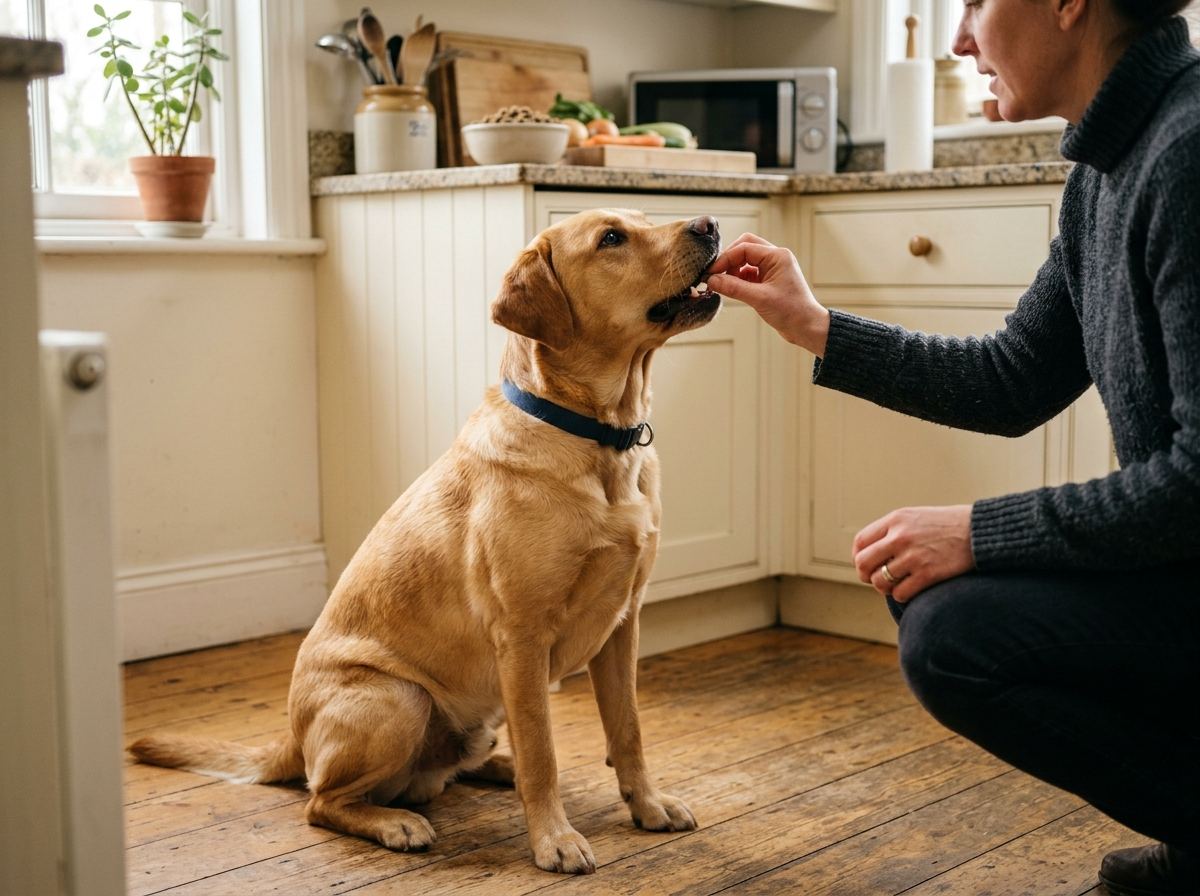
In the morning, or whenever you portion, that box is the budget. A meal is a portion from the box into a bowl. Training pay is a portion from the box into a pouch or a small tub. When you use cheese, meat, or a commercial training treat, those pieces still belong to the budget.
A Labrador who “just gets a few extras on walks” is the most common way I watch a lean dog go soft in six weeks. Nobody is lying. They are not measuring. The body condition page is the check. This page is the tap.
If you feed twice a day, you can train from the next meal. A short session before breakfast is not cruelty. It is a dog who can still eat. A session after a full bowl is why people say food does not work.
When does food stop working?
Four rooms, four different problems. The dog is not “lazy.”
The picture is too hard. The dog can eat cheese on the sofa and will not eat chicken at the park gate. That is not a food problem. That is distance, threshold, or a criterion you have not built. Move back until eating returns. Then train. If they cannot eat on a walk, see on-leash threshold.
The piece is dull for that room. Kibble is enough for a kitchen sit. It is often not enough for a new pavement. Step value up in the hard room, still from the budget, and step it down when you come home. Using steak everywhere is how you run out of a ladder.
The dog is already full. The pouch was generous, someone else fed a chew, a child fed the crusts. Count. If the box is empty, you are done paying with food for the day. Use a toy or end the session.
The body does not want food. Sudden refusal, with lethargy, vomiting, a painful belly, or a dog who cannot settle, is not a motivation lecture. Stop. See when to call the vet. I will not tell you to “make him hungry” through a medical problem.
A fifth, quieter room: the food has become a CS for frustration because you showed it, asked something impossible, and put it away. That is a pairing problem. Hide the food, ask something cheap, pay.
How do you measure without turning the house into a laboratory?
You do not need a spreadsheet. You need one cup or one scale and one box. The bag’s feeding table is a starting guess, not a law. Body condition is the law you can see. Public feeding guidance from the WSAVA Global Nutrition Guidelines treats diet as complete-and-balanced plus monitoring, not as a brand religion. Ask your veterinarian what belongs in the bowl. I will tell you how not to double it.
Practical rules I actually run:
- Pre-count the session. Twenty pieces in a pocket is a session. An open bag at your hip is a leak.
- Tiny pieces. A swallow, not a course. Fast delivery keeps the rate of reinforcement honest.
- Pay to the place you want. Drop between the paws for a down. Deliver at your seam for heel work. Do not make the dog jump at your fingers unless jumping at fingers is the criterion.
- Fade the lure. Showing food to get the sit is a prompt. Marking the sit and then paying is the loop. If the hand has to move first forever, you trained a follow, not a sit.
Is using food bribery?
Bribery, in the way people mean it, is showing the prize before the behavior every time, forever. Teaching is allowed to start with a lure. The job is to get the food after the behavior as soon as the dog understands the picture. A marker helps: the sound pins the sit, the food can arrive from the other hand.
I have heard “he should do it for me.” Dogs do things that pay. Praise is a pay if it has been paired with something that already matters, or if your attention is actually a prize for that dog. For most pet dogs, in most new rooms, food is faster and cleaner. Use it. Measure it. Do not moralise a piece of kibble.
Detection work taught me the same rule in a different jacket. The dog searches because the search pays. The handler who refuses pay and then leans on the lead is not more professional. They are running a different contingency and often a worse one.
What about chews, stuffed toys, and “free feeding”?
A stuffed toy can be the pay for a crate rest or a guest arriving. It still comes out of the day’s idea of food, even if you cannot weigh every smear of paste. Account for it roughly or your BCS will do the accounting later.
Free feeding (a bowl that is never empty) makes training pay invisible and makes toileting and body condition harder to read. If you have a medical reason to leave food down, that reason belongs to a veterinarian, not to this page. For an ordinary healthy dog I can train, meals and a pouch are the architecture.
What this page will not do
I will not tell you to fast a puppy to “build drive.” I will not publish a homemade diet. I will not join a grain-free argument. If the dog needs a medical diet, the clinician owns the bowl and I work with whatever they allow me to use as pay. That is the trainer and veterinarian hand-off, not a blog override.
Sources
WSAVA Global Nutrition Guidelines, owner-facing overview of complete-and-balanced feeding and monitoring. AAFCO consumer note on understanding pet food. Paraphrased as public standards. Ask your veterinarian for the bowl in front of you. wsava.org — global nutrition guidelines · aafco.org — understanding pet food
Questions on this page
Should training treats be extra on top of meals?
No. Measure the day’s ration and spend part of it on work. If you use richer pieces, subtract them from the bowl. Extras are how lean dogs become round dogs. A Labrador who “just gets a few extras on walks” is the most common way a waist disappears.
Why did my dog stop taking food in training?
The picture is too hard, the pieces are dull for that room, the dog is already full, or the body does not feel like eating. The first three are training logistics. A sudden stop, with other signs, is a veterinary question. Do not “make him hungry” through a medical problem.
Can I train with the dog’s ordinary kibble?
Yes, in a boring room, for easy criteria. Step the value up when the room gets harder, still from the day’s budget, and step it back down when you come home. Using steak everywhere is how you run out of a ladder.
How do I measure a ration if I use a pouch?
Measure the daily amount into a box in the morning. Meals and the pouch both come from that box. When the box is empty, feeding for the day is over unless a veterinarian told you otherwise. Pre-count the session. An open bag at your hip is a leak.
Is it bribery to show the food first?
A lure is a teaching tool. If the food has to appear before every sit forever, you never faded the lure. Mark the sit, then pay. The food follows the behavior. Dogs do things that pay. Do not moralise a piece of kibble.
Work with me
A $150 consultation or $500 monthly curatorship. Opens WhatsApp to Andrew.