
Expert Advice · Puppy · 13 min read
Puppy Crying in Crate During Naps: Protest vs Panic
Daytime crate crying is usually a nap set up wrong, not a stubborn puppy. Read the noise, fix the setup, open on calm.

Short answer
Most puppies who cry in the crate at nap time are not tired enough, need the toilet, or have not learned that a closed door in daylight is normal. Short, fading protest is fine to wait out quietly nearby. Panic — climbing volume, thrashing, drooling, food refused — is a stop: open, reset and make the next nap easier. Empty first, give a chew, stay in the room, and open only on a quiet moment.
A puppy who cries in the crate at nap time is telling you something about the nap, not about the puppy’s character. Most of the noise comes from four places: the nap started too early, the nap started too late, the bladder was not empty, or the crate is still a new room. Fix those first. An ignore contest at 2 p.m. is how a crate gets poisoned.
This page owns the daytime nap in the crate: why it gets loud, how to read protest versus panic, and a settle protocol. Night crying is a different job — it lives on crate training at night and the night crying classifier. The crate introduction lives on crate training. Why and when to put a puppy down lives on enforced naps. Barking to be let out after the nap lives on calm release.
Why does a puppy cry in the crate at nap time?
Daylight is loud. Night is easy by comparison: the house is dark, everyone is asleep, the puppy is tired. A daytime nap competes with children, the other dog, the doorbell, the courier, and you walking past with food.
The usual causes, in the order I check them:
- Too early. The puppy is not tired yet. Twenty minutes of awake time and straight into the crate is protest waiting to happen.
- Too late. The window ran long and the puppy is wired. An overtired puppy screams first and sleeps second. That is the same mouth that bites at 6 p.m.
- Bladder. The last toilet was a distracted sniff. The puppy needs to go and is right to complain.
- The crate is new by day. Night crate works, daytime closed door was never built. Different picture to the puppy.
- The room is a party. The crate faces the kitchen, the children, the other dog’s toy box.
- The release pays noise. Every time the puppy got loud, somebody opened the door. Now noise is the key.
Most homes have two of these at once. Fix the timing and the toilet first. They solve more crying than any trick.
Crying at nap time vs crying at night: what is different?
Same crate, same puppy, different problem. Most owners who search for crate crying mix the two, and the fix for one can make the other worse.
| Daytime nap | Night | |
|---|---|---|
| Usual cause | Not tired yet, overtired, full bladder, or a busy room | Toilet need, a new home, or sleeping away from people |
| Room | Light, noise, people moving past | Dark and quiet; the house is asleep |
| Where you are | In the room at first, then stepping out in seconds | Often beside the crate in the first weeks |
| Toilet response | Toilet before every nap; take out if the puppy wakes early and cries hard | Planned, boring trips; lead on, back to bed |
| Length | 30 minutes to two hours, by AKC’s range for puppy naps | The long block of the day |
| Main guide | This page | Crate training at night and the night crying classifier |
A puppy who sleeps well at night but cries at every daytime nap usually has a timing or room problem, not a crate problem. A puppy who cries at night but naps quietly by day usually needs a toilet trip or company, not a longer wait.
Protest or panic: how do you tell?
This is the decision that matters. The same word — crying — covers two different states, and they need opposite answers.
| Protest | Panic |
|---|---|
| Rhythmic whine or a few barks with gaps | Volume climbing, gaps gone, screaming |
| Fades within a few minutes if you stay boring | Gets worse the longer it runs |
| Can still take a chew or lick a food toy | Food refused, chew ignored |
| Body loose, lies down between bouts | Thrashing, biting the bars, claws at the door |
| No drool, normal breathing | Drooling, panting hard, overheating |
| Answer: stay nearby and boring, open on calm | Answer: open, reset, make the next nap easier |
Protest is a puppy saying “I would rather be out.” That is fine. It fades when nothing pays it. Panic is a puppy who cannot cope with the setup. Waiting it out teaches that the crate is where the world ends. Panic is a stop, every time.
If you cannot tell which one you are hearing, treat it as panic for this nap, and make the next nap easier: shorter, nearer to you, with the door open for the first minutes.
How do you settle a puppy who cries in the crate at nap time?
The settle protocol I run for daytime naps:
- Time the nap. End of a wake window, tired but not wild. For an eight-to-ten-week-old that is often 45–60 minutes awake; the numbers by age are on the nap clock.
- Empty first. Out to the named spot, stand still, pay the toilet. A US yard or a UK tray on a balcony, same commute.
- Quiet the room. TV down, other dog out, children busy elsewhere for the first ten minutes. A light cover on three sides if movement keeps waking the puppy.
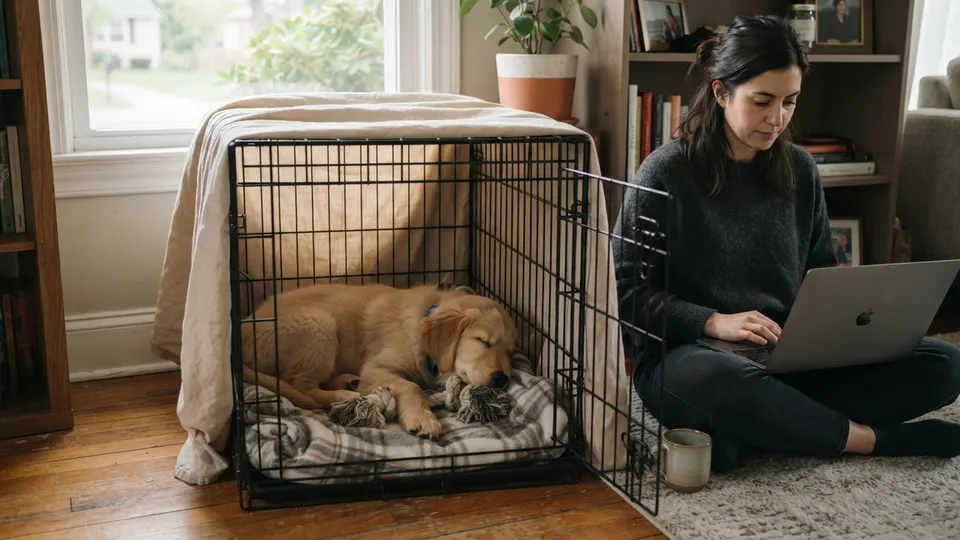
- Puppy in with a chew. Door closed on a puppy already inside and busy. You sit in the room with a book or a laptop. No talking, no eye contact games.
- Read the noise. Protest: stay boring, it fades. Panic: open, reset, try a shorter version next nap.
- Step out in seconds. Once the puppy sleeps, leave for a minute, come back, leave again. Build minutes by day, not hours.
- Open on calm. Wake, wait for a quiet gap, open, straight out to toilet. No party at the door.
Run this for a week. Most puppies go from five minutes of fuss to under one. If the crate still predicts panic after a week of honest timing and toilets, you do not have a nap problem. Go back to the crate introduction and build the closed door with meals first.
Seven-day nap plan for a puppy who cries in the crate
Use this when daytime naps are loud but the puppy is calm out of the crate. One step a day or two; repeat a day if the noise grows.
| Day | Door | You | Aim |
|---|---|---|---|
| 1 | Open; meals and a chew inside | Sitting beside the crate | The crate pays before it closes |
| 2 | Closed for one nap after a full toilet trip and a normal awake spell | In the room, reading | Protest under a few minutes |
| 3 | Closed for two naps | In the room, then out for a minute once the puppy sleeps | Puppy sleeps through your first exits |
| 4–5 | Closed for most naps | Out of the room for longer stretches while the puppy sleeps | Settles within a few minutes |
| 6–7 | Closed naps at the same times each day | Coming and going normally | Naps are routine, crying is rare |
Two limits stay in place all week. AKC advises never to leave a dog to cry it out, and Humane World for Animals advises that puppies under six months should not stay in a crate for more than three or four hours at a time. If whining starts as you add time, you probably added it too fast; Humane World makes the same point. Go back one day.
How long do you wait before opening the crate?
Watch the direction, not the clock. Protest that gets quieter is working. Noise that climbs for more than a couple of minutes is telling you the setup is wrong, not that the puppy needs a longer lesson.
Three rules for the door:
- open in a quiet gap — even two seconds of silence — not on the loudest bark
- if the puppy may need the toilet (woke after a short sleep, cries hard), take them out calmly, pay it, and bring them back for the rest of the nap
- if it is panic, open now. Do not wait for a gap. Reset and make the next nap easier
Opening on the loudest second teaches that noise opens doors. That is the whole subject of puppy barking in the crate to get out. Noise often gets worse for a day or two before it fades when it stops working — the extinction burst described on extinction bursts at the door. That burst is still protest. If it turns into panic, stop.
How long the nap itself can last is a separate number: the ceiling by age is on crate duration.
What setup stops crate crying before it starts?
- the crate has already paid with meals and chews, door open, for days
- it is the right size, with a divider so the back is not a toilet corner — crate size
- it sits in the room you live in by day, not a distant utility room — living room vs bedroom
- a light crate cover over three sides if the room is busy, never in heat
- a chew the puppy can safely work on, not stuffing or toys to shred
- the same nap times each day, so the puppy expects them
- a fresh toilet and a short wake window, every nap
Heat is a stop. A crate in a sun-room, a conservatory or a parked car is not a nap.
What if my puppy only naps on me or in the pen?
Fine for now. A lap nap is still a nap, and sleep matters more than location in the first weeks. But if every nap needs your body, you will run out of hands. Puppy only sleeps on me shows how to move rest off your lap in steps.
A pen is a good daytime nap space if the puppy actually sleeps there. Use it while you keep building the crate in short, easy steps. The trade-offs are on playpen vs crate. If the pen gets loud too, read puppy barking in the playpen — the causes are almost the same.
What not to do: steal closed-crate time the puppy has not learned because you need to cook. Use the pen for that hour. Keep crate work honest.
When is crate crying not a nap problem?
This page: a puppy who fusses at nap time, settles when the setup is right, eats normally, sleeps well at night, and is calm out of the crate.
Not this page:
- a puppy who cannot settle anywhere, even in a quiet room with you
- soiling the crate every nap — start with accidents in the crate
- distress only when the house is empty — that is a separation ladder, see first absences
- injury from the bars, broken teeth, bleeding gums
- crying with vomiting, diarrhoea, pain when touched, or a sudden change in behaviour
The last two are veterinary first — see when to call the vet. Training notes are not veterinary advice. For persistent distress, see a qualified trainer or a veterinary behaviour professional in your country. The AVSAB position statements sit behind the reward-based, management-first method on this site.
What are the usual failure modes?
- You crated a puppy who was not tired. Twenty minutes awake, then a closed door. That is protest you scheduled.
- You waited too long. The puppy was already wild. It screamed first and slept second. Shorten the window.
- You skipped the toilet. The crying was right. Empty first.
- You opened on the loudest bark. Now noise is the key. Open on a quiet gap.
- You treated panic as protest. Waiting it out taught that the crate is scary. Open, reset, go easier.
- You ran a night plan in daylight. Nights have their own classifier. Do not import it as a Tuesday afternoon character test.
- You put the crate in a party. Kitchen traffic and children at eye level. Quiet the room.
Give the protocol a week of honest timing, real toilets and a crate that already pays before you decide your puppy “hates the crate.” Most do not. They hate bad timing.
Sources
AVSAB position statements on humane, reward-based training. Paraphrased as public standards, not quoted as a substitute for reading the originals. Protest-versus-panic is a trainer’s classifier from the training floor, not a diagnosis. avsab.org/resources/position-statements/
- AKC — How to Crate Train Your Dog in 9 Easy Steps
- Humane World for Animals — How to crate train your dog or puppy
- AKC — How to Make Sure Your Puppy Gets Enough Sleep
Crate time limits and the advice never to leave a puppy to cry it out come from AKC and Humane World for Animals; nap length from AKC. Sources checked 17 November 2026.
Questions on this page
Why does my puppy cry in the crate during the day but not at night?
Daylight is busy. The house is loud, people move, and the puppy can hear the party it is missing. At night the whole house is asleep and the puppy is genuinely tired. Daytime naps need a quieter room, better timing and a puppy who is ready to sleep.
Should I ignore my puppy crying in the crate at nap time?
Ignore protest, not panic. Short, rhythmic fussing that fades within a few minutes while you sit nearby is fine to wait out without talking. Climbing volume, thrashing, drooling, overheating or food refused is panic. Open, reset, and make the next nap easier.
How long should I let a puppy cry in the crate before a nap?
There is no fixed number. Watch the direction, not the clock: protest that gets quieter is working; noise that climbs for more than a couple of minutes is telling you the setup is wrong. Most well-timed naps go quiet within about five minutes.
Does a puppy cry in the crate because it needs the toilet?
Often. A puppy who wakes after a short sleep and cries hard may need to go. Take them straight out, calmly, pay the toilet, and bring them back in for the rest of the nap. If the puppy is soiling the crate, see the accidents page before you build more duration.
Should I cover the crate for daytime naps?
A light cover over three sides can help a puppy who is woken by movement in the room. Keep the front open for airflow, never in heat, and remove it if the puppy chews it. Cover is a tool, not a fix for a crate the puppy does not know yet.
Is it better to use a playpen for naps if my puppy cries in the crate?
A pen is fine for naps while you keep building the crate in short, easy steps. Use whichever space the puppy actually sleeps in. Do not steal crate time the puppy has not learned yet just because you need to cook.
When is crate crying not a training problem?
When the puppy cannot settle anywhere, even in a quiet room with you, or when crying comes with vomiting, diarrhoea, pain when touched or a sudden change in behaviour. That is a veterinary conversation first. Distress only when alone in the house is a separation question, not a nap question.
Is crying in the crate at nap time the same as crying at night?
No. Daytime crying is usually timing, a full bladder or a busy room. Night crying is usually a toilet need, a new home or sleeping away from people. Fix nap timing here; use the night guides for nights.
How long should I let my puppy cry in the crate during a nap?
Watch the direction, not the clock. Short protest that fades is fine to wait out nearby. Noise that climbs for more than a couple of minutes, or any sign of panic, means open, reset and make the next nap easier. AKC advises never to leave a dog to cry it out.
Work with me
A $150 consultation or $500 monthly curatorship. Opens WhatsApp to Andrew.