
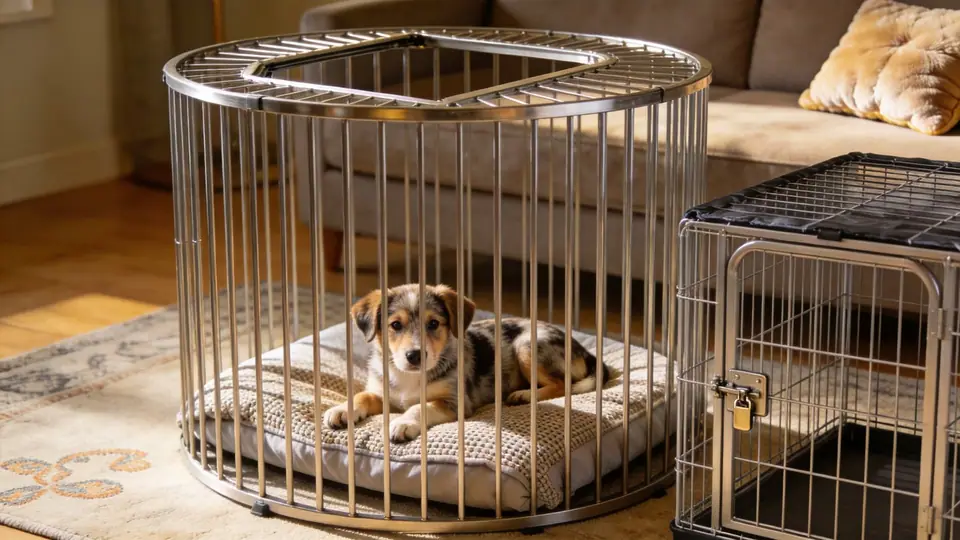
Expert Advice · Puppy · 8 min read
Playpen vs Crate: Which to Use and a Daily Playpen Schedule
A pen is for supervised awake time, the crate for sleep and travel. A sample playpen schedule, safe time limits and how to teach alone time in the pen.

Short answer
Use a playpen for supervised awake time and the crate for naps, nights and car trips. AKC says someone should be nearby when a puppy is in a pen. Build alone time in the pen slowly while you are home, and keep any time alone short: RSPCA advises no longer than four hours, and PDSA no more than three hours in a crate.
A playpen and a crate solve different problems. Crate training teaches the box: open-door meals, duration, calm release, protest versus panic. This page assigns jobs: when a pen is the better daytime management wall, when the crate fits sleep and transport, and how many houses run both without turning the pen into a sloppy overnight toilet.
I train on month-plus residential stays. I am not a veterinarian.
This is a puppy management page. Cross-link wire vs plastic crate for shell style, crate size and crate cover for the box itself, enforced naps and puppy day schedule for the rest loop, and baby gates when rooms need a wall instead of a ring of panels.
When is the pen the better daytime tool?
When the puppy needs space to play between naps without earning the whole flat.
A pen holds toys, a chew, and a puppy who is awake under your eyes. It blocks skirting boards and cables in the rest of the room. It does not replace a nap: overtired mouths still need the enforced naps rule. If you leave a pen unsupervised for hours with a chewing machine, you bought a larger destruction zone, not freedom.
A pen manages a wake window. It does not invent a sleep skill.
When does the crate keep the job?
Sleep stretches, car rides, and short dens where the criterion is settle, not roam.
Nights follow crate training at night and sleep through the night. Daytime rest periods often work better in the crate once introduction is cheap, especially if the pen stays exciting. Transport shells are almost always crates, not pens. Calm release still matters: see crate calm release. This site does not teach “ignore every cry” as a blanket rule.
How do you combine both?
Crate for off-switches. Pen for supervised on-switches. Gates for the rest of the house.
- Park the crate where nights already work, or inside a corner of the pen if space allows.
- Wake window: toilet first, then short play inside the pen or a gated room with eyes on.
- Nap: send to the crate with the same calm routine you already trained. Pen panels can stay up as a second wall.
- Kitchen and stairs stay behind baby gates so the puppy cannot rehearse counter surfing while you cook.
- If the pen becomes a toilet or a chew festival, shrink the wake window and return to the day schedule loop.
Management before manners is the household checklist. Pen versus crate is one line on that list, not a personality test.
A puppy playpen schedule for the day
A pen works best as the place for supervised awake time, with the crate (or a bed inside the pen) for sleep. AKC describes playpens as giving a puppy room to explore and play safely while you are busy around the house, big enough for water and toys, and says someone, preferably you, should be nearby when a dog is in one.
| Block | Where | Notes |
|---|---|---|
| Wake up | Straight out to the toilet | AKC: take young puppies out after naps and crate time |
| Breakfast | In the pen, from a bowl or puzzle feeder | AKC suggests feeding meals in the pen or crate so the puppy links it with good things |
| Awake time | Pen while you work nearby; out with you for play and training | One or two safe chews or toys, not the whole toy box |
| Nap | Crate, or a bed inside the pen | Use the wake-window chart for timing |
| Short absence | Pen with a food-stuffed chew | Build up from a minute or two; see below |
| Repeat through the day | Toilet, awake time, nap | Toilet trip every time the puppy comes out |
| Evening | Pen or gated room while you cook | Kitchen and stairs behind gates |
How long can a puppy stay in a playpen?
Longer than in a closed crate, but not all day. A pen gives more room to move, which is why AKC suggests an exercise pen or gated area rather than a crate for dogs that show anxiety when confined. Time alone is still the limit: RSPCA advises that dogs are left alone for no longer than four hours, and PDSA advises never more than three hours in a crate.
- Teach alone time in the pen while you are home. AKC suggests leaving the puppy with a chew, walking out of the room and coming straight back, then slowly building the time; at first even one or two minutes may be too long, but over three or four days many puppies build up to fairly long periods.
- If the puppy cries, AKC says the time was probably too long or started before the pen meant good things. Shorten it and build more slowly, rather than opening the gate on every cry.
- Choose the pen with teething in mind. AKC notes that plastic playpens are not the best choice for puppies, which may chew them while teething.
- Freedom comes in steps. AKC describes giving a puppy that is confident alone and house-trained access to the home one room at a time. More on that on when to stop crating.
US basement pen versus UK flat gated kitchen?
US (typical): spare floor for a roomy pen in a family room, crate for nights upstairs. Still gate the stairs.
UK (typical): smaller footprint. A compact pen in the living room plus a crate in the bedroom, or a gated kitchen doorway instead of a full pen ring. Same jobs, tighter furniture.
Neither layout makes the pen an overnight bladder solution without a plan. Accidents after a dry stretch need potty regression thinking and a vet check when medical signs appear.
If your puppy barks every time it goes into the pen, start with puppy barking in the playpen for the sleep, toilet and quiet-gate checks.
What are the usual failure modes?
- You cloned crate training into a pen essay. Jobs here; introduction there.
- Unsupervised pen for a workday. Larger chew zone, not management.
- Pen as the only overnight plan. Sleep protocols stay on crate and night pages.
- Ignore-all-crying advice. Not this site’s protocol.
- No gates on stairs or cooker. Pen is not the only wall.
Sources
AVSAB position statements on humane dog training. Management of the environment, enforced rest, and reward-based crate introduction are standard practice. Paraphrased as public training standards. avsab.org/resources/position-statements/
- AKC — Choosing the Right Playpen for Your Dog
- AKC — When Can Puppies Be Left Home Alone?
- AKC — How to Potty Train Your Puppy and Prevent Accidents Indoors
- PDSA — Crate training your dog
- RSPCA — How to train your dog to stay home alone
Playpen use and supervision, alone-time training and toilet timing follow AKC; time limits follow RSPCA and PDSA. The sample schedule is an editorial planning aid, not veterinary advice. Sources checked 21 November 2026.
Questions on this page
When is a playpen better than a crate during the day?
When you need a larger supervised zone with toys, a water bowl, and room to play between naps, while still blocking the rest of the house. A pen manages freedom. It is not a sleep protocol by itself.
When should you prefer a crate?
Sleep stretches, car and travel shells, and short rest periods where a smaller den helps the puppy switch off. Crate training owns introduction and the protest-versus-panic line. This page only assigns jobs.
Can you use both a pen and a crate?
Yes. Common pattern: crate inside or beside the pen for naps and nights, pen open for short wake windows under eyes-on supervision. Gates still block stairs and kitchens.
How is this different from crate training?
Crate training teaches entry, duration, and calm release. Playpen vs crate decides which furniture does daytime management versus sleep and transport. Do not treat the pen as a crate substitute for overnight bladder work without a plan.
Where do baby gates fit?
Gates close rooms and stairs when a full pen is too small or too large for the layout. See baby gates. Pen, crate, and gate are all management walls with different footprints.
What is a good playpen schedule for a puppy?
Toilet on waking, breakfast in the pen, supervised awake time in or out of the pen, a nap in the crate or a bed inside the pen, then repeat, with a toilet trip each time the puppy comes out.
Can I leave my puppy in a playpen while I am at work?
Not for a whole workday. RSPCA advises leaving dogs alone for no longer than four hours. Build alone time in the pen gradually while you are home, and plan visits or help for longer days.
Work with me
A $150 consultation or $500 monthly curatorship. Opens WhatsApp to Andrew.