
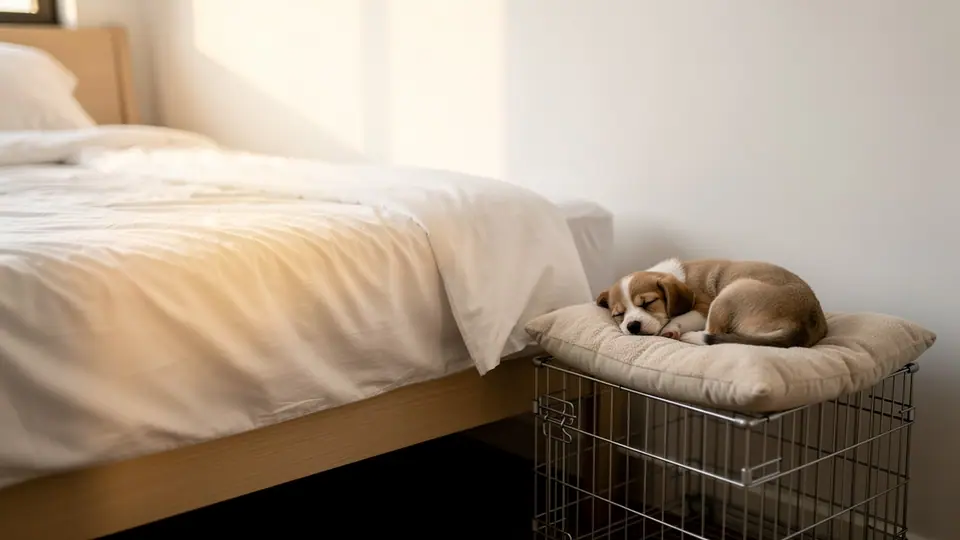
Expert Advice · Puppy · 16 min read
When Do Puppies Sleep Through the Night? Age Guide
When do puppies sleep through the night: dry until morning is the criterion. Nights 1–7 stay on the night page. This page owns stopping planned get-ups.

Short answer
Most puppies can sleep through the night (six to eight hours, dry, until your normal morning) somewhere between 12 and 16 weeks old. At 8–10 weeks, plan one or two quiet toilet trips. Drop the night trip only after a week of dry, quiet nights, and move the alarm later in 30–60 minute steps.
When do puppies sleep through the night? When the bladder can hold from lights-out to the morning wake you chose, and when several consecutive nights are already dry and quiet on the get-ups you still plan. For many households that lands around twelve to sixteen weeks for a six-to-eight-hour stretch. Some tanks get there earlier. Some need longer. Treat every number here as a working ceiling, not a veterinary certificate and not a dare.
This page owns the dry-morning criterion: when “through the night” is real, how you know, and how you stop planned middle-of-night trips without inventing grit. Nights 1–7 own bedside location, the ignore-versus-not classifier, and toilet trips in the dark. First night home owns arrival. Daytime rest that makes nights quieter lives on enforced naps and the puppy day schedule. If the crate is still a fight, or night one is tonight, start there. Come back here when the only question is: can we stop waking them?
When do puppies sleep through the night?
When the tank matches the stretch you actually ask for — and the puppy has already proved it on nights you still show up.
Rough overnight picture I run on the floor. Not research statistics. Not a breed promise. The puppy in front of you can undershoot every line:
- Eight to ten weeks. Plan get-ups. A three-to-five-hour first sleep cycle is common. Two trips on night one is not a failure. The night protocol owns how those trips look.
- Eleven to fourteen weeks. Many stretch toward five-to-seven hours if the evening was empty, calm, and the crate already predicts sleep. Some skip a planned trip. Some still need one. Data beats hope.
- Fifteen to sixteen weeks. A six-to-eight-hour stretch to a normal household morning is often legal. Still a ceiling. A late water bowl, a guest festival, or a missed enforced nap will steal it.
- Past four to five months. Most residential dogs I board overnight are dry to a morning wake if the evening plan is honest. Occasional lapses still happen. A sudden return of wet nights after weeks of dry is not “regression as personality.” Check the body and the evening loop.
Daytime bladder math (age in months plus one, in hours) is a day ceiling on crate duration. Night is often a little longer because a sleeping puppy is not eating, playing, or drinking. That does not turn an eight-week-old into an eight-hour project. It means you plan the stretch you can win, then raise it.
US house with a yard and UK flat with a lift use the same physiology. The furniture changes the commute length. It does not change when the tank is empty.
Through the night is a dry crate at the morning you already run — not a medal for twelve hours.
What does “through the night” actually mean?
Lights-out to the morning wake the household already uses.
If adults rise at 6:30, “through the night” is dry until 6:30. It is not “put them down at 8 p.m. and refuse to open until 8 a.m.” Manufacturing a longer night by shoving bedtime earlier usually buys a puddle and a puppy who learns the crate is where wetting happens. Shorten the ask, or keep one planned get-up, until the tank grows.
A win looks like this:
- last toilet was real, not a distracted sniff at the door
- crate dry at the morning open
- sleep was mostly quiet — protest that faded is fine; thrashing is not “they slept”
- you did not host a 3 a.m. play session and call it bonding
A miss looks like a wet bed, a scream-climb, or a puppy who only “made it” because you never checked. Checking on a planned alarm while you are still training the stretch is honest. Crossing your fingers is not a protocol.
Bedroom reality differs. A US master bedroom with space for a crate against the nightstand is easy furniture. A small UK room may put the crate at the foot of the bed or force a landing later — that move still waits for quiet nights on the night page. This page does not re-teach location. It only says: do not change location the same night you drop a get-up.
How do you know they are ready?
Consecutive quiet nights, a dry crate, and an interval that already fits.
Readiness is a picture you can see, not a birthday.
- Name the morning wake. Write the clock the household actually uses. That is the finish line.
- Keep one planned get-up until the puppy is dry and boring when you arrive. Empty on the trip. No corridor party. Back in. You lie down first.
- Collect several nights in a row. Dry crate. Mostly quiet sleep. Same evening plan. One lucky dry night after a chaotic day is noise. A week of the same picture is data.
- Match age to the stretch. If you are asking for seven hours from a nine-week-old, you are not ready — the tank is not ready. Raise the interval only inside a stretch the age band can plausibly hold.
- Change one thing. When you push the alarm later, leave crate location, evening guests, and water timing alone that night.
If you arrive at a planned get-up and the puppy is deeply asleep with a dry crate, that is the green light to start pushing the alarm — not a reason to skip the pre-bed toilet tomorrow to “test” them. Tests belong on carpet you intend to clean.
The day map still matters. A puppy who never truly naps is a worse overnight bet than a puppy whose evening ended with rest, a real toilet, and a boring wind-down. Sleep debt at 7 p.m. becomes noise at 2 a.m.
How do you stop the planned middle-of-night trip?
Raise the interval. Keep trips boring. Do not stack criteria.
You stop waking them the way you raise any other criterion: in steps you can win.
- Push the alarm later by thirty to sixty minutes once the old time is dry and quiet for several nights.
- If the new time is wet or frantic, drop back. You overshot. That is information, not moral failure.
- Keep any remaining trip a commute: lead, named surface (US yard through one door, or UK pad/tray if that is still the night toilet), stand still, pay the toilet, back to crate. See potty training for the learning rules. This page does not rebuild the toilet ladder.
- Last water earlier in the evening is management, not cruelty — within reason, and never as a substitute for a real last empty. Hot rooms and veterinary guidance beat a rigid bowl rule.
- Do not move the crate to the kitchen, landing, or spare room the same night you delete an alarm. Location is owned by crate training at night. Stacking both changes is how households create a fresh panic and call it “independence.”
One criterion a night. Interval or location — pick one.
If the puppy wakes and offers a clear toilet request before your new alarm, you still get up. Readiness is not a vow to ignore a full tank. The night classifier — protest versus toilet versus panic — stays on the night page. This page only decides whether you still set the clock.
When is overnight waking not just a young bladder?
When the picture is panic, medical, or a broken evening — not a tank that needs two more weeks.
This protocol: age-plausible stretch, calm evening, real last toilet, quiet dry nights building, puppy settles after a boring trip, no sudden change from last week’s pattern.
Not this protocol:
- climbing panic, thrashing, overheating, food refused in the crate — stop, reset; do not invent an ignore-crying contest here
- sudden wetting or screaming after weeks of dry mornings
- diarrhoea, vomiting, blood, a swollen belly, pain when touched, or a puppy who cannot get comfortable
- frantic hunger overnight after you skipped dinner timing or ran a sugar-rush evening (fix the evening loop, do not punish the mouth)
- a crate that is still socially poisoned from daytime exile — fix crate introduction before you argue about sleep length
Training notes are not veterinary advice. US owners can use ASPCA Animal Poison Control if a toxin is on the table. UK owners use their practice or a 24-hour service. See when to call the vet.
Public housetraining and crate overviews treat overnight rest as schedule-plus-management, not a character test. The AKC potty overview and the ASPCA house-training note put schedule and supervision first. The AKC crate overview keeps overnight near you while the puppy is young. Read them as public standards. This page is the dry-morning version from the training floor.
At what age do puppies sleep through the night? (quick table)
The table is the overnight picture I plan around when a puppy boards with me. It is a starting point for your plan, not a promise. Your puppy’s own dry nights overrule it.
| Age | Typical first stretch | What to plan |
|---|---|---|
| 8–10 weeks | 3–5 hours | One or two quiet toilet trips |
| 11–14 weeks | 5–7 hours | One trip, or a later alarm once nights are dry |
| 15–16 weeks | 6–8 hours | Often through to a normal household morning |
| 4–6 months | 7–9 hours | Through the night; lapses usually trace back to the evening |
Two things move a puppy up the table faster: a calm last hour before bed, and daytime naps that actually happen (see enforced naps). Two things move a puppy down: late water and excitement, and a crate that still feels like a punishment.
Why is my puppy still waking up at night?
Work through the list in order. Most night waking has a boring cause you can fix the same week.
- The last toilet was not real. A sniff at the door is not an empty bladder. Wait for the wee, pay it, then bed.
- The evening was a party. Guests, rough play or a late training session at 9 p.m. leave a puppy wired. Make the last hour dull.
- Daytime sleep was short. An overtired puppy sleeps worse, not better. Check the puppy day schedule.
- The night trip became fun. Chat, play or a snack at 3 a.m. teaches the puppy to wake up for it. Keep trips silent and short; the night toilet trips page shows the routine.
- Early morning is a different problem. If the puppy sleeps fine but starts the day at 5 a.m., read puppy waking up at 5am.
- Something changed in the body. Sudden wet nights after weeks of dry, diarrhoea, or a puppy who cannot settle is a call to your vet, not a training issue.
What are the usual failure modes?
- You treated a birthday as readiness. Age bands are ceilings. Consecutive dry quiet nights are the criterion.
- You asked for twelve hours. Through the night means your morning wake. Stretching bedtime to invent endurance usually invents a puddle.
- You dropped the get-up and moved the crate the same night. One criterion. Location waits.
- You skipped the last toilet to “see if they can hold it.” That tests the bedding. Empty, then sleep.
- You paid 3 a.m. with play. Boring commute or you trained a wake-up party.
- You ran a festival evening. Guests, late water, missed nap. Fix the day map and enforced naps before you blame the night.
- You called panic “not tired enough.” Wrong protocol. Open, reset. Classifier lives on the night page.
- You ignored a sudden change. Weeks of dry, then wet and frantic, is veterinary until proven otherwise.
There is no product on this page that buys a mature bladder. A fitted divider, a boring commute, and an honest evening are tools. They are not listed as affiliate URLs. The gear lab stays empty of sponsors on purpose.
Run the criterion for a real week — named morning wake, consecutive dry quiet nights, interval raised one step at a time — before you decide the puppy “will never” sleep through. If the crate is still a fight, you are on the wrong page. If nights 1–7 are still chaos, use crate training at night. If you just walked in the door with a new pup, use first night home. This page starts when the question is no longer how to survive the dark, but when the dark can go quiet until morning.
Sources
AKC, “How to Potty Train Your Puppy.” ASPCA, “House Training Your Dog or Puppy.” AKC crate-training overview for overnight rest near you while the puppy is young. AVSAB position statements as the reward-based, management-first background on this site. Paraphrased as public standards, not quoted as a substitute for reading the originals. This page is trainer protocol on the dry-morning criterion. It does not borrow a veterinary sleep study. akc.org — potty train a puppy · aspca.org — house training · akc.org — crate training step by step · avsab.org/resources/position-statements/
If the night is fine but the day starts at 5am, sort toilet need from habit with puppy waking up at 5am.
Questions on this page
When do puppies sleep through the night?
When the tank can hold from lights-out to the morning wake you chose, and the puppy is already dry and quiet on the nights you still plan a get-up. Many land near twelve to sixteen weeks for a six-to-eight-hour stretch. Some earlier, some later. These are working ceilings, not a medical timeline. A chart is not a dare.
What does “through the night” actually mean?
Lights-out to the morning wake you already run for the household — often six to eight hours, not a twelve-hour endurance test. A dry crate at that wake is the win. Stretching bedtime earlier to manufacture a longer night is a cheat that usually buys a puddle.
How do you know a puppy is ready to skip the night trip?
Several consecutive quiet nights, a dry crate when you arrive on a planned get-up, and an age interval that already fits the stretch you want. One lucky dry night is noise. A week of dry, boring get-ups is data. Then you raise the interval, you do not yank the crate to another room the same night.
How do you stop the planned middle-of-night trip?
Push the alarm later in small steps once the puppy is dry and quiet at the old time. Keep any remaining trip boring. Do not move the crate out of the bedroom on the same night you drop the alarm. One criterion at a time.
When is overnight waking not just a young bladder?
Panic, sudden wetting after weeks of dry, pain signs, diarrhoea, vomiting, or hunger from a wrong evening plan are not “push through it.” Manage, check the evening loop, and see a veterinarian when the body changed. This page is not a clinic.
Can an 8-week-old puppy sleep through the night?
Usually not for a full adult night. At eight to ten weeks most puppies manage a first stretch of three to five hours, so plan one or two quiet toilet trips. Skipping them tends to produce a wet crate, which makes the crate harder to love.
How many hours can a puppy sleep at night?
As a rough guide: three to five hours in one stretch at 8–10 weeks, five to seven at 11–14 weeks, and six to eight by 15–16 weeks if the evening was calm and the last toilet was real. Individual puppies vary, so watch your own puppy's dry nights rather than the chart.
Work with me
A $150 consultation or $500 monthly curatorship. Opens WhatsApp to Andrew.