
Expert Advice · Puppy · 7 min read
Puppy Won't Nap? Causes and a Calm Fix by Cause
A puppy who fights naps is usually overtired, overexcited, uncomfortable or not yet used to resting away from you. Find the cause, then fix that one thing.

Short answer
When a puppy won't nap, check five things in order: how long they have been awake, what happened in the last half hour, toilet and hunger, the rest spot, and health. Most refusals are an overtired or overexcited puppy who needs a toilet trip, a chew or lick mat and a quiet, dim rest spot with you nearby. You cannot force sleep, but you can make rest the easiest option.
What “won't nap” usually means
Young puppies need a lot of sleep. AKC describes puppies sleeping around 18–20 hours a day, with naps that may last from 30 minutes to two hours. So when a puppy refuses to rest, the problem is rarely that they do not need sleep. More often something is getting in the way: they have been awake too long, the room is too exciting, they need the toilet or they do not yet feel safe resting where you have put them.
This page is the diagnosis. The nap method itself lives on enforced naps, crying in the crate at nap time on puppy cries in the crate at nap, and nights on puppy won't sleep at night.
Five checks, in order
Run these before you change anything else. Most refusals are explained by the first two.
- How long has the puppy been awake? Compare with the wake window chart. A puppy well past their usual window often looks more energetic, not sleepier. Dogs Trust notes that puppies short of sleep often show zoomies, wanting to play and mouthing.
- What happened in the last half hour? Visitors, a car trip, a new place or rough play can leave a puppy too wound up to settle straight away.
- Toilet, food and water. A full bladder or an empty stomach makes rest hard. Offer a toilet trip before every nap and keep meals at steady times.
- The rest spot. Is it quiet, a little darker and comfortable? Is it somewhere the puppy already rests happily, or somewhere new?
- Health and comfort. Itching, an upset stomach, sore gums from teething or feeling too hot or cold can all stop a puppy settling.
Causes and the fix for each
| What you see | Likely cause | Try this |
|---|---|---|
| Zoomies, harder biting, barking at you, grabbing sleeves | Awake too long (overtired) | Toilet trip, then a chew in the rest spot with you nearby. Shorten the next awake spell |
| Wild after guests, a walk or a busy room | Too much going on (overstimulated) | Quiet room, a sniffing or licking activity for a few minutes, then rest. See overtired vs overstimulated |
| Whines, circles, sniffs the floor | Needs the toilet | Toilet trip first, then settle |
| Bouncy and alert, happy to play, last nap ended recently | Not tired yet | A little calm activity, then offer rest at the usual time |
| Settles with you, protests when you move away | Not used to resting apart | Rest spot beside you; build distance slowly. See puppy follows me everywhere |
| Cries or claws at the closed crate | Crate not yet comfortable | Use a pen or open crate for now and rebuild the crate introduction |
| Chews everything, mouths more than usual | Teething discomfort | Suitable chews, a lick mat, more rest. See the teething timeline |
| Restless, scratching, panting, or a change in eating or stools | Possible health problem | Talk to your vet |
You cannot make a puppy sleep. You can make rest the easiest thing to do.
How to help a puppy settle for a nap
Dogs Trust suggests encouraging rest rather than forcing it: calming activities such as long-lasting chews or things to lick, a sniffing game before rest, a quiet area that is a little darker, and a comfortable bed, blanket or open crate. AKC similarly recommends planning active time followed by quiet time, and showing your puppy where to sleep.
- End the awake spell on time. Toilet trip, then into the rest area before the puppy is frantic.
- Bring the energy down. Scatter a few pieces of food for a short sniffing game, or offer a lick mat or a safe chew.
- Dim and quiet the space. Lower the blinds, turn down the TV, keep children and other pets busy elsewhere for the first minutes. Some puppies settle better with a radio on quietly.
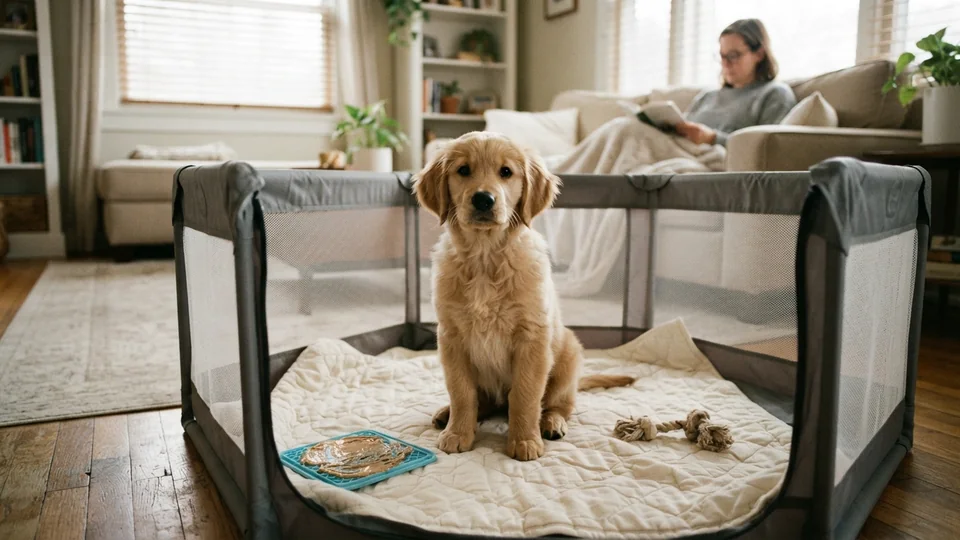
- Stay nearby at first. Sit with a book or laptop, no chatting. Many puppies settle faster when you are present and boring.
- Give it time. A puppy may fidget for a few minutes before falling asleep. If they are calmly chewing, that counts as rest.
- Let the nap run. AKC advises leaving a sleeping puppy alone rather than cuddling them awake. Take them out to the toilet when they wake.
Choose a rest spot your puppy accepts
The best nap spot is one your puppy already finds comfortable. PDSA recommends a bed or safe space in a quiet area where the dog won't be disturbed, several “snooze spots” around the home, and making sure everyone knows not to disturb a resting dog.
- Crate: works well once it is a familiar, comfortable place. See crate training.
- Pen: more space and often easier for puppies who dislike a closed door. See playpen vs crate.
- Gated room: a quiet room with a bed and a chew, good for older puppies.
- Beside you: a bed by your desk or sofa; useful while you build independence.
Avoid hot spots such as sunny windows or conservatories, and keep water available. Dogs Trust suggests keeping some water nearby during rest.
How nap refusal changes with age
| Age | Common reason for refusing naps | What usually helps |
|---|---|---|
| 8–10 weeks | Overtired after awake spells that run long; new home | Short awake spells, rest spot beside you, toilet first |
| 11–16 weeks | More interested in the world; first outings use up energy fast | Count outings inside the awake spell; calm activity before rest |
| 4–6 months | Teething, longer days, fewer planned naps | Chews, a protected midday rest, quiet time after walks |
| 6 months and older | Adolescent energy, following people around | Settle on a mat as a skill; see place |
Age schedules with sample nap times: 9 weeks, 11 weeks, 12 weeks and the puppy day schedule.
Mistakes that make naps harder
- More play to tire the puppy out. Often the opposite of what an overtired puppy needs.
- Shutting a frantic puppy in the crate. If they panic, open, calm down together and try an easier setup.
- Waking a sleeping puppy for cuddles or visitors. Broken naps add to the problem.
- A different rest spot every day. Predictable places help puppies settle.
- Expecting the same nap every day. Busy days and growth spurts change sleep. Look at the week, not one afternoon.
When to talk to your vet
Talk to your vet if your puppy cannot settle anywhere even when calm, fed and in a quiet room, seems uncomfortable, scratches or pants a lot, or shows changes in eating, drinking, toileting or energy. PDSA notes that pain and breathing problems can affect sleep and advises a vet check if sleep or behaviour changes. See when to call the vet.
Sources and scope
- Dogs Trust — Helping a hyper or restless dog to calm down
- Dogs Trust — Mouthing, nipping and biting
- AKC — How to Make Sure Your Puppy Gets Enough Sleep
- PDSA — Dogs and sleep: our top tips
Public welfare and veterinary guidance informs the safety context. Tables, sample days and step lists are editorial planning aids, not research findings, diagnostic tools or a substitute for individual veterinary advice. Sources checked 14 November 2026.
Questions on this page
Why won't my puppy nap during the day?
The most common reasons are being overtired after a long awake spell, too much going on in the last half hour, needing the toilet, a rest spot that is too busy or bright, and not yet being comfortable resting away from you. Check the clock first.
Should I force my puppy to nap?
You cannot make a puppy sleep. Dogs Trust puts it this way and suggests encouraging rest instead: a calming chew or lick, a sniffing game before rest, a quiet, darker area and a toilet trip first. An enforced nap means offering rest on purpose, not shutting a frantic puppy away.
How long should a puppy be awake between naps?
As a planning range, about 45–60 minutes at 8–10 weeks, 60–90 minutes at 11–14 weeks and 90–120 minutes at 15–16 weeks, counting meals and toilet trips. The wake window chart explains how to adjust.
My puppy only naps on me. Is that a problem?
Lap naps are fine sometimes, but a puppy who can only sleep on a person struggles when you need to move. Build rest in a pen or crate beside you a little at a time. See puppy only sleeps on me.
Is it normal for a puppy to skip a nap?
An occasional short or skipped nap is normal, especially on busy days. If your puppy regularly cannot settle anywhere, even when quiet and fed, or seems restless or uncomfortable, ask your vet.
Will more exercise make my puppy nap?
Not necessarily. A short play or sniff before rest helps, but Dogs Trust notes that puppies can struggle to rest if they get too much exercise and become overtired.
Work with me
A $150 consultation or $500 monthly curatorship. Opens WhatsApp to Andrew.