
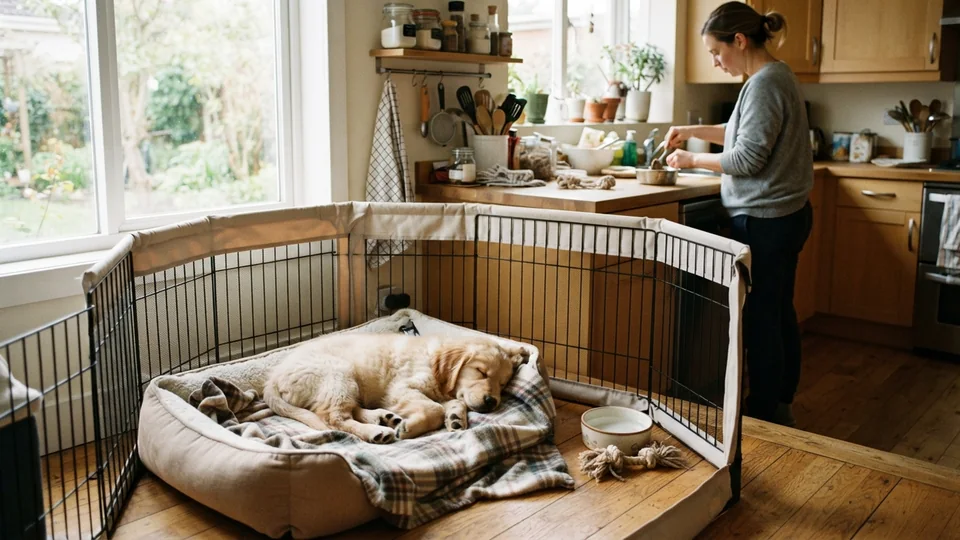
Expert Advice · Puppy · 7 min read
9 Week Old Puppy Schedule: Sample Day and Night
A sample day and night for a nine-week-old puppy, built on the same loop as week eight: toilet, short awake spell, nap, repeat.

Short answer
A 9 week old puppy schedule runs on short loops: toilet on waking, about 45–60 minutes awake including meals and toilet trips, then a nap. Most nine-week-olds still need three or four meals, a toilet trip after every sleep, meal and play, and one or two quiet toilet trips at night. Shift the times to your household and follow your puppy when they disagree with the clock.
What a 9 week old puppy schedule is for
Many puppies reach nine weeks during their first or second week at home. Some arrive at this age. Either way, the job is the same as at eight weeks: a predictable loop of toilet, a short awake spell and real sleep, with meals at steady times. The changes from week eight are small. Do not add new rules just because the puppy is a week older.
This page gives one sample day and one sample night for nine weeks. For the full shape of the day at other ages, use puppy schedules by age. The crate timetable for the first week sits on the 8-week crate schedule.
Sample day for a 9 week old puppy
This sample assumes the household wakes at 6:30. Move every time earlier or later to suit you. Keep the order and the gaps.
| Time | What happens |
|---|---|
| 6:30 | Wake. Straight to the toilet spot. Breakfast, then toilet again. |
| 7:00–7:30 | Short awake spell: a chew, a name game, exploring one room. |
| 7:30–9:00 | Toilet, then nap in the crate or pen. |
| 9:00 | Wake, toilet. Gentle play with a toy, a minute of handling with food. |
| 9:45–11:15 | Toilet, nap. |
| 11:15 | Wake, toilet, lunch, toilet. One to three minutes of training. |
| 12:00–14:00 | Long midday nap. |
| 14:00 | Wake, toilet. Food toy or sniffing game; a carried look at the street or garden if appropriate. |
| 15:00–16:30 | Toilet, nap. Add a fourth meal around 15:00 if your puppy eats four. |
| 16:30 | Wake, toilet, quiet play. |
| 17:00 | Dinner, toilet. |
| 17:30–19:00 | Early evening nap. This one prevents a lot of evening biting. |
| 19:00–20:00 | Wake, toilet, short play with a toy, calm time beside you. |
| 20:00–21:30 | Toilet, nap or quiet rest in the pen. |
| 21:30–22:30 | Quiet wind-down, last toilet around 22:15, bed at 22:30. See the bedtime routine. |
Your puppy will drift from these times. A nap that runs long is fine. A puppy who has been awake for more than an hour and is chewing your sleeves needs a toilet trip and a nap now, whatever the table says.
Wake spells and naps at nine weeks
The wake window chart gives about 45–60 minutes awake for puppies aged 8–10 weeks. Treat that as a planning range, not a target. Toilet trips, meals and any outing all count inside the same window. Many puppies manage a slightly longer first spell in the morning and a shorter one in the late afternoon.
AKC describes naps ranging from about 30 minutes to two hours. The midday nap is often the longest. Protect it on weekends as well as weekdays.
Signs that a nap is overdue include harder biting, zoomies, barking at you, grabbing the lead or trouser legs and not being able to settle with a chew. When you see them, end the spell with a toilet trip and rest. Enforced naps explains how to set up a nap a wound-up puppy will take.
Sample night at nine weeks
Most nine-week-old puppies still need at least one toilet trip at night. Plan it rather than waiting for a crisis. This sample matches the night crate plan.
| Time | What you do |
|---|---|
| 21:30 | Quiet last hour: a chew or lap time, no rough play |
| 22:15 | Last real toilet trip; wait for it and praise quietly |
| 22:30 | Into the crate or bed beside you; lights off |
| 1:30–2:30 | Planned toilet trip: lead on, toilet spot, straight back to bed |
| 4:30 | Only if the puppy wakes and asks; same quiet trip |
| 6:30 | Crate opens; straight out to toilet |
Keep night trips dull: low light, few words, no play. Move the planned trip later only after several dry nights. Night toilet trips covers when to stop setting an alarm.
Meals and toilet timing
Most puppies at nine weeks eat three or four measured meals a day. Feeding at the same times helps you predict when the puppy will need to go. If you change food, do it gradually and ask your vet if stools change.
Take your puppy to the toilet spot at these moments:
- straight after waking, before play or breakfast;
- after eating and drinking;
- after play and training;
- before every nap;
- regularly during awake spells, and whenever they sniff and circle.
Reward toileting in the right place straight away, then go back in for the fun part of the day. The method sits on potty training; timing and a log are on the potty training schedule.
Training and socialisation at nine weeks
Training fits inside awake spells in one- to three-minute pieces, two or three times a day. Good starting skills:
- the name game;
- a nose touch to your hand (hand target);
- going into the crate for a piece of food;
- a few seconds of gentle handling of paws and ears with food.
Socialisation at this age means short, calm experiences the puppy can enjoy: new floors, household sounds, a quiet visitor, watching traffic from your arms. AVSAB recommends early socialisation with appropriate health precautions. Ask your vet about public places while vaccinations are in progress, and use the socialisation schedule for ideas.
8, 9 and 10 weeks compared
| Area | 8 weeks | 9 weeks | 10 weeks |
|---|---|---|---|
| Main goal | Settling in, toilet spot, first nights | Same loop, steadier times | Slightly longer gaps, first calm outings |
| Awake spells | Short; many puppies fade quickly | About 45–60 minutes as a planning range | About 45–60 minutes, often nearer an hour |
| Night | One or two trips | One or two trips | Often one trip |
| Detailed guide | 8 week schedule | This page | 10 week schedule |
These are general patterns, not milestones your puppy must hit. A puppy who arrived at nine weeks may need a week of settling before any of the changes appear.
Common mistakes at nine weeks
- Treating the table as a contract. Follow the puppy's signs when they disagree with the clock.
- A long afternoon to tire the puppy out. This usually creates an overtired, bitey evening.
- Skipping the toilet before naps. The puppy wakes early and the crate gets wet.
- Several new things in one day. A first outing, guests and a longer crate nap together are too much.
- Free run of the house between trips. Use a pen, a gate or supervision until accidents are rare.
When to call your vet
Talk to your vet if your puppy pees very often in small amounts, strains, has diarrhoea or vomits, drinks much more than usual, stops eating, or seems unusually sleepy or unsettled. Put schedule changes on hold until you have advice. See when to call the vet.
Sources and scope
- AKC — How to Make Sure Your Puppy Gets Enough Sleep
- AKC — How to Potty Train a Puppy
- PDSA — First day and night with your puppy
- AVSAB — Position statements, including puppy socialisation
Public welfare and veterinary guidance informs the safety context. Tables, sample days and step lists are editorial planning aids, not research findings, diagnostic tools or a substitute for individual veterinary advice. Sources checked 13 November 2026.
Questions on this page
How long should a 9 week old puppy be awake?
As a planning range, about 45–60 minutes, counting toilet trips and meals inside that time. Offer rest sooner if your puppy starts biting harder, zooming or cannot settle with a chew. The wake window chart has ranges by age.
How much does a 9 week old puppy sleep?
A lot. AKC and PDSA both describe puppies sleeping around 18–20 hours a day, made up of night sleep and many daytime naps. Naps often last from about 30 minutes to two hours.
How often does a 9 week old puppy need to pee?
After every sleep, meal, play session and training session, and regularly during awake spells. There is no fixed number that fits every puppy. The potty training schedule covers timing and a daily log.
Can a 9 week old puppy sleep through the night?
Most cannot yet. Plan one or two quiet toilet trips and move them later only after several dry nights. See when puppies sleep through the night.
How many meals does a 9 week old puppy need?
Most puppies this age eat three or four measured meals a day. Follow the breeder, the food label and your vet for amounts, and keep meal times steady so toilet times stay predictable.
Can I take my 9 week old puppy outside?
Your own garden or yard is usually fine for toilet trips. Ask your vet when your puppy can walk on public ground. Until then, carrying the puppy to watch the world from a distance can be part of socialisation. See when puppies can go outside.
Work with me
A $150 consultation or $500 monthly curatorship. Opens WhatsApp to Andrew.