
Expert Advice · Puppy · 7 min read
Puppy Won’t Sleep at Night? Waking Causes and Checklist
Night noise is a signal. Note when your puppy wakes, sort toilet, tiredness, comfort and panic, and set the room up for sleep before you rewrite the crate plan.

Short answer
A puppy that won’t sleep at night is usually waking for one of a few reasons: a full bladder, an overtired or under-tired evening, discomfort, noise or light, or panic. Note when it wakes for three nights. AKC suggests a quiet, dim room, a toilet trip before bed and active time followed by quiet time. Waking many times to pee or drinking a lot needs a vet.
What “won't sleep at night” usually means
A puppy won't sleep at night is rarely one single failure. Night waking can be a toilet clock, a protest at confinement, an overtired “second wind,” or true panic. Your first job is a short checklist — not a brand-new method every night.
Keep the overnight clock on crate training at night. Keep age expectations on sleep through the night. Stay here when you need to sort why this night is loud.
Night checklist (run it once, in order)
- Toilet: last trip boring, leash on, no play. Young puppies still need night trips — see night toilet trips.
- Comfort: temperature, collar snag, empty water rules for your age plan, crate size that lets stand/turn/lie.
- Day debt: how many real naps happened? An overtired evening predicts night noise — use enforced naps.
- Put-down quality: same cue, dull room, no late wrestling.
- Sound type: protest that pauses vs panic that does not — map on crying in crate.
Day tiredness wrecks nights
If the puppy fought every nap and then “crashed” into a wild late evening, night sleep is already behind. Shorten wake windows. Protect one long midday nap. Pair this page with the puppy sleep schedule and wake windows by age.
| Evening pattern | Likely night result | First fix |
|---|---|---|
| Long late play, few naps | Second wind, crate protest | Earlier dull wind-down + more day sleep |
| Good naps, clear toilet | Short protest then settle | Stay boring; pay quiet pauses |
| Frantic clawing, no recovery | Panic, not stubbornness | Reset setup that session; rebuild value off clock |
| Whine → quiet → whine on a clock | Toilet or habit trip | Age-appropriate night toilet plan |
Why does a puppy keep waking at night? Causes by time
When the waking happens is the best clue. Write down the time for three nights before you change anything.
| When it happens | Most likely cause | What to try first |
|---|---|---|
| Within the first hour after bedtime | Not ready to sleep: overtired after a busy evening, or under-tired after a long late nap; protest at the put-down | A calmer last hour and a fixed wind-down; see the puppy bedtime routine |
| Around the same time every night, then settles after a trip out | Bladder | A planned, boring toilet trip just before that time; see night potty breaks |
| Restless, shifting, panting or digging at bedding | Too warm, too cold, or uncomfortable (teething, a full tummy) | Check the room and bedding; feed the last meal earlier |
| Wakes at every noise or with first light | Noise or light in the room | Quieter, darker room; for dawn waking see puppy waking up at 5am |
| Screams, claws, cannot pause | Panic, not sleepiness | Reset that night; see protest, panic or crate anxiety |
| Wakes many times to pee, drinks a lot, or a dry puppy starts wetting at night | Possible health problem | Vet check; PDSA advises contacting your vet if a dog is drinking or weeing more than usual |
Some waking is simply age. AKC gives a common guideline that a puppy can hold its bladder for about as many hours as its age in months, so a two-month-old puppy that wakes after a few hours to pee is not failing. Day sleep matters too: AKC notes that puppies usually sleep 18 to 20 hours a day, and Dogs Trust advises making sure a dog gets enough rest during the day so it does not get hyper from being overtired.
How do you set up the room for night sleep?
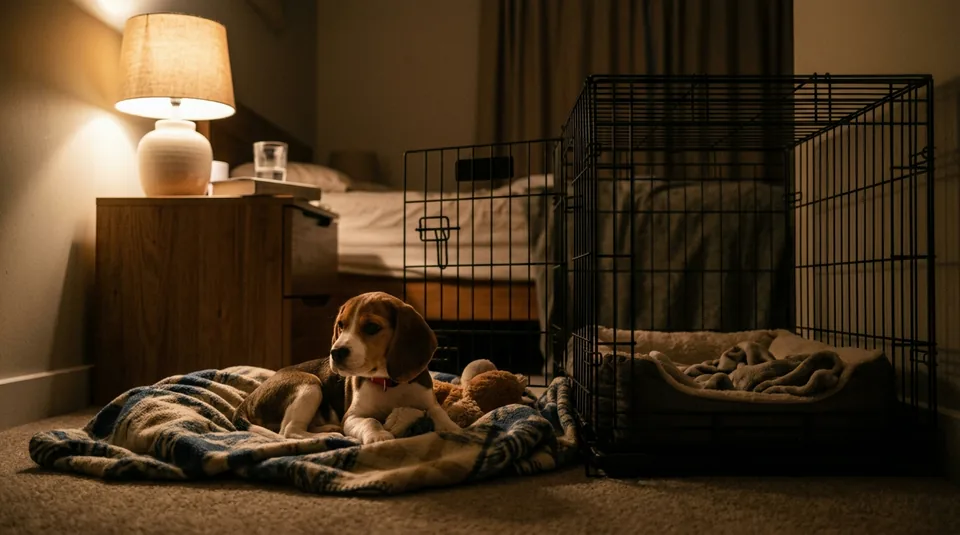
- Close to you at first. AKC notes that many owners put the crate in their bedroom so the puppy feels its family is close. Humane World suggests the bedroom or a nearby hallway at first, so you can hear when the puppy needs to go out. Placement details are on crate training at night.
- Quiet and dim. AKC advises keeping the sleep area quiet and dim, with blackout shades if the room gets early light, so dark and quiet become the cue for sleep.
- Toilet last. AKC suggests play, a cuddle and a trip outside to potty before bedtime.
- Active, then quiet. AKC suggests planning the day so active time is followed by quiet time for sleep. The same applies to the evening: the last half hour should be the dullest of the day.
Protest vs panic at 2 am
Give yourself a quiet minute after the toilet check. Protest can rise and dip. Panic does not organise — open, reset, and do not call that a character flaw. Full scoring lives on the crying pillar and the crate night classifier.
What not to do
- Open at the loudest second every night — that pays the scream.
- Add five new tools (cover, music, bed, snack, relocation) in one night.
- Skip daytime naps and expect silent nights.
- Treat every sound as “stubborn” without a toilet check.
When nights are a management choice
Some households choose a playpen, a bedroom floor bed, or a human bed for a phase. That can be valid management. Name it on purpose and keep toilet training consistent. For first-night chaos, start with first night home.
Sources
Practical overnight protocols from home puppy programmes; cross-check night crate and sleep-schedule articles on this site. Panic and illness signs are not solved by extinction on this page.
- AKC — How to Make Sure Your Puppy Gets Enough Sleep
- AKC — How to Potty Train Your Puppy and Prevent Accidents Indoors
- Dogs Trust — Helping a hyper or restless dog to calm down
- Humane World for Animals — How to crate train your dog or puppy
- PDSA — Why is my dog drinking lots of water and weeing more than usual?
Sleep totals, bladder guideline and room set-up follow AKC; daytime rest follows Dogs Trust; crate placement follows Humane World for Animals; drinking and weeing more than usual follows PDSA. The causes table is an editorial training aid, not a diagnosis. Sources checked 20 November 2026.
Questions on this page
Why won't my puppy sleep at night?
Common drivers: toilet need, overtired evening, under-tired late play, protest at alone-time, or true panic. Name the driver before you change five things at once.
Should I ignore night crying?
Not as a blanket rule. After a toilet check, brief protest can fade. Panic, injury signs or a puppy that never recovers between vocalisations needs a reset.
Is the crate the problem?
Sometimes the day is. Puppies who skip naps often explode at 9–11 pm. Fix daytime sleep with enforced naps, then reassess the overnight plan.
When do puppies sleep through?
Many stretch dry nights around three to four months. See the sleep-through age guide — this page is the checklist when nights are still noisy.
Do I need a cover on the crate?
Some puppies settle with a partial cover; others overheat or fuss. Test one change at a time. Details on the crate-cover page.
Can I bring the puppy into bed so everyone sleeps?
You can choose that management, but it teaches a different night job. Decide on purpose, not only at 3 am. See sleeping in your bed if that is the plan.
When should I call a vet or trainer?
If night distress pairs with illness signs, injury, or never improves with a sane schedule, get hands-on help. This page is training guidance, not a diagnosis.
Why does my puppy wake up at the same time every night?
Most often the bladder. AKC’s common guideline is that a puppy can hold it for about as many hours as its age in months. Plan a dull toilet trip just before that time and let the gap grow as the puppy gets older.
Should my puppy’s crate be in my bedroom at night?
At first it often helps. AKC notes many owners put the crate in the bedroom so the puppy feels close to its family, and Humane World suggests the bedroom or a nearby hallway so you can hear when the puppy needs to go out.
Work with me
A $150 consultation or $500 monthly curatorship. Opens WhatsApp to Andrew.