
Expert Advice · Puppy · 7 min read
Puppy Bedtime Routine: A Calm Wind-Down Plan
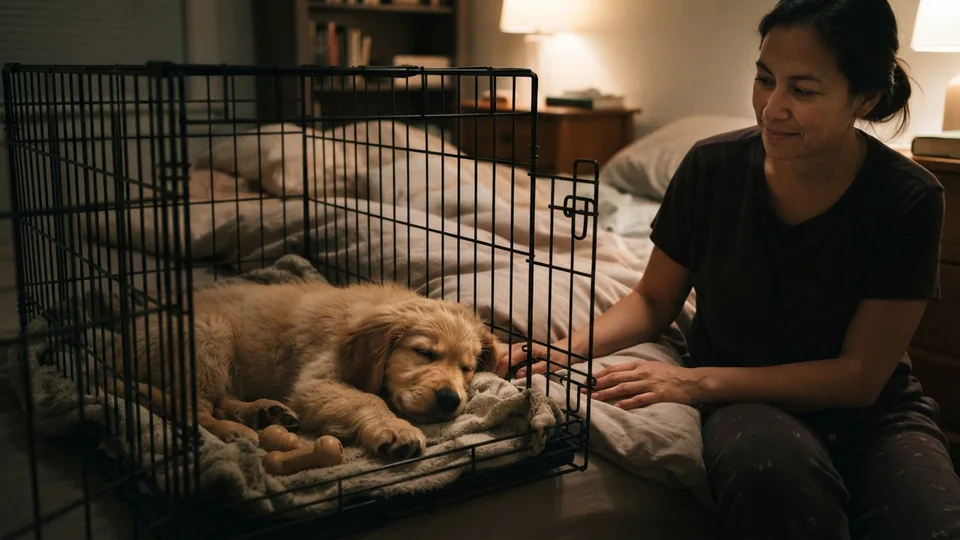
The same short sequence every night tells your puppy what comes next: last play, quiet hour, last toilet, bed beside you.

Short answer
A puppy bedtime routine is the same short sequence every night: dinner early enough for a toilet trip afterwards, a last spell of gentle play, a quiet hour with a chew, a real last toilet trip, then bed in the crate or pen near you with the lights down. Keep any night trips quiet and dull. Repeating the order matters more than the exact clock time.
Why a bedtime routine helps
Puppies learn from patterns. When the same few steps happen in the same order every night, the puppy starts to expect sleep at the end of them. PDSA recommends a set bedtime and a calm, consistent approach; AKC also recommends a bedtime routine from the start, with a toilet trip just before bed and a quiet, dim sleeping area.
This page covers every ordinary night. The very first night has its own hour-by-hour plan on first night home. If you use a crate, the night crate plan covers where the crate sits and how to handle crying. The 6–9 p.m. stretch, when many puppies get wild, is covered on puppy witching hour.
The routine at a glance
Count back from the time you go to bed. The minutes are a guide; the order is what matters.
| Before lights out | Step | Why |
|---|---|---|
| 2–3 hours | Last meal, then a toilet trip | Puppies often need to go after eating; better while you are still up |
| About 90 minutes | Short, gentle play with a toy, then toilet | Uses up energy before the quiet hour, not during it |
| About 60 minutes | Quiet hour: lights lower, a chew or lick mat, lap time or a slow sniffing game | Lets arousal settle before bed |
| About 60 minutes | Lift the water bowl, unless the room is hot or your vet advises otherwise | Less overnight volume |
| 10–15 minutes | Last real toilet trip; wait for it | An empty bladder is the start of a dry night |
| Lights out | Into the crate, pen or bed near you with a safe chew; you lie down too | The puppy can hear and smell you |
Same steps, same order, every night. That is the routine.
Step by step
- Feed dinner early enough. A meal straight before bed often means a toilet need soon after lights out. If your puppy has a late fourth meal, move it earlier.
- Have the last active play earlier in the evening. PDSA suggests a final play after the evening meal, stopping before the puppy gets overtired. Use a toy, not hands.
- Start the quiet hour. Dim the lights, turn the TV down and keep visitors and rough play out of this hour. Offer a chew or a lick mat. Chewing and licking help many puppies settle.
- Do a real last toilet trip. Go to the usual spot on lead and wait. Praise quietly. If nothing happens, come in, wait a few minutes and try once more.
- Settle in the bed. Put your puppy in the crate or pen with a safe chew and anything familiar, such as a blanket from the breeder. AKC suggests a soft but inexpensive blanket rather than a costly bed a puppy may chew. Then go to bed yourself.
- Keep night trips dull. Lead on, toilet, back to bed. Low light, few words, no play.
- Start the morning the same way. Open the crate and go straight to the toilet spot before greetings and breakfast.
How the routine changes with age
The steps stay the same as your puppy grows. What changes is how many night trips you plan and how late the bedtime can sit.
| Age | Night trips to plan | What to adjust |
|---|---|---|
| 8–10 weeks | Usually one or two | Crate or bed beside you; keep the evening very calm. See the 9 week schedule |
| 11–16 weeks | Often one, moving later | Move the planned trip later only after several dry nights |
| 4–6 months | Many puppies need none | Keep the routine; drop the alarm once mornings are dry. See sleeping through the night |
| Adolescents | Usually none | The quiet hour still helps excitable dogs settle |
Every puppy is different. Follow your own puppy's dry nights rather than the age column.
Where your puppy sleeps
Close to you at first. PDSA suggests sleeping in the same room for the first few nights while a puppy adjusts to being away from their mother and littermates. A crate or pen beside the bed lets you hear when your puppy needs the toilet. AKC notes that many owners keep the crate in the bedroom for this reason.
Move the crate further away only in small steps and only after quiet nights. Some families let the puppy sleep on the bed later; puppy sleeping in your bed covers the trade-offs. If your puppy will only sleep on you, see puppy only sleeps on me.
If your puppy cries at bedtime
Some protest in the first nights is normal. Check the toilet first. PDSA advises against leaving a puppy to cry it out and suggests calm, minimal comfort without play or lots of talking. Brief fussing that fades is different from rising panic. If crying keeps building, make the next step easier: crate closer, you nearby, door open for the first sleep cycle. The night crying classifier helps you sort the sounds, and puppy crying in the crate covers daytime crying too.
Troubleshooting
| Problem | Likely reason | Try |
|---|---|---|
| Wild burst of energy at bedtime | Missed evening nap or exciting last hour | Protect an early evening nap; move play earlier. See puppy zoomies |
| Cries the moment the lights go off | New routine, too far from you, or needs the toilet | Toilet check, then crate closer and calm comfort |
| Wakes at 2 a.m. and wants to play | Night trips have become fun | Make trips duller: lead on, no talking, straight back |
| Wakes very early | Full bladder, light or noise | See puppy wakes up early |
| Wet bed in the morning | Interval too long for the bladder | Add or move the planned night trip earlier; ask your vet if it continues |
| Will not settle at all | Overtired, unwell or anxious | See puppy won't sleep at night |
Make it the same for everyone
A routine only works if everyone runs it the same way. Agree who does the last toilet trip, who answers night wakes and what is allowed in the quiet hour. If one person plays at 2 a.m. and another does not, the puppy learns that waking up sometimes pays. If you share care, the shared puppy schedule helps split the jobs.
Bedtime mistakes to avoid
- Rough play right before bed. It leads to a second wind, not sleep.
- Skipping the last toilet trip to see if the puppy can hold it. That tests the bedding, not the puppy.
- Leaving a young puppy to cry it out. It can make them more anxious about being alone.
- Changing the routine every night. Different times and orders make bedtime harder to predict.
- Using bedtime as a punishment. The crate and bed should always predict rest, not trouble.
If your puppy suddenly sleeps much more or much less than usual, drinks a lot more or seems unwell, talk to your vet.
Sources and scope
- AKC — How to Make Sure Your Puppy Gets Enough Sleep
- PDSA — First day and night with your puppy
- PDSA — Vet Q&A: Why do puppies cry at night?
Public welfare and veterinary guidance informs the safety context. Tables, sample days and step lists are editorial planning aids, not research findings, diagnostic tools or a substitute for individual veterinary advice. Sources checked 13 November 2026.
Questions on this page
What time should a puppy go to bed?
Choose a time you can keep every night, usually when the adults go to bed. A consistent bedtime matters more than an early one. PDSA recommends a set bedtime because routine helps puppies settle.
Should I take water away before bed?
Many owners lift the water bowl about an hour before bed so the bladder is emptier overnight. Do not do this if the room is hot, your puppy has been very active or your vet has advised otherwise, and never restrict water during the day.
Should I play with my puppy before bed?
Yes, but earlier. PDSA suggests a last play after the evening meal, stopping before the puppy is overtired, then the final toilet trip. The last hour before bed should be quiet: chewing, lap time or a calm sniffing game.
Is it OK to comfort a crying puppy at bedtime?
Yes. First check whether they need the toilet. PDSA advises against leaving a young puppy to cry it out and suggests calm, minimal comfort, such as a hand on the crate or sitting nearby, rather than play or lots of talking.
Where should my puppy sleep?
For the first nights, close to you, often in a crate or pen beside the bed. Move further away gradually, only after several quiet nights. See crate training at night and puppy sleeping in your bed.
Why does my puppy get hyper right before bed?
Usually because an evening nap was missed or the last hour was too exciting. Protect an early evening nap and move active play earlier. See puppy witching hour.
Work with me
A $150 consultation or $500 monthly curatorship. Opens WhatsApp to Andrew.