
Expert Advice · Behavior · 9 min read
Dog barking for attention: how to stop demand barking
Demand barking works because it gets an answer. Take the answer away, give the dog a quiet way to ask, and plan attention before the bark.

A dog barking for attention is asking, and the bark keeps going because it gets an answer often enough. To stop it, take away the answer, give the dog a quiet way to ask, and plan attention, play and rest before the moments the barking starts. Expect it to get louder for a few days first; that spike is explained on why behaviour gets worse before it gets better. This page owns barking aimed at you inside the home.
I am Andrew Darov, a dog trainer. I am not a veterinarian. This is a behavior page about demand barking at owners.
What is attention barking?
If the bark gets a look, a word or a ball, the dog will keep using it. Make quiet the thing that works.
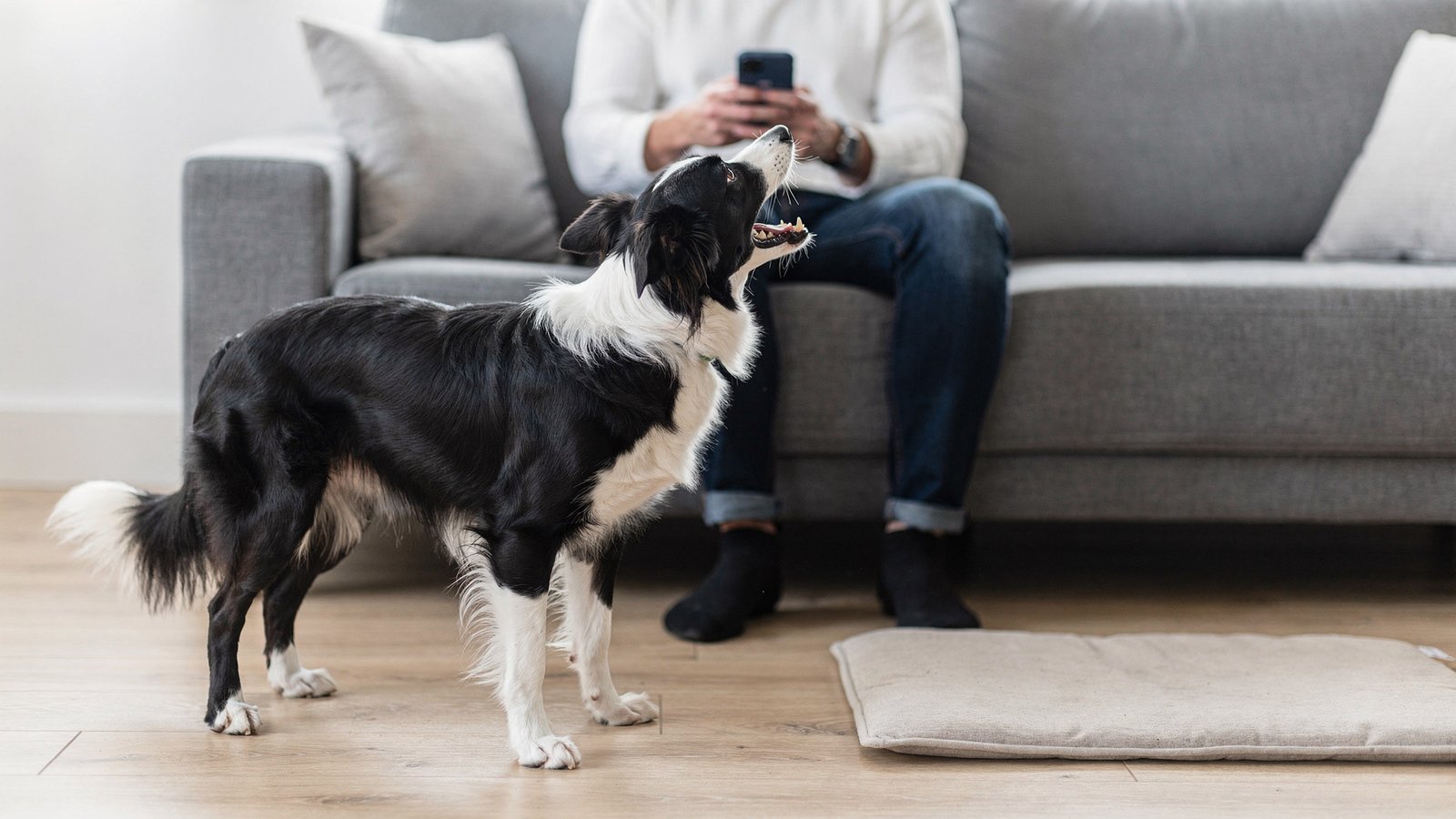
Demand barking is barking at a person to get something: your eyes, your hands, the ball, a seat on the sofa, a bite of dinner. It sounds sharp and repeated, the dog usually looks straight at you, and it often stops the moment you react.
It is different from barking at the window, the door or the street. Those are about something outside. Window barking has its own page on window barking, and night-time barking sits on dog barking at night.
Most dogs learn demand barking without anyone meaning to teach it. A “shh” is attention. Throwing the ball to get a minute of peace is a reward. Letting the dog onto the sofa to stop the noise teaches that noise opens the sofa.
How do you stop a dog barking for attention?
Work on four things at once. Each one alone usually fails.
- Find the hot spots. Keep a short log for three or four days: time, situation, what you did. Most dogs have two or three, such as phone calls, sitting down on the sofa, and family meals.
- Get ahead of them. Before the hot spot, give the dog what it needs: a sniffy walk, a short game, a chew or a five-minute training session. A dog who meets your call tired and busy has less reason to bark.
- Stop answering the bark. No eye contact, no words, no “quiet”, no ball, no sofa while the dog barks. Turn your back, or step behind a baby gate for a few seconds and return when the dog is quiet.
- Give the dog a quiet way to ask. Teach a sit, eye contact or going to a mat in calm moments. Then, at the hot spot, that quiet behaviour gets the attention, the game or the seat. Going to a mat is taught on place.
- Reward calm on the spot. When the dog lies quietly while you talk or eat, drop a reward between the paws with a soft word. Keep it low-key so you reward calm without starting a game. More on that on the calm reward page.
Everyone in the house needs the same rules. One person who answers the bark now and then keeps it going for everyone.
How do you handle calls, the sofa and dinner?
Phone and video calls. Before the call, give a stuffed food toy or long chew on the mat. For important calls, use another room or a gate for the first weeks. Short practice calls with a friend help: you talk, the dog stays on the mat, the dog gets a reward when you hang up.
The sofa. If the dog barks to come up, the sofa opens only after a calm sit or a mat. If the dog barks at you on the sofa for play, stand and leave for a few seconds, then come back. Some homes keep the sofa off-limits for a while so the rule is simple.
Family meals. A chew on a mat near the table, or the dog behind a gate with something to do, during the meal. Nobody hands food from the table. Meal manners have their own page on begging at the table.
US houses with open-plan living and UK flats with one main room both work with a gate and a mat. The smaller the space, the more the mat and chew matter.
Why does it get louder before it stops?
When barking stops working, many dogs try harder: longer, louder, more variety. That spike usually lasts days, not weeks. The risky moment is the loudest one. If you give in there, the dog learns that only the loudest barking works, and you end up with a bigger problem.
Plan for the spike. Pick a quiet week, warn the neighbours if you live in a flat, and have the gate and chew ready so you can hold steady.
When is the barking about something else?
Use a clear fence.
This page: a healthy dog who barks at you for play, food, the sofa or your eyes, and stops when you respond.
Look elsewhere: the dog needs the toilet, is hungry at a normal mealtime, cannot settle at all, seems in pain, or is an older dog who barks at night and seems confused. Sudden new barking in a quiet dog is a reason to ask your vet first. Barking with panic when left alone is a separation question, which starts on first absences. See when to call the vet.
What are the usual mistakes?
- Saying “shh” or “quiet” at every bark. To many dogs that is still an answer.
- Giving in at the loudest moment. That teaches the dog to start loud next time.
- Ignoring with nothing else on offer. A bored dog with nothing to do tends to bark harder.
- Rewarding calm with a big party. Keep calm rewards quiet so you get more calm.
- Different rules for different people. One family member who answers keeps the bark going.
- Shouting or spraying water. It can stop one bark and make the dog more worried or more excited later.
Use this page with why it gets worse before it gets better for the spike, place for the mat, and calm reward for rewarding quiet. More behaviour guides sit on the behavior hub.
Questions on this page
Why does my dog bark at me for attention?
Because it has worked before. A bark that gets a look, a word, a "shh", a throw of the ball or a place on the sofa is a bark that gets repeated. Most demand barking starts small and grows when people answer it some of the time.
Should I ignore attention barking?
Ignoring alone is rarely enough. Stop answering the bark, and at the same time give the dog a quiet way to ask and plan attention, play and rest before the usual bark time. A dog with nothing else to do tends to bark harder, not stop.
Why did the barking get worse when I started ignoring it?
A short spike is common when a behaviour that used to work stops working. The dog tries louder and longer for a few days. If you hold steady and reward quiet, the spike usually fades. If you give in at the loudest moment, you have taught the dog that louder works.
What should my dog do instead of barking?
Something quiet and easy that you can reward: a sit, eye contact, a nose touch to your hand, or going to a mat. Teach it when the dog is calm, then use it at the moments the dog used to bark.
When is barking at me not about attention?
When the dog needs the toilet, is hungry at a normal mealtime, is in pain, or is an older dog who seems confused or restless at night. Sudden new barking in a dog who was quiet before is a reason to ask your vet before you treat it as a habit.
Work with me
A $150 consultation or $500 monthly curatorship. Opens WhatsApp to Andrew.