
Expert Advice · Behavior · 13 min read
How to stop window barking without silencing the door
The window is a cinema. Close the view, move the sofa, then pay a look away. Door knock protocol stays separate.

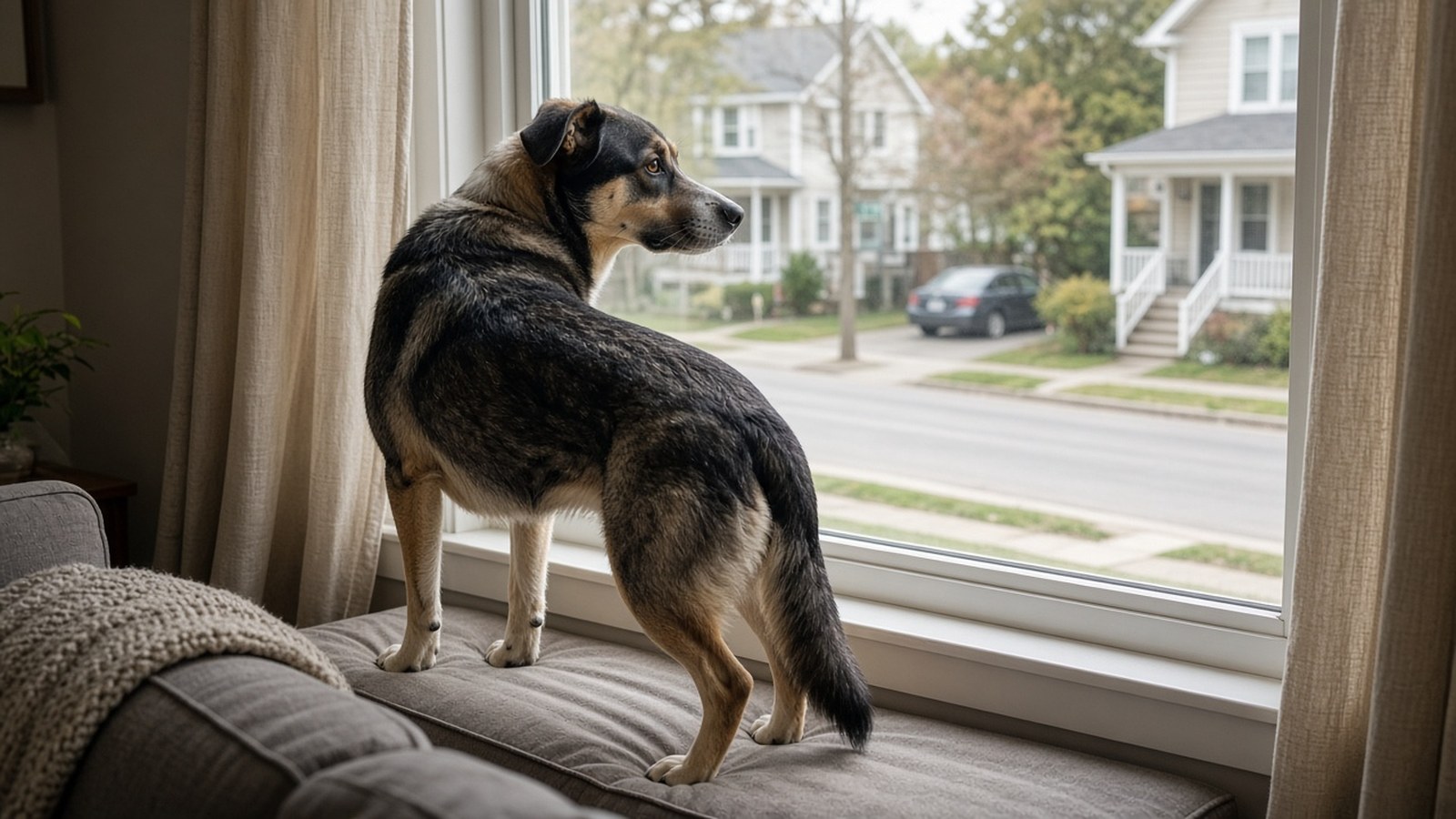
Window barking is unpaid sentry duty at glass. A passer-by, a bike, a cat on the pavement, a van that never knocks, and the dog barks. The person leaves. The bark “worked.” All afternoon. This page is how you stop that loop and teach a different job at the window. Door knock, latch, and doorbell stay on barking at the door. Cross-read that page for arrivals. Stay here for the street and the glass.
This is a behavior protocol. I work dogs in residential boarding for a month and longer. I am a professional trainer from Russia, not a veterinarian. I do not run aversives as a shortcut. The AVSAB position statements recommend reward-based work. Read them as a public standard.
How is window barking different from door barking?
Both are barrier barking. The trigger and the rehearsal schedule are not the same.
Door barking starts at a knock, a doorbell, footsteps on a landing, a hand at a letterbox. You can stage a knock. You can leash before the latch. Guests can be briefed. See barking at the door for that ladder.
Window barking starts at motion on the street. Nobody asks your permission. A US front-yard picture window and a UK street-level sash both give the dog a private cinema. The sofa faces the glass. The day-bed sits on the sill. The dog rehearse for hours while you answer email. That is not a knock protocol with a different title. That is a management and orientation problem at glass.
If the same dog also loses it at the latch, run both pages. Same gate can serve both. Do not merge the criteria into one vague “quiet” cue.
If the street can rehearse the dog all afternoon, you are hosting a loop, not running a session.
How do you manage a window so the dog cannot rehearse?
Manage before you teach. A real delivery van on a Tuesday is a test.
- Apply removable film or a frosted panel at dog height so silhouettes blur. A full blackout is fine when you cannot train.
- Move the sofa, armchair, or day-bed so the dog cannot sit with a clear view of the pavement.
- Close the sitting-room door when you leave the house or work in another room. Unsupervised sentry duty is unpaid practice.
- Give a legal chew or a stuffed toy in a room that does not face the street. See place if you already have a mat job.
- If the dog is already screaming at the glass, increase distance: another room, a crate you have already introduced, a baby gate. See crate training if the crate is still a fight.
US open-plan lounges with floor glass and UK flats with a single bay window use the same rule. Change the furniture. Hope is not film.
You cannot out-train a six-hour loop with a five-minute session. Management is the session until the view is honest.
How do you teach look-away or go-to-mat for window triggers?
Pick one job. A look back to you. Or a go-to-mat or bed away from the glass. Do not stack “sit, down, quiet, place” in one breath.
Stage a trigger you control. Ask a person to walk past once at a distance the dog can still eat. Or play a soft outdoor sound at low volume while the dog is already on a line. When the head turns toward you, or when the dog walks to the mat, mark and feed away from the window. The street predicted pay at the job, not a race to the glass.
Raise criteria in this order, and only when the current picture is cheap:
- Blurred silhouette behind film, you already present, food ready.
- A known person walking past at a distance you chose.
- A bike or a pushchair at a distance the dog can still take food.
- A clearer view for a counted few seconds, then film or curtain again.
- Real street traffic only after the staged picture is boring.
If you open the curtain on a busy pavement as the first lesson, you are hoping.
Food on the mat is useful when the glass is still hot. Measure it from the day’s ration. See food as a reinforcer.
If the dog is already over threshold (screaming, unable to eat), you are on on-leash threshold logic even indoors. Distance first. Close the room. Train later.
Should you shout quiet or use a bark collar?
No. This publication does not run aversives as a shortcut.
Shouting “quiet” after the bark has started is often a conversation the dog already wanted. A spray, a shock, or a vibration collar can suppress a bark and teach that the street predicts discomfort. Some dogs stop barking and start lunging harder at the next silhouette. That is not manners. That is a new problem.
The ASPCA overview of common dog behavior issues treats barking as a common, trainable problem with management in the mix. Read it as a source. This page is the window version: block the view, pay orientation away from the glass.
If a device advert promises to silence window barking in one session, treat that as a product, not a protocol. There is no affiliate URL on this page.
When is window barking not a manners problem?
Use a fence you can see.
This ladder: loose body, bark that stops when the view goes away or when food appears on the mat, able to take a chew in another room, no slam at the glass.
Not this ladder: a stiff body, a hard stare, a jump that cracks the pane, teeth at the glass, a dog who cannot come down even with the room closed, or a sudden new sentry in a dog who was quiet last month. Pain and medical change belong on when to call the vet before they belong on a bark ladder. See not veterinary advice.
True aggression and a child knocked at a window sill are not a weekend DIY project. Gate the dog. See a qualified professional in your country. Dogmindlab will not invent a triage inbox for that.
Door and window can share a mat job. If you already taught go-to-mat for knocks on barking at the door, you can reuse that mat for street silhouettes after the view is managed. Keep the triggers distinct in your own head: knock versus passer-by. The dog learns the job. You keep the staging honest.
What are the usual failure modes?
- The sofa still faces the street. Afternoon sentry duty will beat your evening session. Move the furniture.
- You merged window and door into one quiet cue. Different triggers. Keep door work on the door page.
- You shouted over the bark and called it a cue. You paid the sound. Teach a job before the trigger, or manage the view.
- You opened the curtain on a busy pavement first. That was a test you could not win. Drop to film and a staged pass.
- You bought a collar that hurts and called it five minutes. You taught that the street predicts pain. Rebuild with food and management.
- You trained while the dog had free glass access all day. Unsupervised rehearsal cancels the session. Close the room.
Sources
AVSAB position statements on humane dog training. ASPCA overview of common dog behavior issues. Paraphrased as public standards, not quoted as a substitute for reading the originals. avsab.org/resources/position-statements/ · aspca.org — common dog behavior issues
Questions on this page
How is window barking different from door barking?
Window barking is street surveillance at glass: passers-by, bikes, cats, delivery vans that never knock. Door barking is latch, knock, and doorbell. Same barrier learning, different trigger. Run door knock work on the door page. This page owns the glass and the street.
How do you manage a window so the dog cannot rehearse all day?
Film or frosted panel at dog height, a curtain you actually close, move the sofa off the sill, or shut the room when you cannot train. A US picture window and a UK street-level sash are both free rehearsals if the dog has a seat.
How do you teach look-away or go-to-mat for window triggers?
Stage a cheap trigger you control. Pay a head turn toward you or a walk to a mat away from the glass. Raise only when the current picture is cheap. You cannot out-train six hours of sentry duty with a five-minute session.
Should you shout quiet or use a bark collar at the window?
No. Shouting pays the sound with a conversation. Collars that hurt can suppress a bark and teach that the street predicts pain. This publication runs management and reward-based jobs. AVSAB’s public training position is the standard behind that.
When is window barking not a manners problem?
A stiff body, a hard stare, a slam that cracks the pane, teeth at the glass, or a dog who cannot come down even with the room closed. Manage, and see a qualified professional. Sudden new sentry work in a previously quiet dog is a veterinary question first.
Work with me
A $150 consultation or $500 monthly curatorship. Opens WhatsApp to Andrew.