Expert Advice · Skills · 7 min read
How to teach a dog paw (and use it for nail trims)
Paw, or shake, is an easy first trick that also has a real use: a dog that offers its paw on cue is easier to towel dry, check for thorns and get used to nail trims. Teach it with food in a closed hand, mark the lift, then fade the food and add a word.
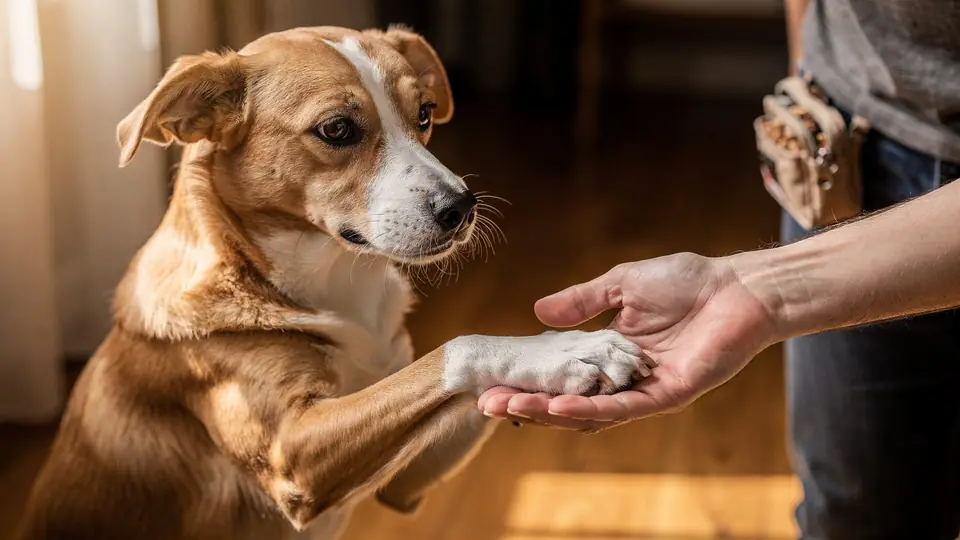
To teach a dog paw, hold a treat in a closed hand low in front of your sitting dog, wait for the paw to lift, mark it and reward. Then switch to an open palm, add the word “paw” or “shake”, and use the trick for towel drying, paw checks and nail trims. If you want the dog to touch your hand with its nose instead, that is a different skill on hand target.
I am Andrew Darov, a dog trainer. I am not a veterinarian. This is a skills page with plain, reward-based steps.
What do you need to teach paw?
A sitting dog, small soft treats, a floor with grip and five minutes. Paw is one of the quickest tricks to start.
- A sit. The dog should be able to sit for a few seconds. If not, start with how to teach a dog to sit.
- A marker word. A short word such as “yes” that means “that is it, food is coming”. More on markers and rules.
- Small soft treats. Pea-sized, so you can do many short tries.
- A quiet room and a floor with grip. A dog on slippery tiles may not want to shift its weight onto three legs.
Keep sessions short: two or three minutes, then a break. Several short sessions a day beat one long one.
How do you teach a dog paw, step by step?
- Hold food in a closed hand. Ask the dog to sit. Put a treat in your fist and hold it low, about the height of the dog’s chest and close to one front paw. Most dogs sniff, lick and nudge first. Wait quietly. Sooner or later the dog will lift a paw or scratch at your hand.
- Mark and reward the lift. The moment the paw comes off the floor, say your marker word and open your hand to give the treat. At first, even a small lift counts. Do five or six tries, then take a break. If the dog gets frustrated and starts biting your hand, hold it a little higher and reward sooner.
- Switch to an open palm. Once the dog lifts the paw quickly to your fist, hold out an empty open palm at the same height. When the paw lands in your hand, mark and reward from the other hand, which you keep behind your back. Now the dog is learning “put your paw in my hand”, not “dig food out of my fist”.
- Add the word. Say “paw” (or “shake”) once, then hold out your palm. Say it before the hand moves, not at the same time. After a few days of practice, the dog will start to lift the paw when it hears the word. Practise in different rooms, standing and sitting, and with other family members.
- Use it for paw checks. When paw is easy, keep the paw in your hand for one second, then reward. Build to two, three, five seconds. Then add small things: look between the toes, touch one nail, rub the paw with a towel. Reward each new step and go back one step if the dog pulls away.
How does paw help with nail trims and paw care?
Many dogs dislike having their feet held because a paw is picked up by surprise, held too long or trimmed before they are ready. Paw turns the start of that into the dog’s own choice: the dog offers the foot, you reward it.
Once the dog gives a paw on cue and holds it for a few seconds, you can follow the steps on the nail trim ladder: clippers in sight, clippers touching a nail, one nail, then more. For grooming, drops or vet exams, a chin rest gives the dog a way to stay still with its head, and paw gives you the feet. Both work better than holding a dog down.
Paw also helps after walks in the rain or snow. Ask for paw, wipe it with a towel, reward, ask for the next paw. A muddy-paw routine at the door is often the first place owners use it every day.
If your dog pulls its feet away, yelps or limps, or one paw is suddenly sensitive, stop and ask your vet. That is a health question, not a training one.
Can you teach both paws, or a high five?
Yes. Once one paw is solid, teach the other with its own word, such as “other” or “left”. Hold your palm closer to the second paw and reward only that paw. A high five is the same paw with your palm held up higher and facing the dog.
Keep paw to the floor for small or short-legged dogs, and for big dogs that could knock people over. Tricks should never ask a dog to hold its weight in a way that looks awkward.
What are the usual mistakes?
- Lifting the paw for the dog. The dog learns that hands grab feet. Wait for the dog to lift it.
- Saying the word over and over. Say it once, then wait. Repeating teaches the dog to wait for the third “paw”.
- Long sessions. A frustrated dog starts to scratch hard or bite at the hand. Stop after a few minutes.
- Rewarding paw you did not ask for. That is how a dog learns to paw at you for attention all evening.
- Jumping to nail trims too fast. Build the hold first, then add the clippers.
Paw is a quick, fun trick with a real job: it makes feet easier to handle. Teach the lift, move to an open palm, add the word, then build short holds. Next steps: nail trim ladder for clipping, chin rest for exams, and hand target for moving your dog with a touch. More on the skills hub.
Questions on this page
How long does it take to teach a dog paw?
Many dogs offer a paw lift within one or two short sessions of a few minutes. A clean paw on a word, in different rooms and with different people, usually takes a week or two of short daily practice.
What is the difference between paw and shake?
They are the same behavior with a different word. Pick one word and use it every time. Some owners also teach a second word for the other front paw.
My dog won't lift its paw. What can I do?
Make sure the dog is sitting on a floor with grip, hold the closed hand low, near the paw, and reward even a small shift of weight or a tiny lift. Bigger lifts come later.
How does paw help with nail trims?
A dog that puts its paw in your hand on cue is already used to the paw being held. You can then add short holds, a gentle squeeze and the sight of the clippers, one small step at a time.
My dog paws at me all the time now. How do I stop it?
Only reward paw when you have asked for it. If the dog paws for attention, stand up, turn away for a few seconds, then ask for a sit and reward that instead.
Work with me
A $150 consultation or $500 monthly curatorship. Opens WhatsApp to Andrew.