Expert Advice · Skills · 8 min read
How to teach a dog to back up: a simple step-by-step
Back up means the dog steps backwards, straight, away from you. Teach it in a narrow hallway or beside a sofa so the dog moves in a straight line, reward each step, add a hand signal and a word, then use it at doors, gates and in tight spaces.
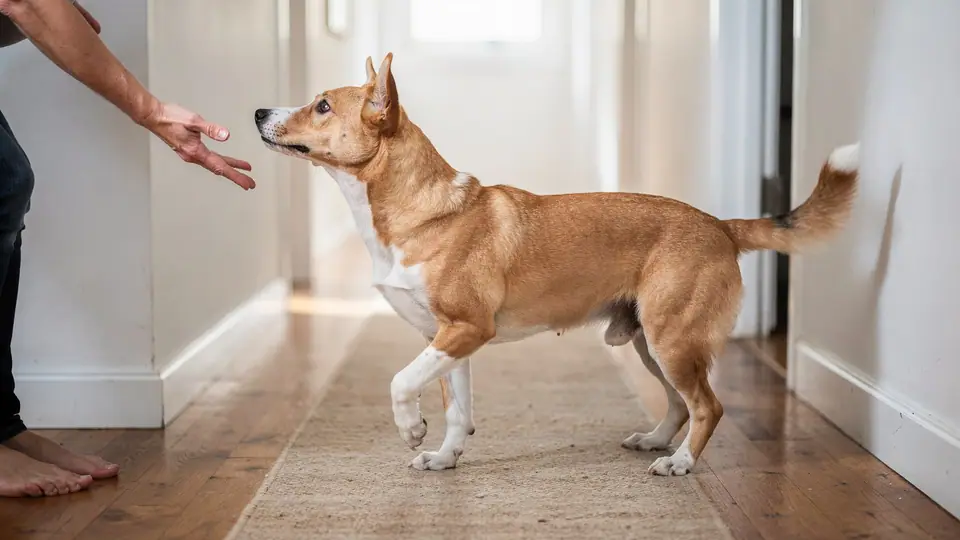
To teach a dog to back up, stand facing it in a narrow hallway, take a small step towards it, and reward the moment it steps back. Build to more steps, add a hand signal and a word, then use it at doors, gates and in tight spaces. Waiting calmly while a door opens is a different skill, taught on how to teach your dog to wait at the door; back up is how the dog makes room in the first place.
I am Andrew Darov, a dog trainer. I am not a veterinarian. This is a skills page for a simple, useful cue.
What is a back up cue for?
Back up means the dog steps straight backwards, away from you, until you say it can stop. It gives the dog a clear job when you need space.
Everyday uses:
- Doors and gates. The dog steps back so you can open an inward door without pushing it.
- Hallways and lifts. In a flat or apartment block, the dog moves back to let a neighbour pass. More on that is on apartment hallways and lifts.
- Carrying things. Shopping, laundry or a hot drink, with no dog under your feet.
- Crowding. The dog steps back from a visitor, a child or the kitchen counter.
- Body awareness. Many dogs have no idea what their back legs do. Backing up teaches them.
What do you need before you start?
- A narrow space: a hallway, the gap between a sofa and a wall, or two chairs in a row.
- Small, soft treats your dog likes.
- A marker word such as “yes” that the dog already knows means a treat is coming. If not, start with markers and rules first.
- A flat floor that is not slippery. A rug or runner helps.
How do you teach a dog to back up?
- Pick a narrow space. Stand in the hallway with the dog facing you, close enough to touch. The walls keep the dog straight, so it cannot turn round or swing its back end out.
- Step into the dog. Take one small, slow step towards it. Stand tall and keep your hands still. The moment the dog shifts its weight or moves a paw back, say “yes” and toss a treat behind it, between its back legs or just past them. The treat behind means the dog moves back again to eat it, and then turns to face you, ready for the next try.
- Build more steps. Once the dog steps back easily, wait for two steps before you mark, then three. Keep sessions to two or three minutes, five to ten tries, and end while the dog is still keen.
- Add a signal and a word. Add a small hand signal, such as a flat palm pushed gently towards the dog. When the dog moves back reliably to your step and signal, say “back” just before you step in. Over a few sessions, take a smaller step, then just lean, then stand still and only give the signal and the word.
- Use it in real life. Practise in other rooms, then in open space without walls, and then at the front door, the garden gate and in the hallway of your building. Reward every time at first, then every other time, and always say a release word such as “OK” when the dog can move again.
How can I use a target to teach back up?
Some dogs learn faster with a target. Teach the dog to touch your hand with its nose first, using the steps on hand target. Then hold your hand low and close to the dog’s chest, and move it slowly towards the dog. Many dogs step back to keep the hand in front of them. Mark the step and reward. Use whichever way your dog finds easier; you can mix both.
What if my dog sits or lies down instead?
That is very common, because sit and down have been rewarded so many times. Go slower and reward earlier: the first lean back, before the dog has time to sit. Toss the treat behind the dog so it stays on its feet. If it still sits, try a slightly narrower space and fewer tries in a row.
Is back up safe for puppies and older dogs?
Yes, in small doses. Keep it to a few steps on a flat, non-slip floor. Skip stairs, slopes and shiny floors. Puppies and heavy dogs tire quickly, so two or three short sessions a day are plenty. If your dog has back, hip or knee problems, seems stiff or sore, or suddenly struggles to step back, stop and ask your vet before you continue.
What are the usual mistakes?
- Pushing the dog back with your hands or knees. The dog learns to lean into you, not to move back.
- Starting in an open room. The dog turns or swings sideways. Use walls first.
- Waiting for many steps too soon. Reward the first step for several sessions.
- Feeding from your hand in front of the dog. It pulls the dog forward. Toss the treat behind it.
- Long sessions on slippery floors. Keep it short and give the dog grip.
Back up is a small cue that solves many tight moments at home. Pair it with wait at the door for doors and gates, use hand target if your dog likes to follow your hand, and see apartment hallways and lifts for flat life. More on the skills hub.
Questions on this page
Why teach a dog to back up?
A back up cue gives the dog a clear way to make space. It helps at doors and gates, in narrow hallways and lifts, when you carry shopping or a hot drink, and when a dog crowds visitors. Many dogs also find it a fun game.
How long does it take to teach back up?
Many dogs take one or two steps back in the first few short sessions. A smooth back up of several steps, on a word, usually takes a week or two of daily practice of a few minutes. Go slowly with puppies and older dogs.
My dog sits instead of backing up. What should I do?
Many dogs sit because sit has been rewarded so often. Walk into the dog more slowly, and reward the very first shift of weight backwards, before the dog has time to sit. Tossing the treat behind the dog also helps it stay standing.
My dog backs up crooked. How do I fix it?
Practise in a narrow hallway or between a sofa and a wall so the dog can only move in a straight line. Keep your own body square to the dog and walk straight towards it. Reward only straight steps for a while.
Is backing up safe for every dog?
Most dogs can back up a few steps on a flat, non-slip floor. Keep sessions short for puppies, heavy dogs and older dogs, avoid stairs and slippery floors, and ask your vet first if your dog has back, hip or knee problems or seems stiff.
Work with me
A $150 consultation or $500 monthly curatorship. Opens WhatsApp to Andrew.