
Expert Advice · Puppy · 8 min read
7 Week Old Puppy Schedule: Sample Day and Early Homecoming
A gentle sample day for a puppy who came home at seven weeks, with the checks to make first and why eight weeks is the usual minimum.

Short answer
Most guidance says puppies should stay with their litter until at least eight weeks, and in the UK it is illegal to sell younger puppies. If your seven-week-old is already home, book a vet check, keep the breeder’s food, and run a simple loop: toilet, a short awake spell, toilet, sleep. Expect four small meals, many naps, at least one night trip and plenty of accidents.
Is seven weeks too young to bring a puppy home?
Usually, yes. Most guidance puts the earliest good age at eight weeks:
- AKC says most veterinarians and breeders put the best age somewhere between 8 and 10 weeks, and that puppies should not go to their new homes until they are happily eating on their own.
- Cornell University's College of Veterinary Medicine says most breeders and veterinarians agree that eight weeks is a good minimum. It reports research finding that puppies separated from the litter too early are more likely to show fear, aggression, anxiety, resource guarding, reactivity and inappropriate play biting.
- The RSPCA says a responsible breeder will not hand a puppy over before eight weeks, and that in the UK it is illegal to sell a puppy younger than that.
- In the US, AKC notes that some states set a minimum age for selling puppies, usually at least eight weeks. Rules differ by state, so check yours.
Cornell explains why the extra week matters. Puppies learn bite inhibition from play with their littermates and mother, and they start learning to toilet away from where they sleep. Most are fully weaned between 7 and 10 weeks.
If you have not collected your puppy yet, ask the breeder or rescue whether the puppy can stay until at least eight weeks. A good breeder will not mind the question. Our questions to ask a breeder list can help.
If your puppy is already home, do not panic. Many seven-week-olds grow into well-adjusted dogs. You just have a little more to do: book a vet check soon, keep the routine very simple, and plan safe social time with calm, healthy, vaccinated dogs your vet agrees to. The rest of this page is for you.
What to do in the first days with a 7 week old puppy
- Vet check. Bring any vaccination and worming records. PDSA says puppy vaccinations usually start at about six to eight weeks, with two injections two to four weeks apart. Your vet will tell you what your puppy still needs. The RSPCA advises arranging vaccinations soon after arrival if they have not been done.
- Same food. The RSPCA advises feeding the same puppy food your puppy had before, with small regular meals. AKC says puppies at 6–12 weeks usually do well on four meals a day.
- Something familiar. The RSPCA suggests bringing a blanket from the first home, so your puppy has a familiar smell to sleep on.
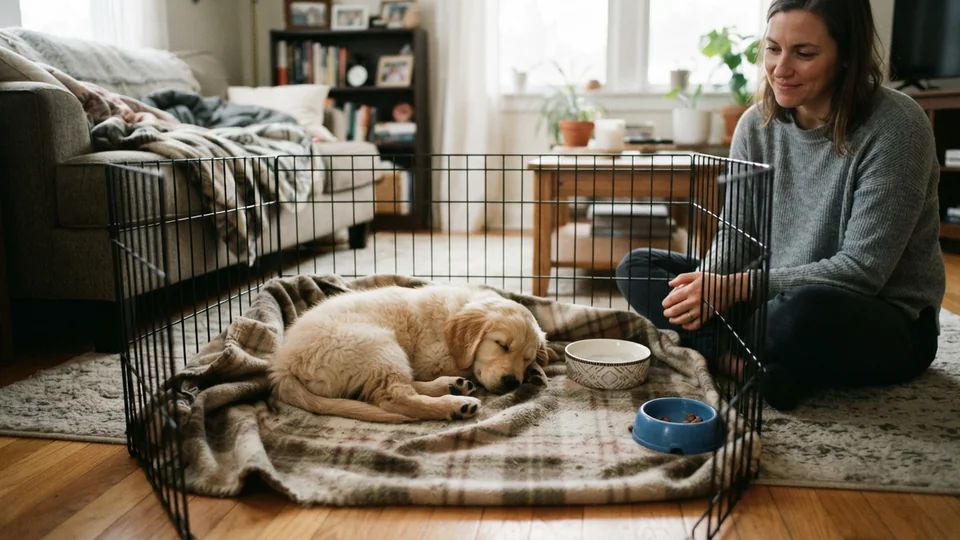
- One small area. A pen or one room with the bed, water and a toilet spot nearby. See the new puppy checklist.
- Sleep near you. A crate or bed beside your bed at night. The first night home plan works at seven weeks too.
Sample day for a 7 week old puppy
This sample assumes a 6:30 start. Shift the times to your household, but keep the order: toilet, a short awake spell, toilet, sleep. It is close to the 8 week old puppy schedule, with four small meals and awake spells kept short.
| Time | What happens |
|---|---|
| 6:30 | Wake, carry to the toilet spot, breakfast, toilet again. |
| 7:00–7:30 | Short awake spell: a little gentle play, a sniff around the pen, a cuddle. |
| 7:30–9:00 | Nap in the crate, pen or bed. |
| 9:00 | Toilet, short play, toilet. |
| 9:30–11:00 | Nap. |
| 11:00 | Toilet, second meal, toilet. One minute of the name game. |
| 11:45–14:00 | Long midday nap. |
| 14:00 | Toilet, third meal, toilet, gentle handling of paws and ears with food. |
| 14:45–16:30 | Nap. |
| 16:30 | Toilet, short play, toilet. |
| 17:00–18:00 | Nap. |
| 18:00 | Toilet, fourth meal, toilet, quiet time with you. |
| 18:45–20:30 | Evening nap. |
| 20:30–22:00 | Short quiet awake spell, last toilet, bed beside you. |
The awake spells in this table are short on purpose. This site's wake window chart starts at eight weeks, with about 45–60 minutes awake. At seven weeks, stay at or below the short end, and end the spell early if your puppy starts biting, crying or wandering. AKC describes puppies needing around 18–20 hours of sleep a day, with naps from about 30 minutes to two hours.
Toilet training at seven weeks
Expect accidents. A seven-week-old has a tiny bladder and is only starting to learn where to go. Take your puppy to the same spot:
- on waking, from every nap and in the morning
- after every meal and drink
- after play
- whenever they start sniffing or circling
Reward quietly the moment they finish. Clean accidents without fuss and never punish. Full details are on potty training and the potty training schedule. Ask your vet when your puppy can use public ground; until then use your own garden, yard or a tray (when puppies can go outside).
Nights with a 7 week old puppy
Plan for at least one toilet trip, and possibly two. Keep the crate or bed beside you so you hear when your puppy wakes. Make night trips quiet and boring: carry to the toilet spot, wait, praise softly, back to bed. No play. The crate training at night table for eight weeks is a sensible starting point; a seven-week-old may need the earlier trip. If you have not introduced a crate yet, a pen or a bed beside you is fine for now.
Socialising a puppy who left the litter early
A puppy who came home at seven weeks has had less time to learn from other dogs. AKC cites a socialisation period from about 6 to 12–14 weeks, and Cornell describes a critical window from about 5 to 14 weeks. Use it gently:
- Ask your vet which calm, healthy, vaccinated adult dogs your puppy can safely meet, and keep meetings short.
- Carry your puppy outside to see people, traffic and new places from a safe distance, as the RSPCA suggests for puppies who are not fully vaccinated.
- Teach a soft mouth early. When teeth touch skin, stop the game for a moment, then offer a toy (biting and nipping).
- Book a puppy class with your vet's advice on timing (puppy class timing).
The wider plan is on the puppy socialization schedule. Quality beats quantity: one calm, good experience is worth more than a busy day.
When to call the vet
Young puppies can go downhill quickly. Call your vet promptly if your puppy stops eating, has vomiting or diarrhoea, seems weak or very sleepy, or has trouble breathing. See when to call the vet. Training notes on this site are not veterinary advice.
Common mistakes with a 7 week old puppy
- Long awake spells. A tired seven-week-old bites and cries. Put them down to sleep sooner.
- Changing food on day one. Keep the breeder's food for now and ask your vet before switching.
- A welcome party. Visitors can wait a week.
- Leaving the puppy alone for long. Start alone time in seconds, while the puppy is sleepy (puppy alone training schedule).
- Waiting to socialise. Safe, gentle experiences start now, with your vet's advice.
Next week: the 8 week old puppy schedule and the first week home plan.
Sources and scope
- AKC — What’s the Best Age to Bring Your New Puppy Home?
- Cornell University College of Veterinary Medicine — How long should puppies stay with their mother?
- RSPCA — How to find a good puppy breeder
- RSPCA — Caring for your puppy, 6 weeks to 12 months
- AKC — Puppy Feeding Fundamentals
- AKC — How to Make Sure Your Puppy Gets Enough Sleep
- PDSA — Dog vaccinations
Public welfare and veterinary guidance informs the safety context. Tables, sample days and step lists are editorial planning aids, not research findings, diagnostic tools or a substitute for individual veterinary advice. Sources checked 16 November 2026.
Questions on this page
Is it OK to bring a puppy home at 7 weeks?
Most guidance says to wait until at least eight weeks. AKC puts the best age at 8 to 10 weeks, Cornell calls eight weeks a good minimum, and the RSPCA says selling younger puppies is illegal in the UK. If your puppy is already home, keep things simple and see your vet soon.
How often should a 7 week old puppy eat?
AKC says four meals a day usually suit puppies aged 6 to 12 weeks. Keep the same food the breeder used, as the RSPCA advises, and ask your vet before changing it.
How long should a 7 week old puppy be awake?
Not long. This site’s wake window chart starts at 8 weeks with about 45–60 minutes, so at seven weeks stay at or below the short end and put your puppy down to sleep as soon as they fade.
How much does a 7 week old puppy sleep?
A lot. AKC describes puppies needing around 18–20 hours of sleep a day, with naps from about 30 minutes to two hours.
Can a 7 week old puppy sleep through the night?
Usually not. Plan at least one quiet toilet trip, sometimes two, with the bed or crate beside you. See crate training at night.
Will a puppy who left the litter at 7 weeks have behaviour problems?
Not necessarily, but Cornell reports research linking early separation with more fear, anxiety and play biting. Use the socialisation window gently, teach a soft mouth and ask your vet about safe meetings with calm, vaccinated dogs.
Work with me
A $150 consultation or $500 monthly curatorship. Opens WhatsApp to Andrew.