
Expert Advice · Puppy · 12 min read
5 Month Old Puppy Schedule: Sample Day with Times
Five months sits between the tight four-month clock and early adolescence. Keep three naps. Stretch the wake windows slowly.

Short answer
At five months most puppies manage about one and a half to two and a half hours awake, still need about three daytime naps, and often still eat three meals. Plan toilet, a short walk or training, then a real nap. Teething may still chew — put a chew in every wake window. This is the bridge between the four-month and six-month clocks.
A 5 month old puppy schedule is the bridge most people skip. The four-month clock still feels right some days. The six-month clock looks tempting on others. Five months is neither. Wake windows stretch. Naps are still three for most puppies. Teething may still own the furniture. Drop naps too early and the evening blows up. Stretch walks instead of sleep and you build a fitter, louder adolescent. The day still runs the house.
This page owns the day at five months: the sample day, wake windows, naps, meals, teething and short training. The tighter clock lives on the 4 month old puppy schedule. The looser one is on the 6 month old puppy schedule. How to put the puppy down on purpose lives on enforced naps. Night crate work is on crate training at night. When a nap turns into crying, use puppy cries in crate at nap. The full puppy map is on Puppy.
What changes at five months?
Four clocks move. People notice the wrong one.
- Wake windows stretch. About one and a half to two and a half hours is legal for most five-month-olds. At four months it was closer to one to two.
- Naps still matter. Three daytime naps is still the working default. Dropping to two is a six-month conversation for many puppies, not a five-month birthday present.
- Teething can still chew. Adult teeth settle across months four to six. A legal chew in every wake window is part of the schedule, not a nice-to-have.
- Meals often stay at three. Some households move toward two. Do it over a week. Keep the times fixed.
- Bladder is longer, not unlimited. Many five-month-olds are dry overnight if the evening is honest. Accidents after long free roam still happen.
What does not change: the dog still needs most of the day asleep, still needs a toilet after sleep and meals, and still cannot learn through sleep debt. A US yard and a UK flat use the same clock. The commute changes. The rule does not.
What does a 5 month old puppy schedule look like? (sample day)
Here is a sample day for a five-month-old with one adult home most of the day. Shift the clock to your household. Keep the pattern: anchor, awake block, toilet, nap.
| Time | What happens |
|---|---|
| 6:30 | Wake, straight out to toilet, short sniff, breakfast |
| 7:00–8:00 | Short walk: 15–25 minutes, loose lead and sniffing; then a legal chew |
| 8:00–10:00 | Morning nap in crate, pen or bed |
| 10:00 | Toilet, 5–10 minutes of training (name, sit, hand target), find-it game |
| 10:30–11:00 | Quiet freedom in one room you can see, chew available |
| 11:00–13:30 | Long midday nap |
| 13:30 | Toilet, lunch or a food puzzle if still on three meals |
| 14:00–15:00 | Short outing or new place at a distance, play with rules |
| 15:00–16:30 | Late-afternoon nap (protect this one) |
| 16:30 | Toilet, calm greetings, short training or sniff walk |
| 17:30 | Dinner, then quiet chew — not a hallway ball game |
| 18:30–20:30 | Calm evening: place, family time on a lead or in the pen |
| 21:30–22:00 | Last real toilet, then bed at the same time each night |
That is roughly eight to nine hours of awake time on paper, split into short blocks. Most of it is quiet. Real exercise is two short walks and two tiny training blocks. The rest is sniffing, chewing and lying near you. That is the point.
Working away from home? Keep the same blocks around a midday visit — the workday puppy schedule shows the shape. Working from home? Put naps where your calls are on the WFH version.
How long should a 5 month old puppy be awake?
About one and a half to two and a half hours between rests for most puppies. A ceiling, not a dare. Soft companion breeds may be done closer to ninety minutes. Busy herding and gundog puppies can look fine at two and a half hours and then take the skirting board apart ten minutes later.
A wake window includes the toilet, the meal, the walk, the training and the play. It does not include “and then the garden centre.” Count the whole block.
The ladder I run when a five-month window ends:
- Read the stop cue. Mouth going up, zoomies that do not flop, chewing the house, refusing food, ignoring cues the puppy knew this morning. The window is over.
- End the activity. No “one more throw.” Fetch is not a nap. Hands quiet, voice quiet.
- Toilet. Out to the named spot. Pay it. A full bladder makes every nap short.
- Rest place with a chew. Crate, pen or bed the puppy already settles on. Door closed if that is what the puppy is used to. Stay boring nearby for the first minutes.
- Wake to a toilet. Then a little freedom in a room you can see. Not a rematch.
Age numbers sit on the enforced nap clock. Total sleep by age is on how much do puppies sleep. This page uses them; it does not repeat them.
How many naps does a 5 month old puppy need?
Usually three. Morning, long midday, late afternoon. The late-afternoon nap is the one people drop first, and it is the one that buys a quiet evening.
How to fade a nap without paying for it at 7 p.m.:
- drop the shortest nap first, not the one that is inconvenient
- replace it with a calm hour — a chew on a bed in the room with you — not with more activity
- keep the change for a full week before you judge it
- if biting, zoomies or destruction come back in the evening, put the nap back for a week
- never drop a nap and stretch a walk in the same week — you will not know which one broke the evening
From enforced naps to optional naps is a gradual slide most puppies finish between about five and seven months. Five is early in that slide. Readiness signs live on enforced naps: lies down on their own, calm evening, takes a chew with the door open.
A puppy who used to sleep and now fights every nap may be in a short wobble — see puppy sleep regression. If the puppy cries in the crate at nap time, classify protest vs panic on puppy cries in crate at nap before you scrap the schedule.
Teething, meals and training on the 5 month clock
Five months still has a mouth in it. Adult teeth are arriving or settling for many puppies — the puppy teething timeline shows why this month often feels busier than four — so chewing is a scheduled job, not a surprise you handle after the shoe is gone. Training stays short. Meals still hold the toilet clock. Walks stay shorter than your neighbour thinks. This section layers those jobs onto the sample day above; it does not replace the nap skeleton.
Teething belongs in every wake window. Put a legal chew down before you need it: after the toilet, after breakfast, before you sit down to work. Frozen washcloths, rubber chews sized so they cannot be swallowed, and a stuffed Kong are tools. Hands and shoes are not. If teeth come up on skin, end the hand game once and offer the chew. If it happens again in the same window, the window is over — put the puppy down. That rule lives next to when do puppies stop biting; do not wait for an evening blow-up to start using it.
Training is two or three sessions of five to ten minutes, not a weekend seminar. Name, sit, hand target, and a short loose-lead loop in the garden or hallway are enough for a five-month day. Pay the basics at home before you raise criteria on the pavement. A full age map sits on the puppy training schedule by age. If the mouth is busy or the eyes glaze, stop. A sloppy five-minute session taught while the puppy is sore and tired is how you rehearse ignoring you.
Meals: stay on three unless you have a reason to change. Three meals still fit most five-month-olds and keep hunger, toilet timing, and evening arousal steadier than a sudden jump to two bowls. If you move toward two, shift over about seven days: slide lunch later, then smaller, then into dinner. Watch stool, scavenging, and whether 5 p.m. turns into a shark. Food is an anchor, not only calories. Do not change meals and nap count in the same week. Training notes are not veterinary advice; a diet change that worries you belongs with your vet.
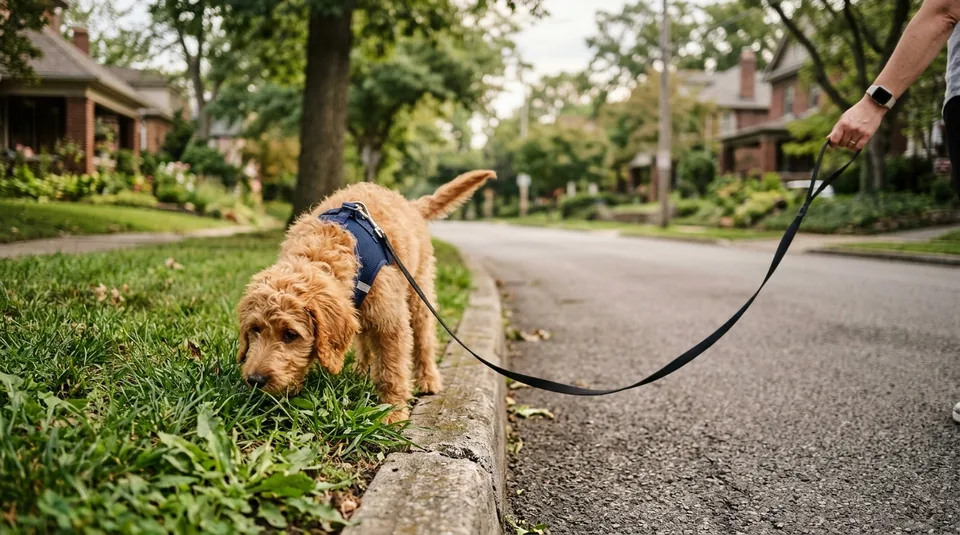
Walks stay shorter than the internet suggests. Twenty to thirty minutes of loose-lead sniffing, two or three times a day, beats an hour of pulling. Joint questions for large or giant breeds are a vet conversation — this page does not publish a kilometre formula. Detail by age is on walk length by age. Sniffing on a long line tires a young brain faster than distance, and it does not pick a fight with growing bones the way a forced march does.
Use the table as a scan of the day. Times follow the sample schedule above; move the clock, keep the jobs. This is the bridge between the 4 month old puppy schedule and the 6 month old puppy schedule. At four months the mouth is often worse and the wakes are shorter. At six months adolescence gets louder and many puppies fade a nap. At five months you stretch slowly, keep three naps, and treat chewing as work you planned.
| Time of day | Teething need | Training block |
|---|---|---|
| Morning wake (after toilet and breakfast) | Legal chew after the short sniff walk, before the morning nap | None yet — let the first meal land; save the brain for the next wake |
| Mid-morning (~10:00) | Chew available during quiet freedom in one room | 5–10 minutes: name, sit, hand target |
| After lunch (~13:30–15:00) | Chew in the car or after the outing; end mouthing on the lead | Short loose-lead loop or a new place at a distance; play with rules |
| Late afternoon (~16:30) | Chew before family chaos starts | Optional second 5–10 minutes (hand target, a name game) or a sniff walk |
| Evening after dinner | Chew, not a hallway ball game | Optional third short session only if the puppy is still soft; otherwise settle on a mat |
| Last hour | One more chew while the house goes dull | No new cues — last real toilet, then bed |
If teeth and training fight each other in the same five minutes, the chew wins and the session waits for the next wake. A five-month-old who practices sit on a sore mouth and then bites your sleeve did not “forget” the cue. The window was too ambitious.
Is the crate still part of the 5 month schedule?
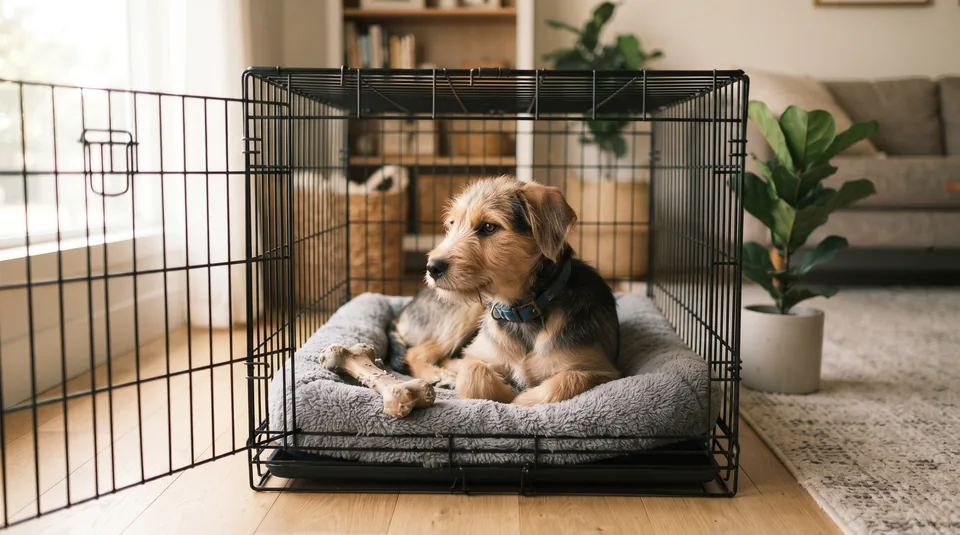
Yes for most households — for naps and nights. Five months is not a crate-free birthday. A crate is a sleep shell. A dog that sleeps well in it has no reason to lose it yet.
Night work: same last toilet, boring bedtime, ignore protest that is not a toilet need. The night protocol is on crate training at night. Readiness to open the door more often is dry mornings and calm chewing — see when to stop crating.
A pen or gated kitchen is a good middle step for daytime. Trade-offs: playpen vs crate.
When is it not a schedule problem?
Use a fence you can see.
This page: a bouncy puppy who gets louder late in the day, settles after a real rest, eats normally, and has no freeze before a bite.
Not this page:
- stiff body, hard stare, a snap that lands and holds
- guarding a bowl, a bed, a person or a doorway
- a puppy who cannot rest even in a quiet, familiar room
- destruction or howling only when left alone
- sudden change: slept well last week, frantic this week, or any vomiting, diarrhoea, limping or pain when touched
The last one is veterinary first — see when to call the vet. Distress when alone has its own ladder on first absences.
What are the usual failure modes?
- You ran the six-month schedule at five months. Dropped a nap too early. Put it back for a week.
- You treated teething as “adolescence.” The chew was missing. The shoe was not.
- You added distance instead of sleep. A longer walk built fitness, not calm.
- You let the anchors drift. Weekend wake at 9, weekday wake at 6. The toilet clock broke first.
- You changed meals and naps the same week. Now you do not know which change broke the evening.
- You ignored crate crying at nap without classifying it. Protest and panic need different answers — see the cries-at-nap page.
Run the clock for two weeks before you decide the dog “needs more exercise.” Most five-month-olds need more sleep, more sniffing and a chew in every wake. Then the training you already did shows up again.
Sources
AVSAB position statements on humane, reward-based training. Paraphrased as public standards, not quoted as a substitute for reading the originals. Wake windows and nap counts are working ceilings from the training floor, not research statistics. This page does not give a veterinary diagnosis. avsab.org/resources/position-statements/
Questions on this page
How long should a 5 month old puppy be awake?
Most five-month-olds manage about one and a half to two and a half hours between rests. That is a ceiling, not a target. If the mouth goes up, the eyes glaze, or the puppy starts chewing the house, the window was too long. Close it and run a nap.
How many naps does a 5 month old puppy need?
Usually three daytime naps: a morning rest, a long midday nap and a late-afternoon one. Some soft puppies still need a short fourth. Do not drop to two until the evening stays quiet for a full week.
How long should I walk a 5 month old puppy?
Short structured walks with sniffing, two or three times a day, are enough for most five-month-olds. Twenty to thirty minutes with a loose lead beats an hour of pulling. Joint questions for large breeds are a vet conversation.
Is teething still part of the 5 month schedule?
Often yes. Adult teeth are still settling for many puppies into month five and six. Put a legal chew in every wake window. If the puppy mouths hands, end the game and offer the chew — do not wait for the evening blow-up.
How many meals does a 5 month old puppy need?
Many still do well on three. Some move toward two over a week. Keep meal times fixed; food anchors the toilet clock. Do not change meals and nap count in the same week.
Can a 5 month old puppy sleep through the night?
Many can if the day schedule is honest. Dry mornings, a last real toilet, and a quiet evening matter more than the birthday. Night crate work lives on crate training at night.
How is 5 months different from 4 and 6?
At four months wake windows are shorter and naps are denser. At six months adolescence is louder and many puppies fade a nap. Five months is the bridge: stretch slowly, keep three naps, and protect the evening.
Work with me
A $150 consultation or $500 monthly curatorship. Opens WhatsApp to Andrew.