
Expert Advice · Behavior · 14 min read
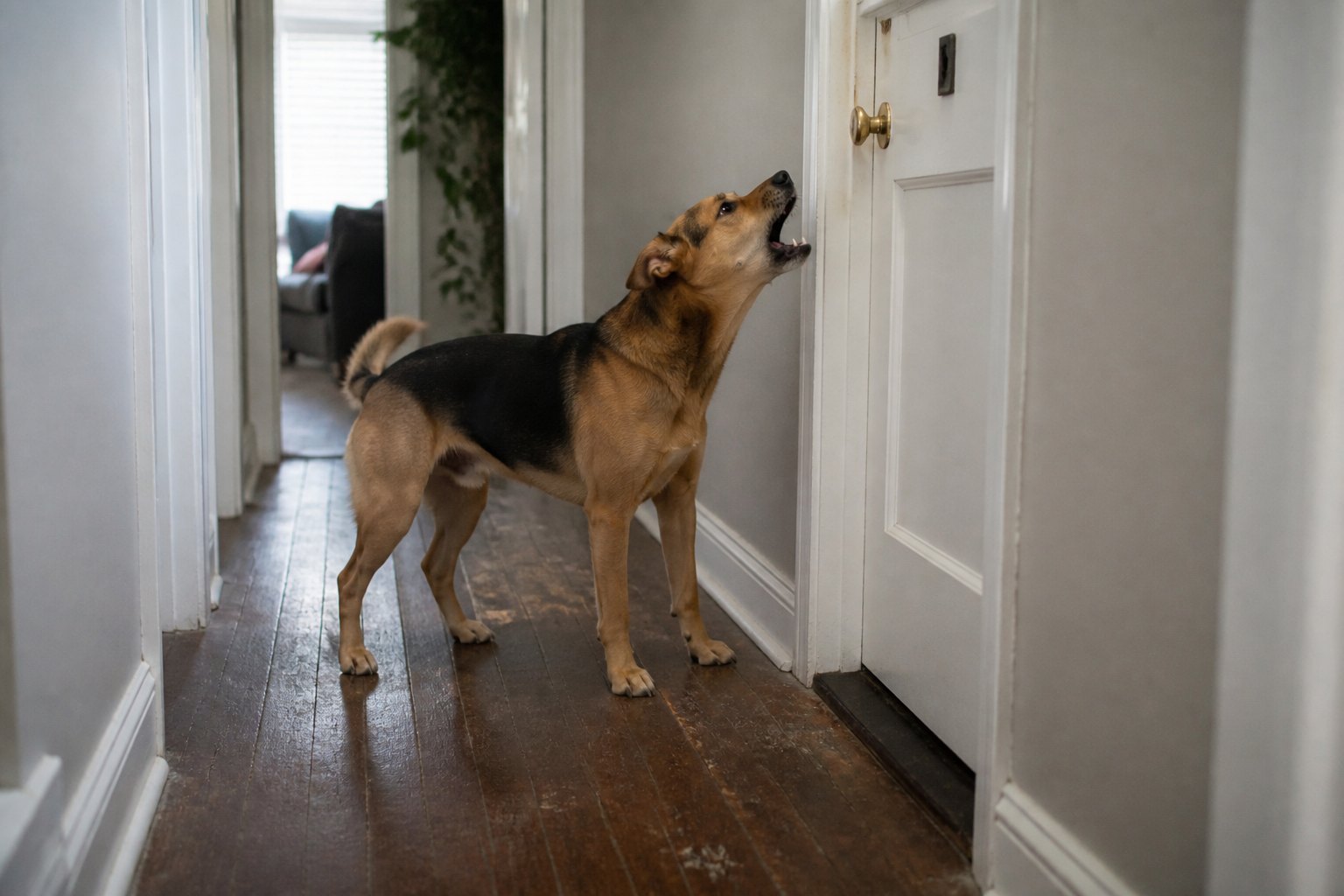
How to Stop a Dog Barking at the Door
Barrier barking is a setup problem first. The door is managed. The view is managed. Then you pay a quieter job.

Door and window barking is a barrier that has been paid. A knock, a shadow, a voice in the hall, and the dog barks. The post leaves. You shout. A guest says hello through the letterbox. That is enough. This page is how you stop the rehearsal and teach a different picture. It is not “stop barking in five minutes.” Products that promise that are products.
This is a behavior protocol. Jumping up owns the front feet. Children and guests owns the household plan. If the dog is already over threshold at the knock (screaming, unable to eat), you are on on-leash threshold logic even inside the house. Distance first. I do not run aversives as a shortcut. The AVSAB position statements recommend reward-based work. Read them as a public standard.
Why do dogs bark at the door and the window?
Because it works, and because the body is already up before the person exists.
Common pay-offs:
- the passer-by disappears (the bark “worked”)
- you arrive and talk, even to say “quiet”
- a guest pushes a hand through the gap
- another dog in the house joins and the chorus pays in movement
- a window seat that is a private cinema
You do not need a story about the dog guarding the household as a rank. You need to name the pay-off and remove the free rehearsal. The ASPCA overview of common dog behavior issues treats barking as a common, trainable problem with management in the mix. Read it as a source. This page is the barrier version.
Arousal sits under the bark. Footsteps on a US front walk or on a UK shared landing start the motor before the latch turns. If you only train “sit” in a quiet kitchen and then open the door on a Friday night, you asked for a sit at the wrong criterion.
If the street can rehearse the dog all afternoon, you are not training. You are hosting a loop.
How do you manage the door so barking cannot rehearse?
Manage before you teach. A real arrival is a test.
- Before the knock, the dog is on a leash, behind a gate, or in a crate you have already introduced. See crate training if that crate is still a fight.
- The view of the approach is blocked: film on the glass, a curtain, a closed sitting-room door, a sofa that does not face the street.
- You open the door. The guest comes in. The dog does not get a free run at the gap or the knees.
- The guest is briefed: no hands through the letterbox, no baby voice until the dog is on the job you trained.
- When the dog looks at you, or four paws are down behind the gate, you mark and feed. Then a hello at the chest, or no hello.
If you cannot brief the guest, the dog stays behind the gate. That is not unkind. That is how you stop paying a pattern you intend to change.
US houses with a front hall and a storm door have two latches. UK flats have a landing and a letterbox at muzzle height. The furniture changes. The rule does not: the dog is already managed before the hardware moves.
Jumping at the same door is a separate criterion. Run jumping up if the feet are the problem. Run this page if the sound is the problem. You can, and often should, manage both with the same gate.
How do you teach a quieter picture at the knock?
You teach it when you can still win, then you bring it toward the real latch.
Pick one job. A look back to you. A go-to-mat or bed. Four paws behind a gate. Do not stack “sit, down, quiet, place” in one breath.
Stage the knock. A person you control taps once. The dog is already on a line or already on the mat. When they look at you, or when they go to the mat, mark and feed. The knock predicted pay at the job, not a race to the gap.
Raise criteria in this order, and only when the current picture is cheap:
- You, a quiet tap, empty hall.
- A known person the dog already likes, still staged.
- A knock at a time you chose, dog already behind a gate.
- A real guest, dog behind a gate or on a leash.
- A courier, dog already in another room. Many dogs never need to greet a courier.
If you skip to a real Friday delivery, you are not training. You are hoping.
Food on the mat is useful when the door is still too hot. You are paying orientation away from the gap. Measure it from the day’s ration. See food as a reinforcer.
Shouting “quiet” after the bark has started is often a conversation the dog already wanted. A shock or a spray can suppress a bark and teach that the door predicts discomfort. This publication does not run those as the protocol.
What about windows and street noise?
Windows are rehearsals you forgot you scheduled.
A street-level UK sash and a US front-yard picture window are both cinemas if the sofa faces the glass. The dog barks. The person leaves. The bark paid. All afternoon.
Change the furniture:
- close the room when you cannot train
- apply removable film or a frosted panel at dog height
- move the day-bed off the sill
- give a legal chew in a room that does not face the street
You cannot out-train a six-hour sentry duty with a five-minute session. Management is the session until the view is honest.
When is door barking not a manners problem?
Use a fence you can see.
This ladder: loose body, bark that stops when the view goes away or when food appears on the mat, able to take a chew in another room, no slam at the glass.
Not this ladder: a stiff body, a hard stare, a jump that cracks the pane, teeth at the letterbox, a bite at a hand in the gap, or a dog who cannot come down even with the room closed. Pain, a sudden new sentry in a previously quiet dog, or a dog who guards the door as a person (freeze, growl, hold) is not a weekend DIY project. Gate the dog. See a qualified professional. If a child has been knocked or bitten, stop unsupervised greetings. See resource guarding if the fight is over a person or a place.
I am not a veterinarian. A sudden change belongs on when to call the vet before it belongs on a bark ladder.
What are the usual failure modes?
- You shouted over the bark and called it a cue. You paid the sound with a conversation. Teach a job before the knock, or manage the view.
- The sofa still faces the street. Afternoon sentry duty will beat your evening session. Move the furniture.
- Guests were unpaid trainers. Brief them or keep the dog behind a gate. “He is just saying hello” is how faces meet teeth at a letterbox.
- You trained a sit and then opened the door cold. The sit was never paid at that arousal. Drop to a gate and a staged knock.
- You bought a collar that hurts and called it five minutes. You taught that arrivals predict pain. Rebuild with food and management. No affiliate URL on this page.
- You used a child as the first criterion. Children run to the door. That is the last rung, not the first.
Sources
AVSAB position statements on humane dog training. ASPCA overview of common dog behavior issues. Paraphrased as public standards, not quoted as a substitute for reading the originals. avsab.org/resources/position-statements/ · aspca.org — common dog behavior issues
Questions on this page
Why do dogs bark at the door and the window?
Because the barrier pays. A knock, a shadow, a passer-by, and the dog barks. People move, the post leaves, you shout. That is enough. It is not a rank contest. Stop the rehearsal, then teach a different job.
How do you manage the door so barking cannot rehearse?
Close the visual, leash or crate before the latch, and brief the guest. The dog does not get a free run at the gap. Jumping and guest plans have their own pages. This page stays the bark at the barrier.
How do you teach a quieter picture at the knock?
Stage a knock you control. Pay a look back, a go-to-mat, or four paws behind a gate. Raise to a real arrival only when the staged picture is cheap. You cannot train over a real courier on Friday.
What about windows and street noise?
Film the glass, move the sofa, or close the room. A street-level UK window and a US front yard are different views with the same rule: if the dog can rehearse all afternoon, you are not in a session. You are in a loop.
When is door barking not a manners problem?
A stiff body, a hard stare, a slam at the glass, a bite at the gap, or a dog who cannot come down even in a closed room. Manage, and see a qualified professional. This page is not a clinic and not a five-minute promise.
Work with me
A $150 consultation or $500 monthly curatorship. Opens WhatsApp to Andrew.