Expert Advice · Reactivity · 8 min read
Dog chasing squirrels on walks: how to stop the lunge
Chasing is normal dog behaviour, so the goal is control, not a dog that never cares. Keep your dog on a long line, teach a happy turn-away, reward calm looking from a distance, and give the chase urge a safe outlet with a toy at home.
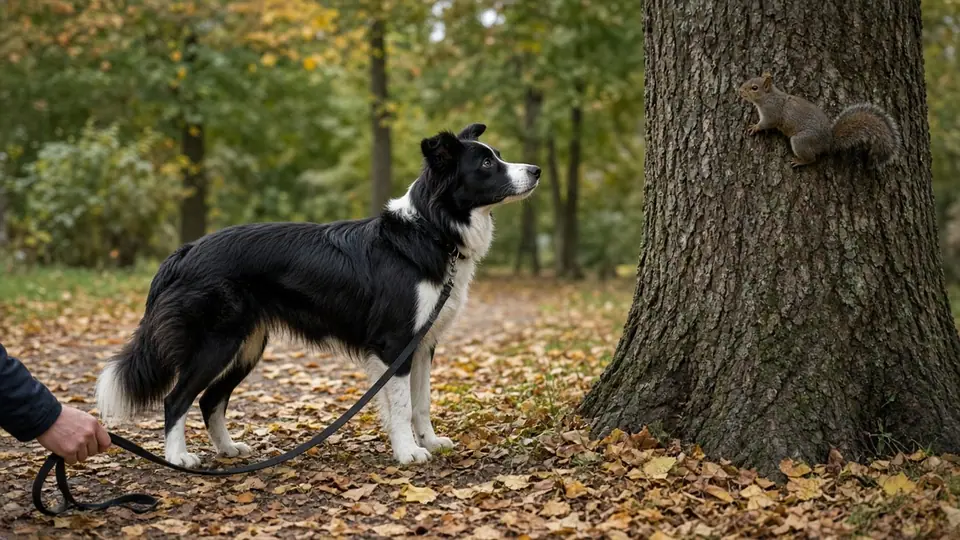
To stop a dog chasing squirrels on walks, keep it on a long line so it cannot reach the animal, practise a happy turn-away game at home, and reward calm looking at squirrels from a distance where your dog can still take food. Close the distance slowly, and give the chase urge a safe outlet with a toy game at home. If your dog reacts to dogs or people rather than wildlife, start with the engage-disengage game, which owns that side of the topic.
I am Andrew Darov, a dog trainer. I am not a veterinarian. This is a reactivity page about squirrels, cats and birds on walks.
Why do dogs chase squirrels, cats and birds?
Chasing moving animals is normal dog behaviour, and it feels great to the dog, so the plan is control, not a dog that never looks.
Every chase that ends with a squirrel up a tree still feels like a win to many dogs. The more often it happens, the faster and harder they go next time. Some types, such as herding breeds, terriers, sighthounds and scent hounds, often have a stronger urge, but almost any dog can do it.
That means two jobs: stop the chasing from happening again and again while you train, and teach your dog what to do instead when it sees a squirrel.
How do you keep everyone safe while you train?
A long line on a well-fitted harness is the main tool. It lets your dog sniff and move while you stay in control, and it stops a sudden bolt across a road or into a pond. See the long line recall page for how to hold and handle one without rope burns.
A few basics:
- Harness, not collar, for the long line, so a sudden stop does not jerk the neck.
- Gloves if your dog is big or fast.
- Pick quieter times and places at first, when there are fewer squirrels about.
- Watch ahead. Spot the squirrel before your dog does, so you can act early.
How do you stop the chase, step by step?
- Put your dog on a long line. In parks, woods and anywhere with wildlife, the long line stays on until your training is solid in that place.
- Teach a turn-away game at home. Say a cheerful cue such as “this way”, turn and walk away quickly, and give a treat when your dog follows. Practise indoors, then in the yard or garden, then on quiet walks. The emergency U-turn page covers this in detail.
- Reward calm looking at a distance. When your dog sees a squirrel far away and stays loose, say “yes” and give a treat. Looking calmly is the skill. If your dog cannot take food, you are too close.
- Close the distance slowly. Over many walks, move a little closer only when your dog can look, take food and turn away easily. If it stiffens, stares or pulls, use the turn-away and add distance.
- Add a safe chase game. At home, play a short game with a toy on a rope or a flirt pole. Start with a word, stop with a word, and end while your dog still listens.
What does “too close” look like?
Your dog is over its limit when it:
- Stops taking food, or snatches it hard.
- Freezes and stares, with the body leaning forward.
- Ignores its name or the turn-away cue.
- Whines, shakes, or lunges at the end of the line.
When you see this, do not argue. Use the turn-away, move further off, and let your dog settle before you go on. Next time, start further away.
How does “leave it” help?
A strong leave it on walks teaches your dog that turning away from something tempting brings a reward from you. It works for food on the ground first, and you can build it up to moving things. Use it together with the turn-away, not instead of a long line.
What about cats and birds?
Use the same plan, with more distance for cats. A dog should never be allowed to practise chasing cats: it can hurt the cat, and the habit grows each time. Birds that fly up are often easier, because they leave quickly; reward calm looking when they take off.
When can your dog go off lead again?
When, in that same place, your dog turns away from squirrels and comes back to you reliably on the long line many times in a row. Then try short off-lead moments in a safe, fenced area first. If your dog is a sighthound or has a very strong chase urge, off-lead time may stay limited to fenced areas, and that is fine.
What are the usual mistakes?
- Letting the dog off lead too soon. One successful chase undoes many good walks.
- Training too close to squirrels. If your dog cannot take food, add distance.
- Only saying “no”. Teach what to do instead: look, turn away, follow you.
- Jerking the lead. It adds frustration and can hurt the neck. Use a harness and a turn-away.
- No outlet for chasing. A short toy game at home gives the urge an allowed place.
Chasing is part of being a dog, but you can build a dog that sees a squirrel, looks, and turns back to you. Next steps: emergency U-turn for the turn-away, long line recall for safe freedom, and leave it on walks for the skill behind it. More on the reactivity hub.
Questions on this page
Why does my dog chase squirrels on walks?
Chasing moving animals is normal dog behaviour, and for many dogs it feels very rewarding. Some types, such as herding dogs, terriers, sighthounds and hounds, often have a stronger urge. Training builds control around it rather than removing it.
How do I stop my dog lunging at squirrels?
Keep your dog on a long line so it cannot reach the animal, work at a distance where it can still take food, reward calm looking, and teach a happy turn-away that you practise at home first. Close the distance only as your dog stays calm.
Should I let my dog off lead in a park with squirrels?
Only when your dog turns away from squirrels and comes back reliably on a long line, in that park, many times in a row. Until then a long line keeps your dog and the wildlife safe, and stops the chase from becoming a habit.
What if my dog chases cats?
Use the same plan with more distance: a long line or lead, calm looking rewarded, and a turn-away. Never let a dog practise chasing cats, because it can hurt the cat and the habit gets stronger every time.
Can I give my dog a safe way to chase?
Yes. A toy on a rope or a flirt pole at home or in a safe fenced area, with clear start and stop rules, lets your dog chase something allowed. Keep sessions short and stop while your dog still listens.
Work with me
A $150 consultation or $500 monthly curatorship. Opens WhatsApp to Andrew.