Expert Advice · Reactivity · 8 min read
Dog lunging at cars on walks: a calm, safe plan
A dog that lunges at passing cars is at real risk near a road. Make the walk safer first with route choice, distance and a short lead by the traffic, then teach the dog to turn away from a car and look back at you.
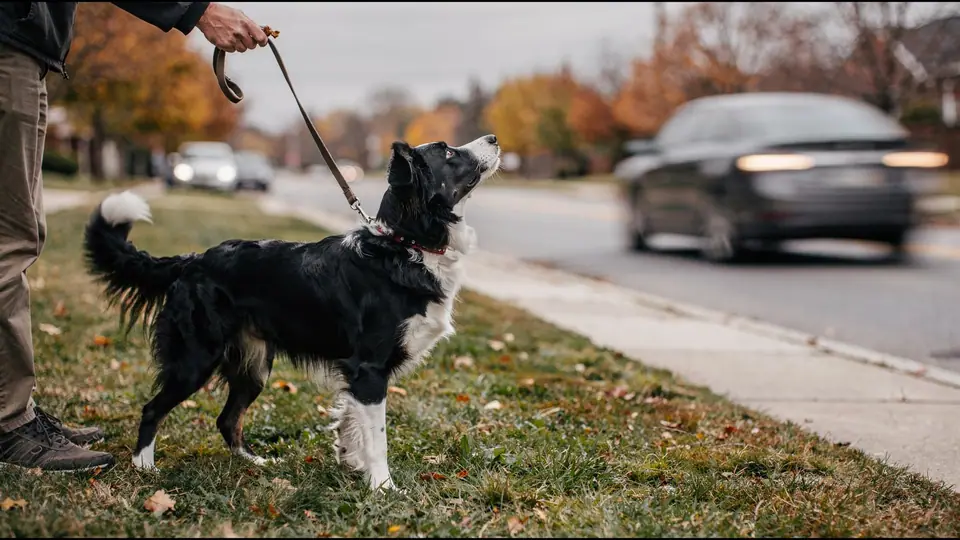
When a dog lunges at cars, start with safety: choose quieter routes, walk further from the road, and keep the lead short on the traffic side. Then teach a turn-away game, practise it where cars pass at a distance your dog can handle, and save long lines for open fields far from any road. If your dog also lunges at runners, bikes and scooters, there is a full plan for people and wheels on dog lunging at bikes, runners and people.
I am Andrew Darov, a dog trainer. I am not a veterinarian. This is a reactivity page about walks near traffic.
Why does a dog lunge at cars?
Most car lunging is chasing, fear, or a mix of both. Either way, the dog is too close to the road to think.
- Chasing. Many herding and hunting dogs, and plenty of mixes, have a strong urge to chase things that move fast. A car is big, fast and noisy, and lunging feels great to the dog, even if it never catches anything.
- Fear. Some dogs, often young or rescue dogs who did not see much traffic early in life, are scared of cars. They bark and lunge to make the scary thing go away, and from the dog’s point of view it works, because the car always leaves.
- Mixed and learned. After weeks of lunging at every car, the habit can run on its own, whatever started it.
Look at your dog’s body when a car comes. A dog leaning forward, eyes locked on, tail up, is often chasing. A dog who first pulls back, tucks its tail or tries to hide behind you, then lunges, is often scared. The plan below helps both, but a scared dog needs more distance and more time.
How do you make walks near roads safer right now?
Before any training, make sure your dog cannot reach the road:
- Normal lead, held short on the road side. You walk between the dog and the traffic. A lead of about 1.2 to 2 metres (4 to 6 feet) gives the dog room to sniff without reaching the curb.
- Snug gear. Check that the harness or collar cannot slip over the head when the dog pulls backwards. Fit checks matter more than the type of gear.
- No retractable leads by roads. They let a dog reach the road before you can react.
- Long lines only in open spaces. A long line is great for sniffing and recall practice in a field or park, far from traffic. Near a road, it is a hazard.
- Pick the time and the place. Rush hour on a busy road is the hardest test. Quiet residential streets, early mornings, or driving to a park make the walk easier while you train.
How do you teach a dog to stop lunging at cars, step by step?
- Pick quieter routes. For a few weeks, avoid busy roads where you can. Look for streets with wide pavements or sidewalks, grass verges, or paths set back from traffic. Every lunge you avoid is one less time the dog practises it.
- Walk further from the road. Put yourself between the dog and the cars and use all the space the path gives you. When a car is coming, step back from the curb, or turn into a driveway or gateway and let it pass. Distance is what lets your dog think.
- Check the gear. A well-fitted harness or collar and a normal lead. If your dog is strong and you are worried about being pulled, a harness with a front clip can give you more control. If you use a harness, see the harness fit check.
- Teach a turn-away game at home. Say a happy word, such as “this way”, turn and walk away, and reward the dog as it follows you. Practise in the house, then the yard or garden, then on a quiet street. The emergency U-turn page shows this skill in detail.
- Practise with cars at a distance. Stand far back from a quiet road, at the distance where your dog notices a car but can still take a treat. When a car passes and the dog looks at it, say your word, turn away and reward. If your dog looks at the car and then back at you on its own, reward that too. Move closer only over many sessions, and step back if the dog starts to stare or bark.
How do you find the right distance from the road?
The right distance is where your dog can see a car, then still take food and turn back to you. If your dog grabs the treat hard, ignores it, or cannot stop staring, you are too close. Move back, find a quieter road, or train at a quieter time of day. There is more on this idea on training at the right distance.
Short sessions work best: five to ten cars, then a sniff walk somewhere calm. A tired, frustrated dog learns less. If you have a bad day and your dog lunges, do not tell it off. Calmly move away, let it calm down, and make the next session easier.
Over time you can cut the distance, add busier roads and walk alongside traffic. Many dogs who chase cars also chase cyclists, runners or squirrels. The same turn-away game works for all of them.
What are the usual mistakes?
- Walking busy roads every day while you train. Each lunge makes the habit stronger. Choose easier routes for a few weeks.
- Long lines or retractable leads near traffic. Keep a normal lead by roads; long lines go in open fields.
- Jerking the lead or shouting. It adds stress and can make a scared dog more scared of cars.
- Getting too close too soon. If your dog cannot eat, you are too close.
- Only training on bad days. Practise when things are calm, so the skill is ready when a car surprises you.
If your dog has pulled you over, slipped out of its gear near traffic, or turns and bites at the lead, you or another dog when it cannot reach the car, get help from a qualified trainer. If the lunging started suddenly in an older dog, or your dog seems sore or jumpy in general, ask your vet.
Car lunging gets better when the dog is safe, far enough from the road to think, and has a clear game to play instead. Next steps: emergency U-turn for the turn-away skill, training at the right distance for finding a workable distance, and dog lunging at bikes, runners and people for other moving triggers. More on the reactivity hub.
Questions on this page
Why does my dog lunge at cars?
Some dogs chase anything that moves fast, especially herding and hunting types. Others are scared of the noise and size of cars and lunge to make them go away. Both get better with more distance and a plan for what to do instead.
Is it safe to use a long line near a road?
No. Near traffic, keep your dog on a normal lead, held short on the road side, with a well-fitted harness or collar. Long lines belong in open fields and parks well away from roads.
How far from the road should I walk my dog?
Far enough that your dog can see a car and still take a treat and look back at you. For some dogs that is a few steps back from the curb; for others it is a park path well away from traffic.
Will my dog grow out of chasing cars?
Some young dogs calm down with age, but chasing often gets stronger with practice. It is safer to start a plan now than to wait.
When should I get help?
Get help from a qualified trainer if your dog has pulled you over, slipped its collar or harness near traffic, or redirects onto you or another dog when it cannot reach the car.
Work with me
A $150 consultation or $500 monthly curatorship. Opens WhatsApp to Andrew.