
Expert Advice · Expert Advice · 14 min read
How to introduce a new dog to a resident dog
Parallel walks beat a hallway face-off. Resources stay managed. The yard and the flat change the furniture, not the rule.

Introducing a new dog to a resident dog is a setup problem first. Neutral territory, parallel walks, short supervised indoor time, and managed resources beat a forced face-to-face in a hallway. This page is a household plan. It invents no client diaries and no breed guarantees.
This is a life protocol. It sits next to children and guests for household management. If freeze, hard stare, or a fight over food shows up, stop and read resource guarding. I work dogs in residential boarding for a month and longer. I am a professional dog trainer, not a veterinarian. See not veterinary advice.
How should you introduce a new dog to a resident dog?
Outside first. Parallel, not nose-to-nose.
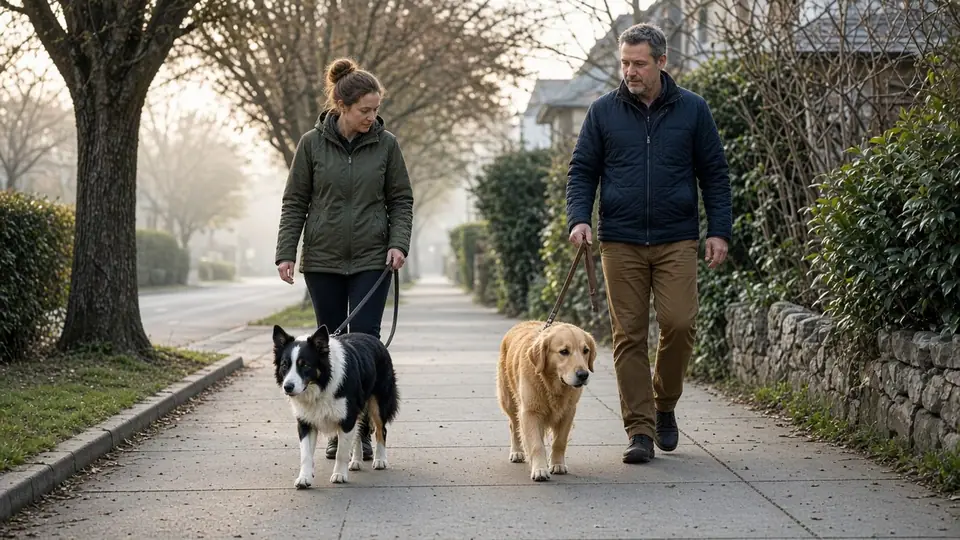
Pick a quiet path, a park edge, or a low-traffic street neither dog owns. Both dogs on secure leads and well-fitted harnesses. See harness and lead for kit. Handlers walk in the same direction with space between the dogs. You are building a shared activity: walking. You are not staging a meet-and-greet for a camera.
Pay calm walking with food or a quiet voice. If a dog stiffens, stares, or lunges, increase distance. Do not drag them into a greeting to “get it over with.”
After several calm outdoor sessions across more than one day, bring short indoor time into the plan. Minutes, not hours. End while bodies are still loose. Unsupervised free access in week one is how you rehearse a fight you did not plan.
A hallway face-off on day one is a test you did not need to run.
Why start outside instead of in the house?
The house is already the resident dog’s map. Bowls, beds, sofas, doorways, and scent say “mine” before the new dog has a job.
A park path or a quiet pavement gives both dogs room to curve away. Parallel walking lets them share motion without a doorway funnel. When you later open the front door, both dogs already have a history of calm near each other outdoors.
Common rush mistakes:
- carrying the new dog into the lounge while the resident is free
- dropping leads in a kitchen and hoping for “sniffs”
- leaving both dogs with one bowl “to share”
- inviting friends to watch the first greeting
You do not need a story about pack rank. You need space, duration you can end, and resources that are not contested.
How do you manage resources in the first weeks?
Manage what you have not yet proofed.
- Feed apart: different rooms, crates, or baby-gated zones. Pick up bowls when the meal ends.
- Give each dog a clear rest place. Do not force shared sofa real estate in week one.
- High-value chews and toys stay with you when you cannot watch. Trade and drop it skills help later; they do not replace management now.
- Doorways and narrow halls are pressure points. One dog through at a time, or a gate, until both dogs are boring in wider rooms.
- If either dog freezes over food, a bed, or a person, you are off this page. See resource guarding. Separate them. Get qualified help.
First absences with two dogs in the house belong on first absences logic: short, rehearsed, managed. Do not leave new pairings unsupervised while you run errands “to bond.”
Is a US yard different from a UK flat?
Architecture differs. Criteria do not.
A US suburban house with a fenced yard can hold spaced parallel walks on grass and short indoor sessions with baby gates between kitchen and lounge. Use the yard as outdoor space, not as an unsupervised wrestling ring on day one.
A UK flat with a narrow hallway and a shared landing is a funnel. Do not stage the first greeting at the front door with both dogs in the corridor. Use the street or a quiet park first. Indoors, use rooms and gates. A lift lobby is not neutral territory if both dogs are already tight on leads.
In both countries: end sessions early, split resources, and raise freedom only when the current picture is cheap.
When is a multi-dog introduction not DIY?
Use a fence you can see.
This plan: loose bodies on parallel walks, able to take food at a distance, short indoor sessions that stay boring, no blood, no freeze over bowls.
Not this plan: hard stares that do not break, repeated fights, punctures or torn skin, a history of serious bites toward other dogs, or a dog who cannot eat even when the other is across a wide park path. Pain in either dog can change thresholds overnight. That is veterinary first.
True inter-dog aggression is not a weekend DIY project. Keep the dogs separate. If the dogs already live together and have started fighting, see dogs in the same house fighting for the first steps. See a qualified trainer or veterinary behaviour professional in your country. Dogmindlab will not invent case studies or a triage inbox to stand in for that. For paid residential work, use work with me as a human contact path, not as emergency care.
If either dog has a known fight history, skip DIY parallel walks in a busy park. Work with a qualified professional who can set distance and equipment. Parallel walking is a tool, not a promise that every pair will share a sofa.
For households that already run guest plans, keep early multi-dog weeks quieter than usual. Extra doorbells and visiting children raise arousal for both dogs. Borrow the gate and rest-place ideas from children and guests, then return here for the dog-to-dog map.
What usually fails?
- You forced a nose-to-nose in the hall. Reset outdoors with space. Parallel walks first.
- You left one bowl “to share.” Feed apart. Guarding is a stop list.
- You gave free house access on day one. Short supervised sessions. End while it is still boring.
- You used the UK landing or a US front hall as the first classroom. Neutral path first. Funnels create pressure.
- You invited an audience. Guests raise arousal. Keep early sessions quiet.
- You treated a freeze as “they will work it out.” Separate. Wrong ladder. Get help.
Sources
AVSAB position statements on humane dog training and related behaviour guidance. ASPCA overview of common dog behavior issues. Paraphrased as public standards for multi-dog household setup, not quoted as a substitute for reading the originals. No fabricated case studies. avsab.org/resources/position-statements/ · aspca.org — common dog behavior issues
Questions on this page
How should you introduce a new dog to a resident dog?
Neutral territory first. Parallel walks with space between the dogs. Short supervised indoor sessions after outdoor calm. Manage bowls, beds, and toys. Do not force a face-to-face greeting in a hallway on day one.
Why start outside instead of in the house?
The house is full of resident scent, bowls, sofas, and doorways that create pressure. A park path or quiet street gives both dogs room to move. Parallel walking builds a shared activity before anyone claims a bed.
How do you manage resources during the first weeks?
Separate bowls, separate rest places, pick up high-value toys when you cannot watch, and feed apart. Do not leave chews free on the floor between unsupervised dogs. Guarding is a stop list, not a manners speech.
Is a US yard different from a UK flat for introductions?
Yes for furniture, not for learning. A US fenced yard can hold spaced parallel walks. A UK flat hallway is a narrow funnel: use the street or a quiet park first, then short indoor sessions behind baby gates. Same criteria, different rooms.
When is a multi-dog introduction not DIY?
Hard stares, freezes, fights that draw blood, a history of serious bites, or a dog who cannot eat near the other even at distance. Manage separately and see a qualified professional. This page is not a clinic and invents no case studies.
Work with me
A $150 consultation or $500 monthly curatorship. Opens WhatsApp to Andrew.