
Expert Advice · Expert Advice · 9 min read
Dog and new baby: how to prepare your dog before the birth
Make the big changes months before the birth, so your dog does not link them with the baby: new rooms and gates, new walk times, calm practice around baby gear. Then plan a quiet first meeting and keep an adult between them, always.

To prepare your dog for a new baby, make the big changes two to four months before the birth: move beds and gates, shift walks and meals to the times you will keep later, and practise calm around baby gear. Then the baby arrives into a routine the dog already knows. Plan a quiet first meeting on lead, and keep an awake adult watching whenever they share a room. Daily life with older children and visitors is covered on children and guests; this page owns the months before the birth and the first weeks.
I am Andrew Darov, a dog trainer. I am not a veterinarian. This is a life page about preparing a household dog for a baby.
When should you start preparing your dog for a baby?
Start two to four months before the due date. Changes made early feel like normal life to the dog, rather than something the baby brought.
A baby changes almost everything for a dog at once: who gets up at night, when walks happen, which rooms are open, how much attention there is and what the house smells and sounds like. If all of that changes the week the baby comes home, the dog meets it all at once. Spread over a few months, each change is small.
Start with a list of what will be different. Then change those things one at a time, a week or two apart.
What should you change in the house first?
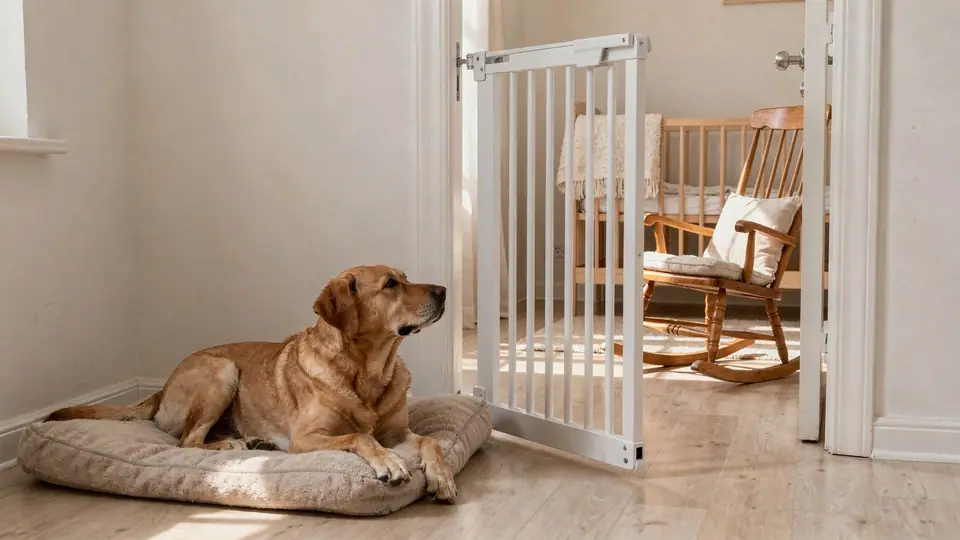
- Rooms. Decide which rooms will be off limits, usually the nursery and sometimes the bedroom, and start now. A gate at the nursery door means the dog can still see and hear, and can be kept out without shutting a door. Types and placement are on baby gates for dogs.
- Furniture. If the dog will be asked off the sofa or the bed, teach a happy “off” with a treat now and make the change early.
- A dog rest area. Set up a quiet corner or pen with a bed, water and chews, somewhere the dog can retreat to when the house is busy. Make it a good place with meals and chews long before the birth.
- Food zones. Plan where the dog eats and where its bowls and chews live, out of reach of crawling hands later. See kids and dog food bowls.
How do you change walks and daily routine?
Think about how days will actually look with a newborn. Walks may be shorter, come at different times or be done by a different person. Start that pattern now:
- Move walks and meals to the times you can keep after the birth.
- If a partner, friend or dog walker will take over walks, let them start now.
- Practise walking the dog next to an empty pram, on a loose lead, on quiet streets first.
- Add short sniffing games and chews at home, so a shorter walk still leaves the dog content.
Many dogs get less attention after a baby arrives. Getting the dog used to some quiet time alone now, with a chew in its rest area, makes that easier. Small steps are on first absences.
How do you practise with baby gear and sounds?
Bring out the pram, cot, baby bouncer and changing mat early, one at a time. Let the dog look and sniff at its own pace, and reward calm looks with a treat. Keep the dog off the baby gear with a gate or a cue rather than by scolding.
- Teach a mat cue first. Teach the dog to go to a mat and lie down there. Full steps are on place.
- Add baby gear nearby. Put the pram or bouncer a few metres from the mat and reward the dog for staying settled.
- Carry a doll wrapped in a blanket. Walk around, sit down and pretend to feed while the dog rests on its mat with a chew. Treat calm behaviour.
- Play baby sounds quietly. Play recorded crying at low volume while you give treats, and raise the volume slowly over days only if the dog stays relaxed.
- Practise the busy moments. Go through everyday moves: answering the door with the doll in your arms, changing a nappy on the mat, sitting on the sofa with the dog on its bed.
How should the dog meet the baby?
Plan the first meeting so it is short and boring:
- The parent who has been away greets the dog first, alone, so the excitement of the reunion is over before the baby comes in.
- A second adult holds the dog on a lead. The baby is in the arms of a calm adult who is sitting down.
- Let the dog look and sniff from a short distance for a few seconds. Praise quietly, then move the dog away to its mat and a chew.
- Repeat short, calm moments over the following days. Dogs do not need to lick or touch the baby.
A blanket that smells of the baby, brought home before the baby, can be offered for a sniff, but it is optional. Calm meetings and a steady routine matter more.
How do you keep your dog and baby safe every day?
The simplest rule is the most important one: the dog and baby are never alone together, not even for a moment. Either an awake adult is actively watching, or a gate or closed door separates them. This applies to every dog, however gentle. More on supervision with children is on children and guests.
Watch for signs that the dog wants space: turning its head away, lip licking, yawning, freezing, moving off. Respect them and let the dog go to its rest area. A dog who guards toys, food or resting places needs extra care around a baby who will crawl; see resource guarding and get help early.
If your dog growls, stiffens or snaps at the baby, separate them calmly with a gate, do not punish the growl, and contact a qualified trainer or behaviour professional soon. Ask your vet too if the change is new, because pain can lower a dog’s tolerance; see when to call the vet.
What are the usual mistakes?
- Changing everything the week the baby comes home. Make the changes months ahead.
- Banning the dog from the family completely. Give it a rest area nearby and some calm time with you.
- A hug-and-sniff first meeting. Keep it short, on lead, with the baby held by a seated adult.
- Leaving them together “just for a second”. Gate or door, every time.
- Punishing a growl. It removes the warning. Separate and get help.
- Dropping walks and games for weeks. Line up help with walks before the birth.
Start with rooms and baby gates, keep food and chews in planned food zones, and read children and guests for life as the baby grows. More on the life hub.
Questions on this page
How do I prepare my dog for a new baby?
Start two to four months before the due date. Make room changes and set up gates early, move walks and meals to the times they will happen after the birth, practise a mat or place cue, and let the dog meet baby gear calmly. Then the baby arrives into a routine the dog already knows.
How do I introduce my dog to my newborn?
Let the parent who has been away greet the dog first without the baby. Then, with the dog on a lead held by a second adult and the baby in a calm adult's arms, let the dog look and sniff from a short distance for a few seconds, praise, and move the dog away to a chew.
Should my dog sleep in the same room as the baby?
Keep the dog out of the room where the baby sleeps. A gate or closed door at the nursery is simplest. The dog can have its own comfortable bed nearby, so it is still part of the household.
Can I leave my dog alone with my baby?
No. Keep an awake adult actively watching whenever the dog and baby are in the same room, even for a moment, or separate them with a gate or a closed door. This applies to every dog, however gentle.
What if my dog growls at the baby?
Separate them calmly with a gate, do not punish the growl, and get help from a qualified trainer or behaviour professional soon. A growl is a warning. Ask your vet too if it is new, as pain can make dogs less tolerant.
Work with me
A $150 consultation or $500 monthly curatorship. Opens WhatsApp to Andrew.