
Expert Advice · Behavior · 8 min read
Dogs in the same house fighting: what to do now
When two dogs who live together start fighting, the first job is to stop more fights, not to make them friends again by tomorrow. Separate with gates and doors, rotate who gets which room, write down what happened before each fight, and bring in your vet and a qualified behavior professional if anyone was hurt.

If dogs in the same house are fighting, separate them now with doors, gates or crates, rotate who gets which room, and write down what happened before each fight. Do not put them back together and hope it settles. After any injury, call your vet, and get qualified in-person help before you try more shared time. Bringing a new dog into the home is a different job, covered on how to introduce a new dog; this page is for dogs who already live together.
I am Andrew Darov, a dog trainer. I am not a veterinarian. This is a behavior page about safety and management at home. It is not a replacement for someone who can see your dogs in person.
What should you do right after a fight?
Stop the next fight before you try to fix anything: separate, check for wounds, call your vet if anyone is hurt.
When the dogs are apart and calm, check both of them in good light. Look for punctures, bleeding, swelling, limping or a dog that does not want to be touched in one spot. Bite wounds can look small on the outside, so ask your vet if you are unsure. Check yourself and other people too.
Then keep the dogs apart for the rest of the day at least. Most owners want to “make up” by letting them back together quickly. That is usually when the second fight happens.
How do you break up a dog fight safely?
The safest fights are the ones that never start, but it helps to have a plan:
- Keep your hands, face and legs away from the dogs’ heads.
- Make a sudden loud noise, such as a clap or dropping something heavy, which can be enough to break a short scuffle.
- Push something between them: a chair, a board, a cushion, a laundry basket or a closed door.
- If two adults are present and the dogs are locked on, each person takes one dog by the back legs or the base of the body and moves backwards, away from the other dog. Only do this if you can do it without putting your hands near a mouth.
Do not grab collars or reach between the dogs. Many owners are bitten by their own dog this way, and the dog did not mean it.
How do you manage two dogs who fight, step by step?
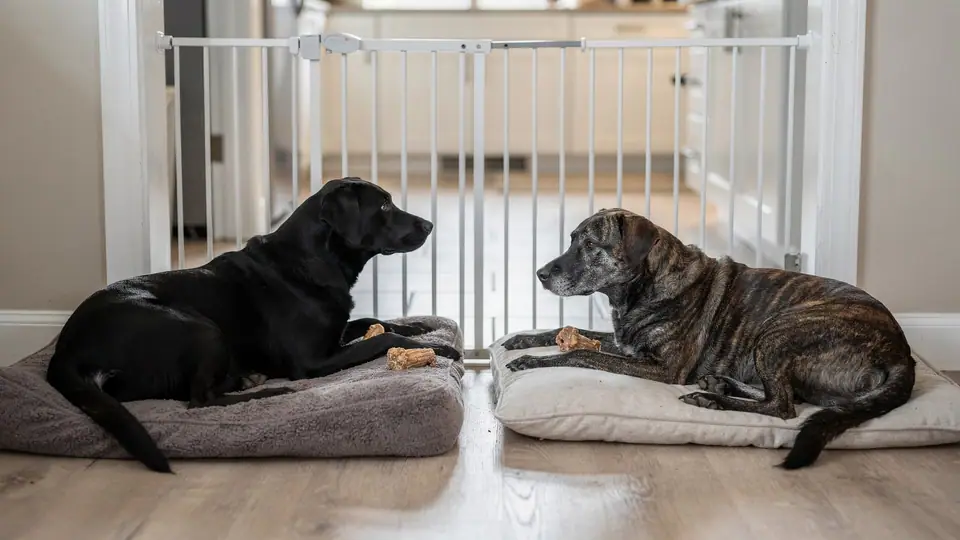
- Separate the dogs. Use closed doors, baby gates or crates so that the dogs cannot reach each other while you plan. A solid door is safer than a gate if fights were serious. Gate types and fitting are on baby gates.
- Rotate rooms and time. Give each dog its own turns in the living room, the yard or garden, the bedroom and on walks. A simple daily rotation, written on paper on the fridge, helps everyone in the house follow it. Each dog should still get walks, play, chews and calm time with you every day.
- Write down the triggers. For each fight or near-fight (stiff body, staring, growling, a lifted lip), write the time, the room, who and what was nearby, and what happened in the minute before. After a week, patterns often show up: food time, the front door, a narrow hallway, the sofa, one particular toy, a visitor, a walk coming back.
- Remove the flashpoints. Feed the dogs in separate rooms with doors closed, and pick up bowls afterwards. Give chews and food toys only when the dogs are apart. Block narrow spots where they have to pass each other, and do not let both dogs on the same sofa or bed. More on food set-ups in multi-dog meal management, and on guarding in resource guarding.
- Bring in the vet and qualified help. Ask your vet to check both dogs. Pain, illness, hearing or sight changes and getting older can all make a dog less tolerant. Then book a qualified behavior professional who works in person. They can watch the dogs, read the body language and build a plan for your home.
Why do dogs who live together start fighting?
There is rarely one reason. Common patterns include:
- Things. Food, chews, toys, bones, a bed, the best spot on the sofa.
- Places. Doorways, hallways, the top of the stairs, the car.
- Excitement. The doorbell, the lead coming out, a squirrel through the window. Two excited dogs in a small space can turn on each other.
- Change. A young dog growing up, an older dog slowing down, a new pet, a new baby, a move or a change in routine.
- Health. A dog in pain or feeling unwell may snap at a dog it used to tolerate. That is a vet question first.
Rough play that tips over is a separate pattern; if most of your scuffles start in play, read puppy and adult dog play rules.
When is it time to get help, or to think about rehoming?
Get qualified in-person help straight away if:
- either dog needed a vet after a fight;
- fights happen even with management in place;
- a person was bitten breaking up a fight;
- there are children in the home who could be caught in the middle.
Some pairs of dogs live safely together again with management and a plan. Some pairs live together with long-term rotation. A few pairs are safer in different homes. That is a hard decision, and it is better made with your vet and a professional who has met the dogs than alone after a bad night.
What are the usual mistakes?
- Letting them “sort it out”. Fights tend to make the next fight more likely.
- Putting them back together too soon. Same day, same sofa, same bowls is how many second fights start.
- Punishing the dog who growls. A growl is a warning. Without it, the next step is a bite.
- Feeding side by side. Separate rooms, doors closed, bowls picked up.
- Grabbing collars in a fight. Use a barrier, not your hands.
Dogs in the same house who fight need space first, then a written record of what sets them off, then your vet and a qualified professional. For food time see multi-dog meal management, for bowls and chews resource guarding, and for gates baby gates. More on the behavior hub.
Questions on this page
What should I do right after my dogs fight?
Separate them into different rooms with a closed door or a gate, check both dogs for wounds once they are calm, and call your vet if there is any bleeding, puncture, limping or swelling. Do not put them back together the same day.
How do I break up a dog fight safely?
Keep your hands away from heads and mouths. Use a loud noise, a board, a chair, a cushion or a blanket to block between the dogs, or a door if one is close. Grabbing collars is how most owners get bitten.
Why have my dogs started fighting when they used to get along?
Common patterns are food, chews, toys, resting spots, doorways, excitement at the door or on walks, a dog growing up, a new pet, and pain or illness in one dog. Ask your vet to check both dogs if the change was sudden.
Can dogs that fight live together again?
Many can, with good management and a clear plan, but not all. Fights with injuries, fights that keep happening, or fights between dogs of similar size and age are a reason to get qualified help in person before trying more time together.
Should I let my dogs work it out?
No. Fights rarely settle things between dogs and often make the next one more likely and more serious. Prevent fights with space and routine instead.
Work with me
A $150 consultation or $500 monthly curatorship. Opens WhatsApp to Andrew.