Expert Advice · Gear · 12 min read
Dog Harness and Lead: Fit and Use for Training
Fit, a length you can actually handle, and a job for the tool. The walk is still a skill. The slot for a sponsored link stays empty.

A harness and a lead are tools for a walk you can steer and feed. They do not teach loose leash by themselves. A fashionable two-metre chaos rope does not become a recall. A tight neck collar does not become calm. This page is what the tools are for, what they fail at, and when they are the wrong project.
There is no affiliate link on this page. Product names, if they appear later, will sit behind the affiliate disclosure. Until then the slot stays empty on purpose. I will not send you to a checkout.
What is a harness for, and what is a lead for?
A harness is a handle on the body. Used well, it lets you turn a dog or hold a lunge without making the trachea the attachment point. Used badly, it is a twisted strap that rubs, a vest that blocks the shoulder, or a costume.
A lead is a chosen length. It is not “freedom.” It is the distance at which you can still prevent a rehearsal: a jump on a guest, a dive at a dog, a road. A long line in a quiet field is a different tool with the same job: stop the ignore without turning the session into a hunt. See the recall ladder.
Neither tool replaces food, criteria, or distance. If the dog is already over threshold, you are on on-leash threshold, not in a shopping problem.
A collar still has a job in many countries: an ID tag in public. In the UK that is a legal habit as well as a safety habit. The collar can hold the tag while the harness holds the walk. Do not hang a heavy city of tags on a thin neck and then wonder why the dog coughs.
The tool prevents a rehearsal. The food buys the picture you want.
How do you choose a harness that does not twist?
Fit is mechanical. If you cannot describe it, you bought a vibe.
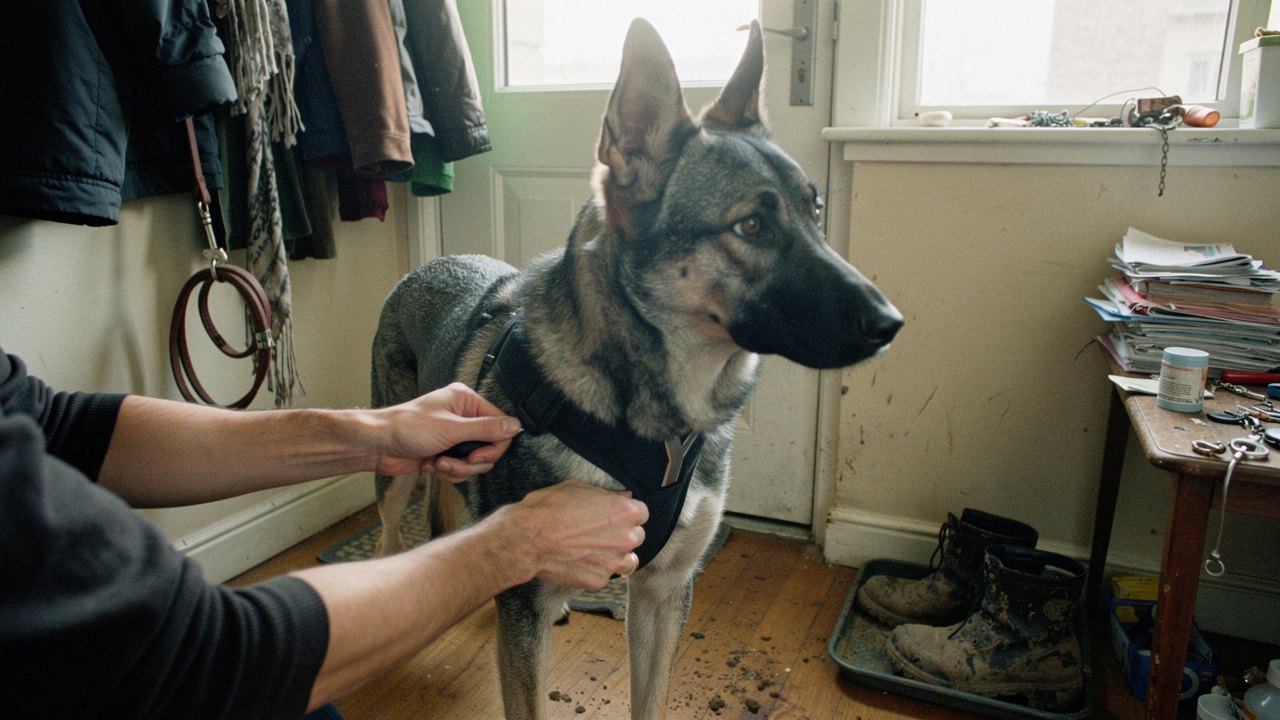
- The chest piece sits on the breastbone, not on the throat.
- The girth strap sits behind the elbows, not in the armpit.
- After ten steps, the D-ring is still on top. If the whole thing has rotated, the size or the cut is wrong.
- The dog can move the shoulder. A strap that blocks the scapula is a hobble.
- You can clip and unclip without a fight. If dressing is a wrestling match, that is a handling session, not a reason to tighten until they submit.
Y-front designs that leave the throat clear are the usual working choice for a walk you will feed. A harness that looks like a figure-eight on the neck is often a collar in costume.
Try the fit when the dog is calm, then again after a short walk. Puppies grow. A harness that fitted in June can twist in August. That is not a brand betrayal. That is a body.
I will not name a shop. Measure the dog (girth behind the elbows, lower neck) and use the maker’s own chart when you have one. If two sizes argue, the larger with a tighter strap is often kinder than the smaller that carves a line.
What lead length actually helps a walk?
A length you can gather in one hand without a science project.
For a pavement walk, a fixed lead around the two-metre mark is a common working length: enough for a sniff and a sit, not enough for a full sprint into a bicycle. For a door greeting, shorter. You are preventing a jump, not offering a tour. For recall work in a quiet field, a long line of ten metres or more, on a harness, handled so it does not wrap a hock.
Two fixed leads beat one gadget. You can clip short at the kerb and long in the park. You cannot do that honestly with a tape that lives at whatever length the last lock left it.
US pavements and UK pavements differ in width. On a narrow path, a long lead is how you trip a stranger and then call the dog reactive when they startle. Shorten. That is manners toward people as well as toward the dog.
Hold the lead so there is a soft bend, not a bowstring. A tight lead is a conversation the dog will answer by pulling. You pay slack at your seam (hip, thigh) the same way you pay a look on the reactivity page.
Should you use a retractable lead or a prong?
A retractable tape is a variable you do not control when it matters: a door, a kerb, a dog appearing at six metres. The stop is a button and a thin cord. Thin cords cut. Locks fail when your thumb is late. If you already own one, treat it as a long line in an empty field and lock it short in town, or replace it with a fixed length. I will not link a model.
A prong, a choke, a shock collar, a spray. Those are aversives. The AVSAB position statements recommend reward-based methods for training and behavior work and do not support aversive tools. This publication follows that public standard. I will not run a “sometimes, in the right hands” exception on a gear page.
If a walk is a fight, the project is distance, food, and a shorter session, not a sharper collar. Pain can also sit under a sudden pull or a scream. A dog who was fine and now hits the end of the lead may need a veterinarian, not a new device. See not veterinary advice.
When is the tool the wrong project?
When you changed the shop basket and not the walk.
The harness will not create meters from an oncoming dog. The lead will not turn a screaming greeting into calm if you still open the door on an uncontained dog. A “no-pull” strap will not replace paying slack.
The tool is the wrong project when:
- the dog cannot eat on the walk (threshold, not hardware)
- the dog coughs, paws at the chest, or comes up lame after the harness (fit or medical)
- a child is holding a long line in a crowd
- you are looking for a device to replace the recall ladder
Then you change the route, the time, the food, the criteria, or you get a person who can see the dog. Gear is downstream of the protocol. That is why this lab sits under gear, after the work, not before it.
What are the usual failure modes?
- The harness spins. Wrong size or cut. Refit. Do not add a second collar “to keep it still” and then yank both.
- The lead is a retractable in a doorway. Fixed length at the latch. See guests on the children and guests page.
- You bought a prong because an advert said so. That is a different project. Not this site.
- You used a long line on a neck collar. Long lines belong on a harness so a hit does not become a neck injury.
- You expected the tool to teach. Pay slack. Manage distance. The lead only stops the opposite rehearsal.
- A child held the walk. An adult holds the lead until the picture is actually easy.
Sources
AVSAB position statements on humane dog training: reward-based methods. Aversive tools are not supported. ASPCA overview of common dog behavior issues as the public map for “this is not a hardware problem.” Paraphrased as public standards, not quoted as a substitute for the originals. avsab.org/resources/position-statements/ · aspca.org — common dog behavior issues
Questions on this page
What is a harness for, and what is a lead for?
A harness is a way to steer the body without making the neck the handle. A lead is a length you chose so the dog cannot rehearse a lunge you cannot stop. Neither one teaches a walk by sitting in a drawer. If the dog is already over threshold, you are in a distance problem, not a shopping problem.
How do you choose a harness that does not twist?
The straps sit where they were designed to sit after the dog walks ten steps. A Y-front that does not rub the armpit, a clip you can reach, no spinning barrel. If it twists, it is the wrong size or the wrong cut, not a training mystery. Puppies grow. Refit.
What lead length actually helps a walk?
Long enough that the dog can stand in a natural posture, short enough that a jump or a lunge cannot land. Two fixed lengths beat a retractable tape you cannot lock in a crowd. On a narrow UK pavement, a long lead is how you trip a stranger.
Should you use a retractable lead or a prong?
A retractable is a variable you do not control in a doorway or a road. A prong or a shock is an aversive. This page does not run those as tools. Reward-based walking is the method. AVSAB’s public training position does not support aversive tools.
When is the tool the wrong project?
When the dog is over threshold, in pain, or the handler is using the gear as a substitute for distance and food. Change the walk, not only the shop basket. A “no-pull” strap will not replace paying slack. Tools prevent a rehearsal. They do not teach.
Work with me
A $150 consultation or $500 monthly curatorship. Opens WhatsApp to Andrew.