
Expert Advice · Behavior · 8 min read
Border Collie Bored at Home? A Daily Plan for House Life
A border collie in a house needs a busy brain and a clear off switch. Give it short daily thinking work and sniff time, teach it to rest on a mat, and keep ball games short with a clear finish.

A border collie bored at home is usually a dog with a busy brain and no clear way to switch off. The fix is not more running. Give your collie short daily thinking work, walks with plenty of sniff time, a calm spot to rest and ball games that end. For the breed itself, from history to health and family life, read our border collie breed guide; this page is about the daily plan in a house or flat.
I am Andrew Darov, a dog trainer. I am not a veterinarian. This is a behaviour page about everyday life with a border collie.
Why does a border collie get bored in a house?
Border collies were bred to watch, think and move for hours with a person. In a house, that drive has to go somewhere.
A working collie spends its day watching sheep, waiting for a signal, and making many small decisions. In a home, the same dog may get one walk and then hours of nothing to think about. That gap often shows up as:
- Watching and chasing small things. Shadows, lights, flies, cars past the window.
- Herding people and pets. Circling children, nipping at heels, blocking the cat.
- Restless evenings. Pacing, bringing toys again and again, not lying down even after a long walk.
- Barking at small noises and getting stuck staring at the door or window.
None of this means the dog is “bad” or the home is wrong. It means the dog’s day needs more brain work and more real rest, in the right balance.
Is more exercise the answer for a bored border collie?
Usually not on its own. Hours of running or ball chasing build a fitter dog that needs even more to feel tired, and many collies get more wound up, not calmer. Lots of fast turns and sudden stops after a ball are also hard on young joints; ask your vet about how much hard running suits your dog’s age.
A better day mixes three things: walks where the nose works, short thinking games, and time spent resting. Brain work tends to tire a collie in a calmer way than another round of sprints.
What does a good day look like for a border collie at home?
- Plan the walks around sniffing. One or two walks a day where your collie can sniff, explore and move at its own pace, on a long lead or in a safe, fenced area. A slow walk in a new place often settles a collie better than a fast lap of the same park.
- Add short thinking games. Two or three five-minute sessions a day. Hide food around the room for a find it game, practise a few skills, or teach a new trick. Stop while your dog still wants more.
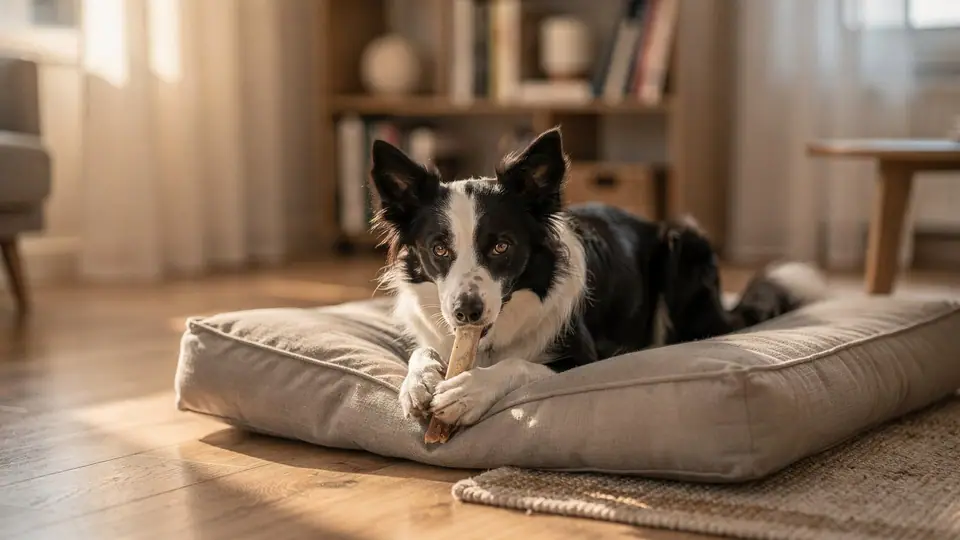
- Teach an off switch on a mat. Reward your collie for lying on a mat, add a chew, and build the time in small steps. Our guide to teaching place shows the steps. This is the most useful skill a house collie can have.
- Keep ball games short. A few throws, then a clear finish cue and the ball goes away. Our page on fetch with a clean finish shows how to teach a game that ends calmly instead of a dog that stares at the ball all evening.
- Protect rest time. Give a quiet place to sleep away from the busy part of the house, block the view of the street if your collie watches it all day, and aim for a calm, sleepy middle of the day.
How do I stop my border collie herding the children?
Herding children is the drive pointed at the wrong target. First, manage it: use a gate or a lead indoors when the children are running around, so the dog cannot practise circling and nipping. Then give the drive another place to go: a find it game, a chew on the mat, or a short training game with an adult while the children play. Ask children not to run past the dog to get it going. If there is nipping that breaks skin, or growling, speak to a trainer in person.
What are the usual mistakes?
- Endless ball throwing. It builds fixation and fitness, not calm. Keep it short and end it on your cue.
- No rest in the plan. A collie that is busy all day can become more restless. Rest is part of the day, not a gap in it.
- Only physical exercise. Running without thinking leaves the brain hungry.
- Letting the dog watch the window all day. Staring and chasing lights or cars gets stronger with practice. Block the view.
- Telling the dog off for herding. Manage the situation and give the drive somewhere else to go.
A border collie can be a calm house dog when its day has thinking work, sniff time and real rest. Next steps: the border collie breed guide for the breed in full, place for the off switch, and the find it game for quick brain work. More on the behaviour hub.
Questions on this page
How do I know if my border collie is bored?
Common signs are pacing, staring at you or at lights and shadows, chewing things it should leave alone, barking at small noises, herding children or other pets, and failing to settle in the evening even after a walk.
How much exercise does a border collie need in a house?
Most healthy adult border collies do well with one or two good walks a day with plenty of sniff time, plus short thinking games at home. More running alone rarely fixes boredom; it often builds a fitter dog that needs even more.
Is it bad to throw a ball for a border collie all day?
Long, repeated ball sessions can make some collies more wound up and fixated on the ball, and lots of sudden turns and stops are hard on young joints. Keep ball games short, mix in other games and end each one with a clear finish.
Can a border collie live happily in a flat or small house?
Many can, if their day includes daily walks, brain work and a quiet place to rest. Space matters less than what the dog does with its time. A busy brain and an off switch are the key parts.
How do I teach a border collie to relax?
Teach a mat or bed as a calm spot, reward lying down there, give a chew on the mat and build up the time slowly. Practise after a walk, when the dog is already a little tired, and keep the room quiet.
Work with me
A $150 consultation or $500 monthly curatorship. Opens WhatsApp to Andrew.