Expert Advice · Reactivity · 14 min read
Leash reactivity to people and bikes: threshold and management
People and wheels on lead are the trigger. Distance first. A forced pass is not exposure.
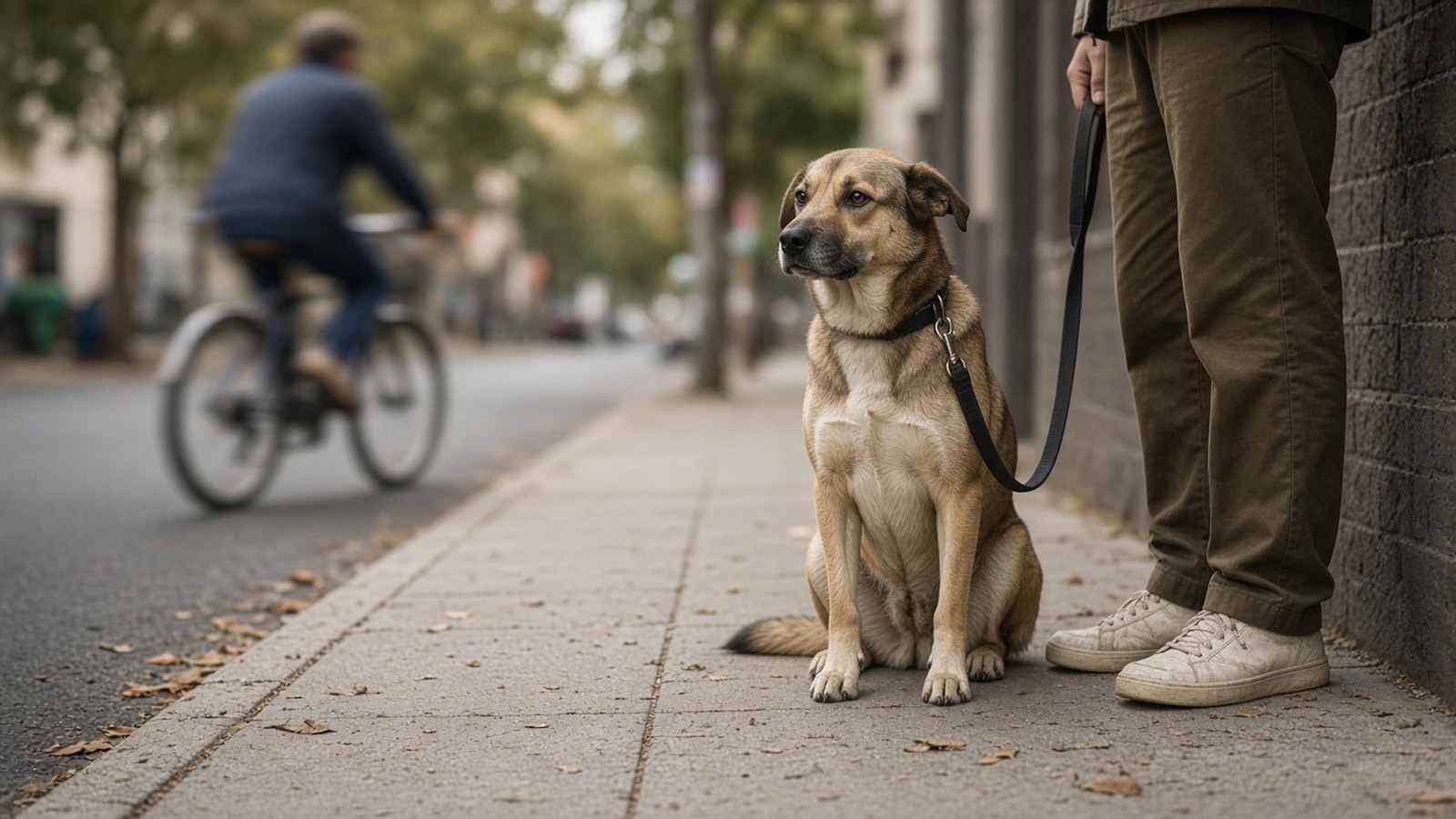
Leash reactivity to people and bikes means the trigger is a human or a wheeled machine while your dog is on lead: runner, cyclist, scooter, pushchair, skateboard, or a fast walker who closes distance. The working rule matches on-leash threshold: train at a distance the dog can still eat. This page stays people and wheels. Dog-to-dog lunging lives on leash reactivity to dogs. Do not mash both into one drill and call it done.
I board dogs for a month and longer as a trainer from Russia. I am not a veterinarian. No fake client reviews. AVSAB’s public training position supports reward-based behavior work. Flooding is not the method here.
What does people-and-bike on-leash reactivity look like?
- Lunging to the end of the lead when a runner or bike appears
- Barking or screaming that starts while the trigger is still far
- Spinning, redirected mouthing of the lead or handler
- Freezing, then exploding when a pushchair or scooter is forced past
- Chasing the wheel line with the body while the head stays locked
Speed and angle matter more than with stationary dogs. A bike that appears from behind is a different picture than a person walking toward you on a wide path. Name the picture. Train one at a time.
Window rehearsal at home can feed the same arousal when bikes and joggers pass the glass. See window barking if the dog already practices at the sill. Equipment that lets you feed and turn matters; see harness and lead.
If the dog cannot eat, you are too close.
How do you run a people-and-bike threshold pass?
Management first. Training second. Flooding never.
- Pick the route. Off-peak paths, wider pavement, parked cars or hedges as visual breaks. Avoid the shared cycle lane at 08:00 while you are still teaching.
- Find feedable distance. Runner or bike appears. Can your dog take food? If not, increase distance, step behind a barrier, or U-turn.
- Mark a clean picture. Look at the trigger, then back to you; or a turn away (engage-disengage seed). Feed at the mouth, not thrown into the chase.
- U-turn or curve early. Leave while the dog is still below threshold. Winning reps beat heroic close passes on a narrow path.
- Reset at home. Rest. Do not stack five hard bike passes “because we are out anyway.”
Engage-disengage starts as: notice person or bike → mark → treat for turning back or moving with you. Keep it short. Do not demand a formal heel through a stream of scooters on day one.
How is this different from dog-to-dog leash reactivity?
Leash reactivity to dogs owns other dogs on lead: parallel walking geometry, greeting pressure, narrow dog alleys. This page owns human and wheeled traffic: speed, silent approach from behind, pushchairs that do not stop for your training plan, and the social script that “the dog should be fine with people.”
The distance rule is shared with on-leash threshold. The criteria and routes are not. A quiet look at a jogger at thirty metres is not the same rep as a quiet look at a spaniel on a parallel path. Keep the logs separate in your head.
How do US sidewalks and UK pavements differ for people and bikes?
Width, shared-use paths, and culture. A wide US suburban sidewalk may give lateral distance from a jogger. A UK terrace pavement may force an earlier curve into the road (safely) or a wait behind a parked car when a delivery scooter closes. Shared canal towpaths and rail trails often mix bikes and dogs with little lateral room. Timed exits and off-peak walks are part of the protocol, not optional extras.
On a UK shared path, plan the U-turn before you need it. On a wide US sidewalk, use the lateral space instead of marching straight at every runner. The criterion does not change: feedable distance, early leave, no forced “just let them pass” when the dog is already gone.
How do you handle narrow paths when distance is scarce?
Arrive early or late. Wait behind a car or a hedge. Step into a driveway if safe. Cross before the cyclist closes. Carry high-value food so the mark has something to buy. If the path is a forced head-on with bikes every day, change the walking time before you change the dog. Architecture and schedule are part of threshold work.
A pushchair that cannot stop mid-path is a reason to leave early, not a reason to hope the dog will “be polite this once.” Politeness is not a distance criterion.
What about fence flooding versus true aggression?
Fence flooding here means walking the dog into a busy cycle stream or park entrance so they “get used to it.” That pairs people and wheels with panic on a tight lead. It is rehearsal, not exposure. Short, clean looks at a feedable distance are the work.
True aggression is a different fence. Bite contact on a person, injury, a hard stare that does not soften at any practical outdoor distance, or redirected biting of the handler. Use management (car exits, off-peak routes, visual barriers) and see a qualified trainer or veterinary behavior professional in your country. See not veterinary advice. A sudden new lunge pattern in a previously soft dog is a veterinary question first: pain can change the street picture overnight.
What does an engage-disengage seed look like with a runner or bike?
Trigger appears at a feedable distance. Your dog glances. You mark the glance or the turn back to you. You feed. You curve away or continue if the dog stays soft. Two to five clean reps beat one heroic close pass. If barking starts, you already missed the exit; increase distance next time.
Parallel geometry (same direction, lateral space) is often easier than head-on. A bike coming from behind needs an earlier scan and an earlier decision to step aside or U-turn. Teach your household that “they are just jogging” is not a reason to hold a tight lead into a face-to-face slot.
What are the usual failure modes?
- You flooded the cycle path at rush hour. Panic rehearsed. Distance is the criterion.
- You yelled heel at zero metres. Obedience at the wrong range is not threshold work.
- You forced a pass “to be polite.” Many reactive dogs learn that people and wheels predict conflict.
- You used a tool that hurts and called it focus. Suppression is not the same as a feedable pass.
- You ignored window rehearsal of bikes and joggers. Glass practice raises the baseline. Manage the view.
- You stacked hard passes until the dog was cooked. Quit while winning. Rest is part of the protocol.
Sources
AVSAB position statements on humane training and behavior modification. ASPCA public overviews of reactivity-related behavior issues. Paraphrased as public standards, not quoted as a substitute for reading the originals. avsab.org/resources/position-statements/ · aspca.org — common dog behavior issues
Questions on this page
What is leash reactivity to people and bikes?
Lunging, barking, screaming, or freezing on lead when a runner, cyclist, scooter, pushchair, or fast walker appears. It is usually a distance and history problem. It is not fixed by a louder heel at the wrong range.
How is this different from dog-to-dog leash reactivity?
Dog-to-dog work owns other dogs on lead. This page owns people and wheeled traffic: speed, sudden approach angles, and the social pressure to “just let them pass.” Same distance rule. Different routes and criteria.
What is the working rule at threshold for people and bikes?
Find the distance where the dog can still look, breathe, and eat. Mark orientation or a clean turn away. Leave or U-turn before the explosion. If the dog cannot eat, you are too close.
Should you flood the dog on a busy cycle path?
No. Walking into a stream of bikes “so they get used to it” rehearses panic. Off-peak routes, visual barriers, and early U-turns are how a protocol gets room to exist.
When is people-and-bike leash reactivity not DIY?
When there is bite contact, injury to a person, a stiff hard stare that does not yield at any practical distance, or handler injury from the lunge. Manage, and see a qualified professional. This page is not a clinic.
Work with me
A $150 consultation or $500 monthly curatorship. Opens WhatsApp to Andrew.