
Expert Advice · Puppy · 7 min read
Umbilical Cord Method: Supervise a Puppy on a Lead
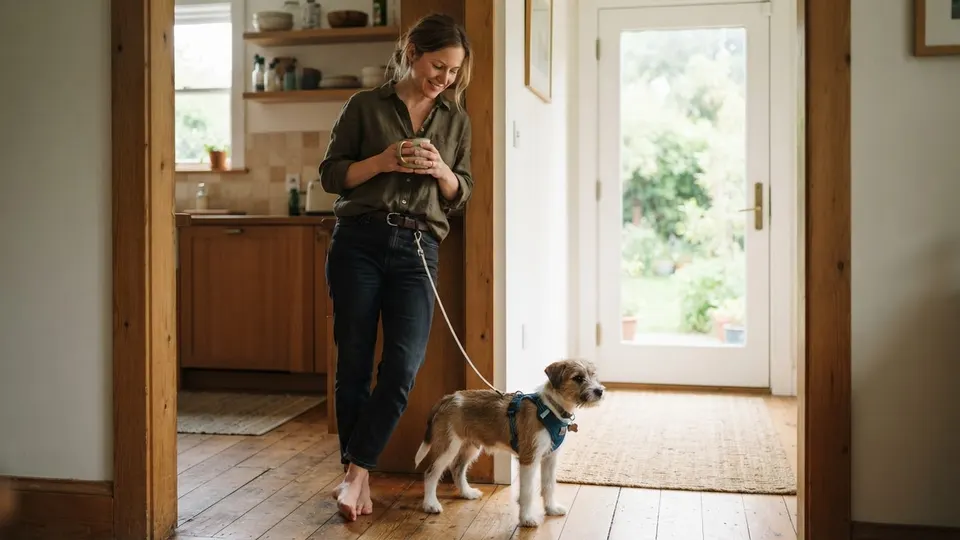
A light lead from your puppy to your waist keeps it in sight. Use it when you can watch, a crate or pen when you cannot, and never leave a puppy tied up alone.

Short answer
Keep a puppy on a light lead attached to your waist or wrist so it cannot wander off to toilet or chew unseen. SPCA of Texas describes this, and VCA says a puppy that is not confined should be tied to an observant person or kept within about 10 feet of someone watching. Use a crate or pen when you cannot watch.
The umbilical cord method means keeping a puppy on a light lead attached to you — usually to your waist, a belt loop or your wrist — so it stays in sight and cannot wander off to toilet or chew unsupervised. SPCA of Texas describes it as a light leash attached to the owner's waist, and a closely related "tether" set-up as a light leash fixed to a point in the room where you are present. VCA puts the same idea in its supervision rule: a puppy that is not confined should be tied to an observant person on a leash, or kept within about 10 feet (3 metres) of someone who is watching.
I am Andrew Darov, a dog trainer. I am not a veterinarian. This page is the supervision method. The toilet routine it supports is on puppy potty training. A crate or pen is still what you use when you cannot watch.
When should you use the umbilical cord method?
Use it during waking time, when you are home and can watch, especially in the first weeks of house training. SPCA of Texas notes that strict supervision is needed for at least 4-6 weeks to help establish an outdoor toilet routine. It also works when you are teaching a puppy not to practise biting clothes, chewing furniture or following you from room to room unseen.
It is not a substitute for sleep. Naps and overnight still belong in a crate or pen. It is not something you leave on when you cook, shower or go out of the room.
| Set-up | Use it when | Do not use it when |
|---|---|---|
| Lead to your waist or wrist | You are moving around the house and can watch | You need both hands for something unsafe (hot pans, stairs with shopping) |
| Lead held, or sat on, in one room | You are sitting still: working, eating, watching the puppy | You are distracted enough to miss a squat |
| Tether to a heavy, fixed point in the same room | You are present and watching, as SPCA of Texas describes | You leave the room, even "for a minute" |
| Crate or pen | You cannot watch, and for naps | As the only plan all day with no breaks |
How do you set it up safely?
- Use a well-fitted harness rather than a collar if the puppy pulls, twists or is a flat-faced breed, so the neck is not loaded.
- Use a light indoor lead of about 1.5-2 metres (around 6 feet). That is enough room to lie down, not enough to disappear behind the sofa.
- Clip it to you at the waist or wrist, or hold the handle. You can also sit on the end of the lead.
- Watch the puppy, not only the lead. The point is to see sniffing, circling, panting or a wander toward the door — signs VCA and SPCA of Texas both list — and get outside in time.
- Give a legal chew or a settle mat so the puppy has something to do besides climbing your legs. Capturing calm is on how to teach a puppy to settle.
Safety rules, always:
- Never leave a puppy tied up if you cannot see it.
- Never let it wander with the lead dragging behind it, where the clip can catch.
- Do not attach the lead to a chair, table or dryer that can tip or be dragged.
- Do not use a retractable lead indoors.
- Stop if the lead tangles around a leg or a table, or if the puppy panics against the clip.
How does it help with potty training?
You see the warning signs and you are already holding the lead. Go out of the same door to the same toilet place, wait, and reward as soon as the puppy finishes, as VCA and potty training describe. If nothing happens in a few minutes, come back in and keep watching on the lead; try again when the puppy sniffs or circles, or after 10-15 minutes, as SPCA of Texas suggests after a blank trip.
When you cannot watch, put the puppy in its crate or pen — VCA's third mode — rather than hoping the lead will work from another room.
What else can you teach on the lead?
- Biting and clothes grabbing. You are close enough to freeze and swap to a toy; see how to stop puppy biting.
- Chewing furniture. You can redirect before the sofa arm is a habit; see chewing furniture.
- Following you without racing the hallway. Reward walking beside you from room to room.
Keep sessions short enough that you stay attentive. Swap to a nap in the crate or pen when the wake window is over.
Common problems
- The puppy chews the lead. Offer a chew, use a chain or biothane section near the mouth, or hold the lead shorter. Do not let chewing the lead become a game.
- It wraps around table legs. Stay in a clearer room, or shorten the lead.
- It screams or shuts down on the lead. Stop. Practise wearing the harness and a trailing lead while you sit on the floor and feed, then try again later. A panic response is not something to wait out.
- You keep missing accidents anyway. The lead is too long, or your attention is elsewhere. Shorten it, or use the pen.
When to get help
If the puppy panics on a lead, has sudden accidents with other signs of illness, or cannot settle even for short, watched periods, speak to your vet and a qualified trainer. Lead fear is not fixed by longer tethering.
Sources and scope
- VCA Animal Hospitals — Housetraining for Puppies and Dogs
- SPCA of Texas — Housetraining Dogs and Puppies
The supervision rule (leash to an observant person, or within about 10 feet) follows VCA. The names "umbilical cord" and "tether" techniques, and the 4-6 week supervision window, follow SPCA of Texas. Safety rules and the set-up table are editorial training aids. Sources checked 25 November 2026.
Questions on this page
What is the umbilical cord method for puppies?
Keeping the puppy on a light lead attached to you, usually at the waist or wrist, so it stays in sight during waking time. SPCA of Texas describes this as a supervision technique for house training.
Is it safe to tie a puppy to the furniture?
Only if you stay in the same room and the object cannot tip or be dragged, which is the "tether" set-up SPCA of Texas describes. Never leave a puppy tied up unsupervised, and never let a lead drag where it can catch.
Can the umbilical method replace crate training?
No. Use the lead when you can watch. Use a crate or pen for naps, nights and any time you cannot supervise, as VCA's confinement option.
How long should a puppy stay on the umbilical lead?
Only during a waking period while you are actually watching. When the wake window ends, toilet and put the puppy down for a nap in the crate or pen.
Work with me
A $150 consultation or $500 monthly curatorship. Opens WhatsApp to Andrew.