
Expert Advice · Puppy · 6 min read
Capturing Calm: How to Teach a Puppy to Settle
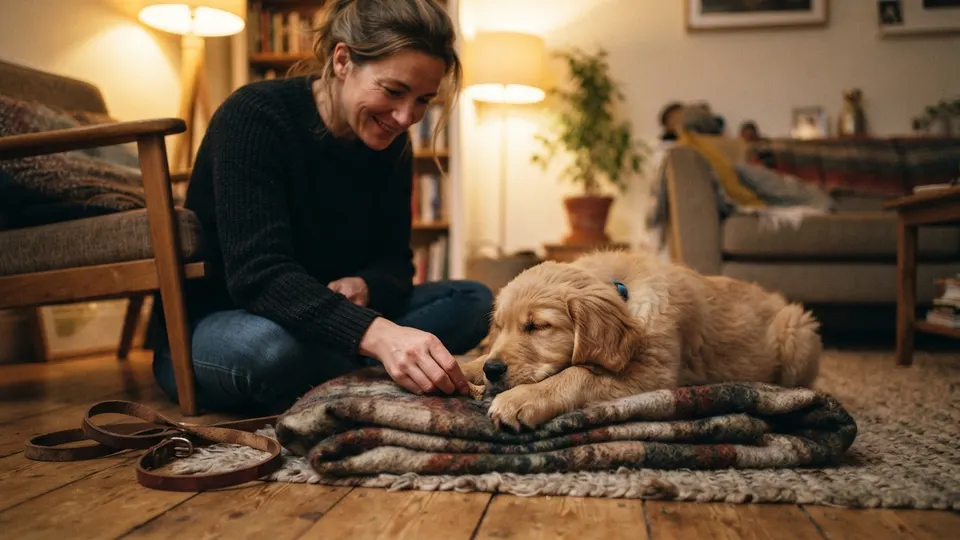
Reward the quiet moments your puppy offers on its own. No cue and no talking: the puppy learns that lying down calmly is the choice that pays.

Short answer
To capture calm, sit quietly with your puppy on a lead or by its pen with a blanket, and silently drop a tiny treat between its paws whenever it lies down, sighs, rests its head or shifts its weight to relax. Build the time a couple of seconds at a time, as Dogs Trust suggests, then add small distractions.
Capturing calm means rewarding your puppy for relaxing on its own, without a command. Sit quietly with the puppy on a lead or in a pen with a blanket, and drop a tiny treat between its paws whenever it lies down, sighs, rests its head or shifts its weight to get comfortable. Say nothing, build the time slowly, and the puppy learns that settling down pays.
I am Andrew Darov, a dog trainer. I am not a veterinarian. This page is the no-cue settle for puppies. A cued mat behaviour is on how to teach place, and settling in public on settle on lead in a café.
Why teach a puppy to settle?
Puppies need a lot of sleep. AKC puts it at 18 to 20 hours a day, and notes that puppies are usually ready to nap after play or a walk. An overtired puppy often gets more bitey and wild, not sleepier. Dogs Trust suggests a comfy bed in a quiet area so a dog can rest and does not become hyper from being overtired. Capturing calm teaches the puppy that lying down quietly is a choice that pays, which makes naps, evenings and visitors easier.
Dogs Trust explains why the method uses no cue: the aim is for the dog to learn for itself to be calm and relax, so that it settles without needing to be asked.
How to capture calm: step by step
This follows the Dogs Trust settle method, adjusted for a young puppy.
- Pick a quiet time. After a toilet trip and a short play, when the puppy is already winding down. Not when it is desperate for the toilet or has just woken.
- Set up. Sit on a chair with the puppy on a lead, or beside its pen, with a blanket or bed on the floor. Have tiny treats ready.
- Reward anything calm at first. Dogs Trust suggests rewarding any behaviour that is not staring at you, pulling on the lead or barking. Drop a treat quietly; say nothing.
- Raise the bar. Then reward only lying down, and later specific signs of relaxing such as sighing, shifting weight and resting the head.
- Add time. Dogs Trust advises building up a couple of seconds at a time over several sessions before each reward.
- End quietly. Stop while the puppy is still calm. If it falls asleep, let it sleep. That is the best result.
| Stage | What you reward | Typical session |
|---|---|---|
| 1 | Any quiet moment: standing still, sniffing the blanket, looking away from you | 2–3 minutes |
| 2 | Sitting or lying down on the blanket | 3–5 minutes |
| 3 | Relaxed signs: hip rolled to one side, head down, sigh | 5–10 minutes, rewards further apart |
| 4 | Staying settled with small distractions | A few minutes while someone walks past |
Session lengths are a starting point for a young puppy, not a rule; stop earlier if the puppy gets frustrated.
How to reward without waking the puppy up
- Place the treat between the paws, so the puppy does not have to get up.
- No talking, no eye contact games. Dogs Trust’s method is silent.
- Use calm food, not the jackpot treat that makes the puppy leap up.
- A long-lasting chew counts. Dogs Trust notes the dog should be having a good time when settling, whether with chews, toys or simply dozing.
Adding distractions
Dogs Trust suggests slowly adding distractions: practising in busier places, or a helper walking past, then doing more exciting things such as sweeping. If the dog gets up, ignore it and wait for it to settle again before rewarding; if it cannot settle, increase the distance or make the distraction less interesting. Once the puppy relaxes well, practise off lead too, so it learns to settle either way.
Where capturing calm fits in a puppy’s day
- Before naps: two minutes of capturing calm on the blanket, then into the crate or pen. See enforced naps.
- The evening crazies: settle sessions before the usual wild hour; see puppy witching hour.
- When you eat or work: the blanket by your chair becomes the place calm happens.
- Visitors: later, the same blanket in a quieter corner when people arrive.
Common problems
- The puppy stares at you or the treats. Hold the treats out of sight, look away, and reward the moment it looks elsewhere.
- It jumps up after every treat. Deliver more slowly and lower, between the paws.
- It cannot settle at all. It may be overtired, need the toilet or be too excited. Toilet, then try in a quieter room.
- It only settles on a lead. Normal at first; practise off lead once lead sessions are easy, as Dogs Trust suggests.
When to get help
A puppy that never relaxes, pants and paces, or seems worried rather than excited may be anxious rather than overtired. See dog anxiety signs, and talk to your vet if restlessness is sudden or comes with other changes.
Sources and scope
- Dogs Trust — Train your dog to settle
- Dogs Trust — Helping an overexcited dog settle down
- AKC — How to Make Sure Your Puppy Gets Enough Sleep
The settle method follows Dogs Trust; sleep amounts and nap timing follow AKC. The stage table and session lengths are editorial planning aids for young puppies. Sources checked 24 November 2026.
Questions on this page
What does capturing calm mean?
Rewarding calm behaviour the puppy offers on its own, such as lying down, sighing or resting its head, without asking for it. Over time the puppy chooses to settle more often.
Should I use a word like “settle”?
Not at first. Dogs Trust’s method rewards calm silently so the dog learns to settle without being asked. A cued mat behaviour can be taught separately.
How long should capturing calm sessions be?
Short for a young puppy: start with two or three minutes and build up as the puppy relaxes faster. Stop while it is still calm.
My puppy gets up every time I give a treat. What now?
Deliver the treat slowly and low, between the paws, without talking, and use a less exciting food.
Work with me
A $150 consultation or $500 monthly curatorship. Opens WhatsApp to Andrew.