
Expert Advice · Behavior · 7 min read
Dog Anxiety Signs: Body Language From Subtle to Obvious
Most anxious dogs warn quietly before they growl or snap. Learn the early signals, read the whole dog, and give space before worry turns into a bite.

Short answer
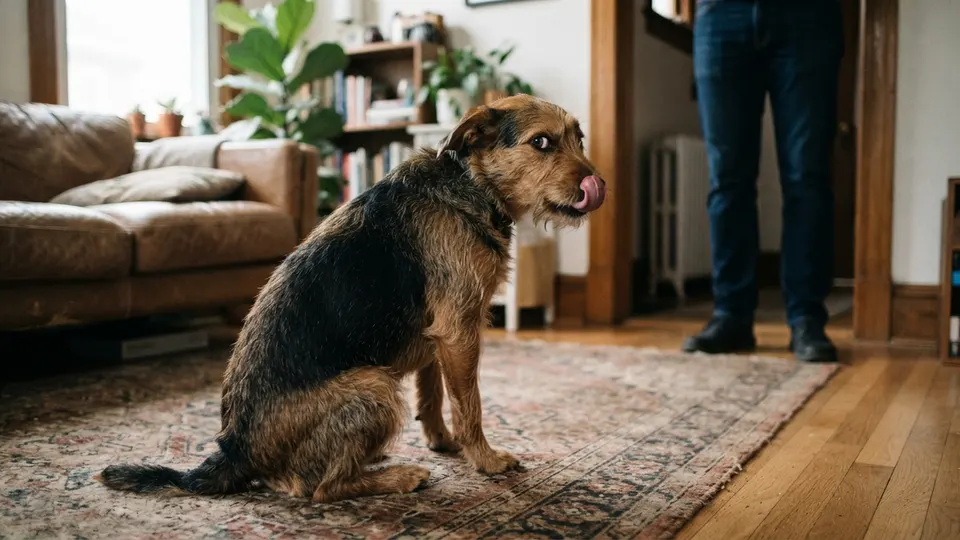
Early dog anxiety signs include yawning when not tired, lip or nose licking, looking away or showing the whites of the eyes, ears back, a raised paw and a low or tucked tail. Panting, pacing, trembling, hiding and refusing food are more obvious signs. Read the whole dog and the situation, and give space early.
Dog anxiety signs usually start small: yawning when not tired, lip or nose licking, looking away, a raised paw, ears back and a lowered or tucked tail. If the worry continues, you may see panting when the dog is not warm, pacing, trembling, hiding or refusing food, and then stiffening, staring, growling or snapping. Read the whole dog and the situation, not one signal, and give space early.
I am Andrew Darov, a dog trainer. I am not a veterinarian. This page is about reading worry and stress in everyday life. For specific problems see separation anxiety, fireworks fear or a dog scared of visitors.
What are the early signs of anxiety in dogs?
The earliest signs are easy to miss because they are quick and quiet. PDSA lists yawning when not tired, licking the nose or lips, a low or tucked tail, panting when not warm, ears pinned back, stiff or tense body language, whale eye (the head turned away but the eyes still watching, so the whites show), turning away, not eating and low energy. Blue Cross adds pacing back and forth, dilated pupils and panting with the tip of the tongue curled.
| Body part | Relaxed | Worried |
|---|---|---|
| Body | Loose, weight across all four paws (RSPCA) | Low or crouched, leaning away, stiff or slowing down |
| Face and mouth | Mouth open and soft (RSPCA) | Mouth closed and tight, lip or nose licking, yawning |
| Eyes | Normal shape (RSPCA) | Looking away, whale eye, dilated pupils |
| Ears | Natural position (RSPCA) | Back or pinned |
| Tail | Relaxed, often wagging loosely | Low or tucked under |
| Paws | Weight even | One front paw raised (RSPCA) |
One sign alone means little. A yawn after a long walk is tiredness; a yawn while a child hugs the dog is not. PDSA advises looking at the dog as a whole, not just one sign, and at the situation the dog is in.
What are the more obvious signs of stress?
When early signs are missed, stress becomes louder. Blue Cross lists loss of appetite, backing away, a tail tucked between the legs, cowering, diarrhoea or more frequent bowel movements, and trembling or shivering when the dog is not cold or excited. Some of these can also be caused by a health problem, so speak to a vet if you are concerned.
- Moving away or hiding: under a table, behind your legs, out of the room.
- Restlessness: pacing, unable to lie down, getting up again and again.
- Panting and drooling without heat or exercise.
- Refusing food, even a favourite treat. A dog who will not eat in a situation is usually too worried to learn there.
- Toileting indoors in a house-trained dog during storms, visitors or departures.
The ladder: from a yawn to a bite
PDSA explains stress signals as a ladder of communication, an idea developed by behaviourist Kendal Shepherd. Low steps are yawning, blinking, nose licking and looking away; higher steps are creeping away, ears back, standing stiff and staring, then growling, snapping and biting. If early signals are not listened to, the dog may move up the ladder, and a dog that has learned its quiet signals are ignored may skip steps and jump straight to a higher level. Not every dog shows every step or follows the same order.
Blue Cross puts the end of the ladder simply: stiffening and staring, growling, showing teeth, snapping and biting are defensive behaviours, and dogs have usually shown other signs of stress before this. Dogs Trust describes aggressive behaviour as an emotional or pain-led response to a trigger, usually because the dog feels threatened and needs space.
What should you do when you see anxiety signs?
- Stop and make space. Dogs Trust’s first step is to pause, stop what you are doing and give the dog space. Step back, call the dog away calmly, or move the thing that worries it.
- Do not punish a warning. A growl is information. Punishing it can teach the dog to skip the warning next time, as the ladder explains.
- Note the trigger. What happened just before: a visitor, a hand reaching over, a noise, a car, being picked up?
- Change the set-up. More distance, fewer people, a quiet resting place, a gate between the dog and the busy part of the house.
- Build confidence slowly. Short, easy exposures with food the dog will still take, and a way out every time.
Anxiety signs in puppies
Puppies show the same signals, just faster and often mixed with play. Watch for a puppy that freezes when picked up, licks its lips and turns away during handling, hides behind you at the door, or will not take food on a busy street. These are signs to make the next step easier, not to push through. Short, positive experiences are covered on the puppy socialization checklist, and gentle handling on getting a puppy used to being handled. A tired puppy also copes worse, so protect naps; see capturing calm.
When should you call a vet or behaviourist?
PDSA advises contacting your vet for a check-up if your dog has a sudden change in behaviour, and acting early so stress does not lead to aggression. RSPCA suggests speaking to your vet first, who may refer you to a clinical animal behaviourist. Blue Cross recommends talking to your vet and finding a professional animal behaviourist if a dog shows aggression or other problem behaviours. Get help early if signs are frequent, getting stronger, or appear around children.
What are the usual mistakes?
- Reading one signal on its own and missing the rest of the body.
- Calling a worried dog “stubborn”, “dominant” or “guilty”. Dogs Trust notes such labels are not helpful.
- Letting visitors or children keep approaching while the dog is turning away.
- Waiting for growling before acting.
- Skipping the vet when behaviour changes suddenly.
Sources and scope
- PDSA — Tips to identify and prevent stress in dogs
- Blue Cross — Signs of stress in dogs
- RSPCA — Understanding your dog’s body language
- PDSA — Canine ladder of communication
- Dogs Trust — Signs of aggression in dogs and what to do
Stress signals and when to get help follow PDSA, Blue Cross and RSPCA; the ladder of communication follows PDSA (after Kendal Shepherd); giving space and labels follow Dogs Trust. The body-part table and puppy notes are editorial aids, not a diagnostic tool. Sources checked 24 November 2026.
Questions on this page
What are the first signs of anxiety in a dog?
Small, quick signals: yawning when not tired, lip or nose licking, looking away, ears back, a raised paw and a lowered tail. PDSA and Blue Cross both list these as early stress signs.
Is yawning a sign of stress in dogs?
It can be. PDSA lists yawning when the dog is not tired as a stress sign. Look at the situation and the rest of the body before deciding.
What is whale eye in dogs?
The dog keeps its eyes on something while its head is turned away, so you see the whites of the eyes. PDSA and Blue Cross list it as a sign of stress.
Should I comfort my anxious dog?
Calm help is fine. Give space, remove or move away from the trigger, and let the dog choose to come to you. Do not force contact or punish warning signals.
When should I see a vet about anxiety?
PDSA advises a vet check if behaviour changes suddenly. RSPCA and Blue Cross suggest the vet first, then a qualified animal behaviourist for ongoing or aggressive behaviour.
Work with me
A $150 consultation or $500 monthly curatorship. Opens WhatsApp to Andrew.