Expert Advice · Skills · 7 min read
How to give a dog ear drops without a fight
Ear and eye drops go in easier when the handling is practised before the real thing. Build a chin rest, get the dog used to the bottle and the touch, then do the real dose quickly and follow it with a treat.

To give a dog ear or eye drops without a fight, practise the handling first: a chin rest, a short touch to the ear or near the eye, and the bottle brought close, each followed by a treat. Then give the real dose quickly and calmly, exactly as your vet prescribed, and end with a treat. If your dog does not know a chin rest yet, start with chin rest, which teaches the position this page builds on.
I am Andrew Darov, a dog trainer. I am not a veterinarian. This is a skills page about handling. Your vet decides which product, how much and how often; this page does not cover that.
Why do dogs fight ear and eye drops?
Most dogs fight drops because the handling feels sudden and the drops feel cold or strange, not because they are being difficult.
Common reasons:
- The ear or eye is sore. A sore ear hurts to touch. That is why the vet visit comes first.
- It feels sudden. A hand comes from above, the head is held, and something wet goes in.
- The bottle predicts it. After one or two doses, the dog sees the bottle and leaves the room.
- Being held down. Firm holding can make the dog struggle more next time.
How do I get my dog ready for drops?
Do this before the first dose if you can, and between doses during treatment. Sessions of one to two minutes are enough.
- Pick a spot. A non-slip mat or towel, with the dog’s back against a wall or the sofa so it cannot back away easily. Small dogs can sit on a towel on your lap.
- Use good treats. Small, soft and easy to swallow.
- Keep it short. Stop while the dog is still happy to stay, not when it starts pulling away.
If touching the ears or face is hard in general, work through puppy handling first, which works for adult dogs too.
How do I give ear drops or eye drops, step by step?
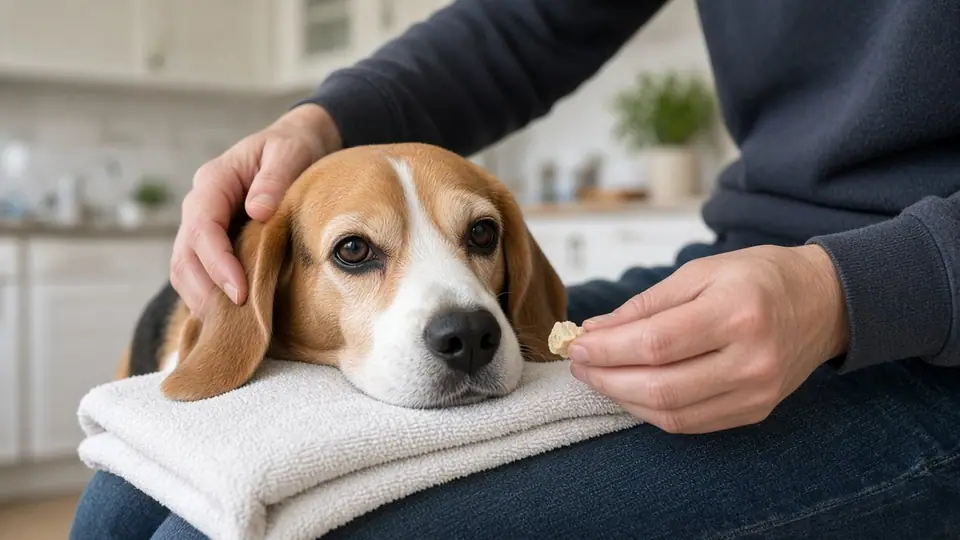
- Build a chin rest. Teach your dog to rest its chin on your palm or on a towel on your knee, and to stay for a few seconds for a treat.
- Practise the touch. From the chin rest, lift the ear flap or touch the fur near the eye for one second, then give a treat. Repeat three to five times.
- Add the empty bottle. Show the bottle, touch it to the fur near the ear, or hold it above and behind the eye out of direct sight, then give a treat.
- Give the real dose. Use the product exactly as your vet prescribed and showed you. Be quick and calm, then give a treat straight away. If your vet said to massage the base of the ear, do it gently before the treat.
- Keep up fake sessions. Between real doses, do a few short rounds with the bottle and no drops, so the bottle does not always mean drops.
If your dog lifts its chin off your hand, stop. That is the dog saying “not yet”. Go back a step and make it easier.
What if my dog still won’t let me?
- Get a second person. One person feeds treats or holds a lick mat at nose height, the other gives the drops.
- Use a lick mat. Smear soft food on a lick mat stuck to a wall or held up. Many dogs stay still while licking.
- Ask your vet. Your vet or vet nurse can show you a safer hold, or suggest another form of treatment if drops are too hard.
If your dog is afraid of handling at the clinic too, our page on fear of vet handling has a plan for that.
How do I keep it calm over a full course of drops?
A course of drops often runs for days or weeks, so the routine matters as much as the first dose. Use the same spot, the same order and the same treat each time, so your dog knows what is coming and that it ends well. Short, predictable steps are easier for a dog than surprises.
Plan doses for times when your dog is already relaxed, such as after a walk, not when it is excited about visitors or dinner. If you miss the window and your dog is wound up, wait a few minutes and do a quick practice round first. Ask your vet how much leeway you have on timing. When the course ends, keep doing a short handling round once or twice a week, so the next time your dog needs drops it is already used to the routine.
What are the usual mistakes?
- Practising only on dose days. The dog learns that every touch means drops.
- Chasing the dog. Calling it over and then grabbing it teaches it not to come.
- Holding the dog down hard. It may work once and make every next time worse.
- Long sessions. Short and easy keeps the dog willing.
- Going on through pain. If your dog yelps, or the ear or eye looks worse, stop and call your vet.
Drops get easier once the dog knows the routine and expects a treat at the end. Next steps: chin rest for the position, puppy handling for ears, paws and mouth, and fear of vet handling for the clinic. More on the skills hub.
Questions on this page
How do I give my dog ear drops by myself?
Sit the dog next to you or against a wall, rest its chin on your hand or knee, lift the ear flap, put in the drops exactly as your vet showed you, gently massage the base of the ear if your vet said to, and give a treat straight away.
How do I give eye drops to a dog that won't let me?
Practise first without drops: chin on your hand, a touch near the eye, a treat. Then bring the bottle close from above and behind, out of the dog's line of sight. Keep each session short and stop before the dog pulls away.
Should I hold my dog down for ear drops?
Firm holding can make the next time harder. Gentle support is fine, but if you need to fight the dog every time, ask your vet to show you a safer method and practise the handling between doses.
How do I make ear drops less unpleasant for my dog?
Ask your vet whether you can warm the bottle in your hand first, give a treat right after each dose, and practise the touch without drops so the dog does not expect drops every time you reach for its ear.
What if my dog's ear looks worse or it yelps when touched?
Stop and call your vet. Pain, swelling, a bad smell, a tilted head or an eye that looks worse all need a vet check, not more practice.
Work with me
A $150 consultation or $500 monthly curatorship. Opens WhatsApp to Andrew.