
Expert Advice · Puppy · 7 min read
Car Rides With a Puppy: First Trips and Car Sickness
Start with the car parked, build to one-minute drives, and keep the puppy restrained. Short calm trips now prevent car sickness and fear later.

Short answer
Start with the car parked: reward your puppy near the car, then inside with doors open, then with the engine on. Drive for one or two minutes and build up a few minutes at a time, as PDSA suggests. Keep the puppy in a secured crate or travel harness, feed a few hours before, and stop if it drools, pants or shakes.
To get a puppy used to car rides, start with the car parked: reward the puppy near the car, then inside with the doors open and the engine off, then with the engine running. When it is relaxed, drive for one or two minutes and build up a few minutes at a time. Keep the puppy restrained in a crate or travel harness, feed a few hours before, and stop if it drools, pants or shakes.
I am Andrew Darov, a dog trainer. I am not a veterinarian. This page covers first trips and car sickness in puppies. Barking in the car has its own page: dog barking in the car.
Why do puppies need car training?
Car sickness is common in puppies. AKC explains that it is most often seen in puppies because the inner-ear structures used for balance are not fully developed yet; many grow out of it, but some dogs never do. PDSA notes that a dog is more likely to develop car sickness if it is not used to travelling or was not introduced to it slowly as a puppy, and that motion sickness tends to get worse over time if it is not managed. PDSA’s safe-travel advice is to start young: pets used to car travel from a young age are much more likely to be relaxed in the car.
First car rides: a step-by-step plan
PDSA suggests practising each step for 2–3 days, rewarding at every stage, and going back a step at any sign of anxiety. Puppies often move faster; move on only when the current step is easy.
| Step | What to do | Move on when |
|---|---|---|
| 1. Near the car | Walk past and around the parked car; treat calm moments (Dogs Trust) | The puppy walks up to the car happily |
| 2. Inside, doors open | Lift the puppy in, engine off, doors open; a long-lasting chew and something that smells of home (Dogs Trust) | It settles or chews inside |
| 3. Doors closed, engine on | Sit with the puppy, engine running for a few minutes, then out (AKC, PDSA) | No drooling, panting or trying to get out |
| 4. Restraint | Practise in the crate or travel harness while parked (PDSA) | It lies down in the crate or harness |
| 5. Tiny drive | Up the road and back, or one to two minutes; stop and walk home if the puppy gets worked up (PDSA, AKC) | A few calm short trips |
| 6. Build up | Add a few minutes at a time; drive to somewhere pleasant (AKC) | Longer trips stay calm |
Dogs Trust advises short, slow and gentle journeys, smooth driving with plenty of time for braking, and a familiar person sitting beside the puppy if possible. Before your puppy’s vaccinations are complete, ask your vet where it is safe to take it at the end of the trip.
How should a puppy travel in the car?
Always restrained. In the UK, rule 57 of the Highway Code asks drivers to make sure dogs are suitably restrained so they cannot distract you or be injured, or injure you, if you stop quickly, and lists a seat belt harness, pet carrier, dog cage or dog guard as ways of doing it. PDSA notes that many car insurance policies also expect pets to be properly restrained. US laws vary by state, but the safety reasons are the same.
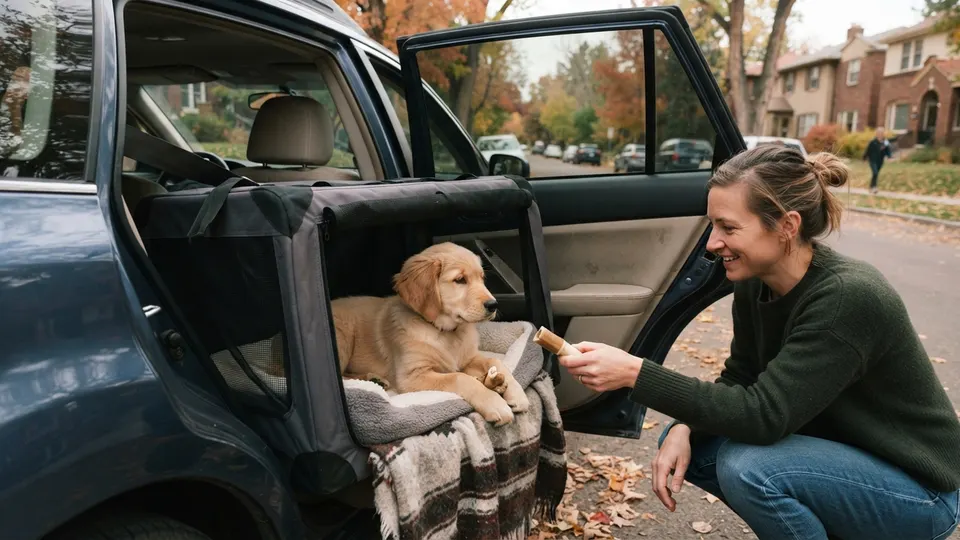
- Crate or carrier: secured so it cannot slide; a non-slip mat inside. AKC notes some owners prefer a solid-sided crate to limit what the dog sees.
- Travel harness: attached to the seat belt system, ideally in the middle of the back seat, where AKC says a dog is more likely to look forward.
- Never in the front footwell or on a lap, and never loose in the boot without a guard.
Puppy car sickness: signs and prevention
PDSA lists drooling, panting, swallowing a lot, lip licking and retching as signs of nausea, alongside vomiting. Signs that a dog is becoming afraid of travel include barking or whimpering, shaking, toileting in the car and refusing to get in.
- Food: PDSA suggests feeding at least 2–3 hours before travel. AKC goes further and suggests withholding food for up to 12 hours before a trip if possible, while keeping water available; for a young puppy, ask your vet what gap is right.
- Fresh air: keep the car cool and ventilated; AKC suggests lowering the windows a few inches.
- Before the trip: a short walk and toilet break first (PDSA).
- On the trip: short journeys at first, no more than five minutes, built up a few minutes at a time, with regular breaks (PDSA).
- If it is sick: stay calm; AKC advises going back a step or two rather than making a fuss.
If sickness continues, see your vet. PDSA says anti-sickness medication can be a short-term help while you retrain, and AKC advises consulting your vet before giving any medication or herbal remedy.
Getting in and out calmly
Dogs Trust suggests asking the dog to sit while you slowly open the door, with a few treats to keep it sitting, so it learns to wait before being guided in. Teach the same calm exit: open the door a little, wait for stillness, then invite the puppy out on the lead. Small puppies should be lifted rather than allowed to jump. The full routine is on threshold wait at the car door.
Never leave a puppy alone in the car
PDSA is blunt: never leave your pet alone in the car, because “not long is too long”, and dogs die in hot cars every summer. Cars also get very cold in winter. Plan stops so someone stays with the puppy or it comes with you.
If your puppy is scared of the car
Dogs Trust advises never forcing a frightened dog to travel, because it may feel trapped and panic, and avoiding car journeys while you get help from an experienced behaviourist if fear is strong. Go back to step 1 with the car parked and short, food-filled sessions. Signs of worry are explained on dog anxiety signs.
Sources and scope
- PDSA — Car sickness and motion sickness in dogs
- Dogs Trust — Train your dog to travel in the car
- AKC — Carsickness in Dogs: Signs, Symptoms, Treatments
- PDSA — Safe car travel for pets
- GOV.UK — The Highway Code, rules about animals (rule 57)
Travel training steps and car-sickness signs follow PDSA, Dogs Trust and AKC; restraint follows the Highway Code (rule 57) and PDSA. The step table is an editorial planning aid; ask your vet about feeding gaps and medication for young puppies. Sources checked 24 November 2026.
Questions on this page
How do I get my puppy used to the car?
Start parked: reward the puppy near the car, then inside with the doors open, then with the engine on. Then drive one or two minutes and build up a few minutes at a time, going back a step if it gets worried.
Why does my puppy get car sick?
AKC says car sickness is most common in puppies because the inner-ear balance structures are not fully developed. Worry about the car can add to it. Many puppies grow out of it with short, calm trips.
Should I feed my puppy before a car ride?
PDSA suggests feeding at least 2–3 hours before travel. Ask your vet what gap suits a young puppy, and always keep water available.
Where should a puppy sit in the car?
Restrained in a secured crate or a travel harness, usually in the back. The Highway Code asks drivers to make sure dogs are suitably restrained.
Can I leave my puppy in the car for a few minutes?
No. PDSA says never leave a pet alone in the car, because not long is too long and dogs die in hot cars.
Work with me
A $150 consultation or $500 monthly curatorship. Opens WhatsApp to Andrew.