
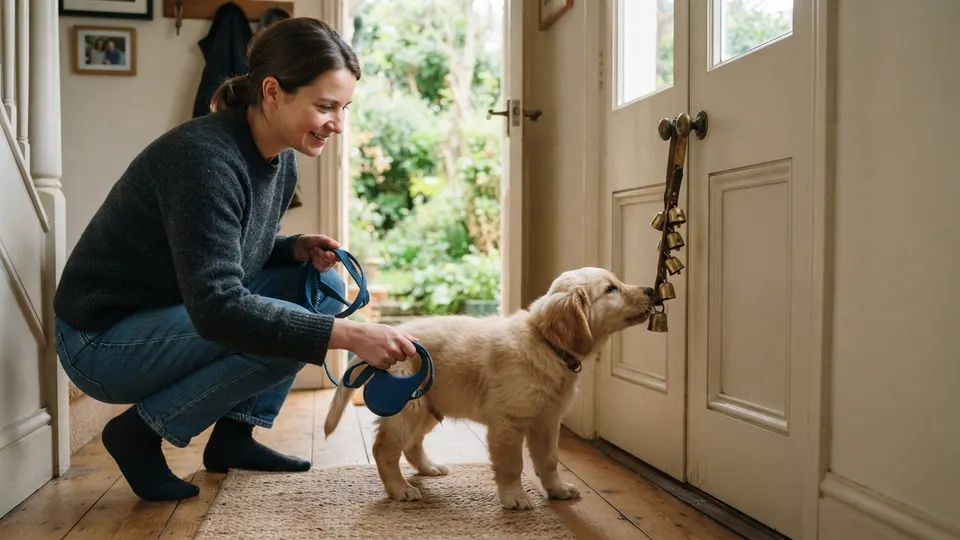
Expert Advice · Puppy · 7 min read
Potty Bell Training: Teach a Puppy to Ring to Go Out
Hang the bell by the toilet door, ring it yourself on every trip, and answer your puppy’s first ring. Keep bell trips boring so the bell means toilet, not play.

Short answer
Hang a bell at nose height on the door you use for toilet trips and ring it yourself every time you take your puppy out, as AKC recommends. When your puppy rings on its own, praise and go straight out. Keep bell trips short and on lead: VCA warns some dogs ring just to play, so play comes only after the puppy has toileted.
Potty bell training teaches a puppy to ring a bell by the door when it needs the toilet. Hang the bell at nose height on the door you use for toilet trips, ring it yourself every time you go out, and open the door the moment your puppy rings on its own. The hard part is keeping the bell for the toilet only, so ringing does not become a way to ask for play.
I am Andrew Darov, a dog trainer. I am not a veterinarian. This page is the full bell method. The basic toilet routine it rests on is on puppy potty training.
Should you use potty bells?
Bells are optional. They help most in homes where you cannot always see the door, with puppies that ask quietly, or with several people who miss the signs. AKC notes that many dogs go to the door or bark when they need to go out, and that a bell or button can make the request clearer; it also helps other people in the home and pet sitters understand the dog. VCA adds that a bell can save your door from scratching.
Bells do not house-train a puppy. A young puppy still needs you to take it out on a schedule: after waking, after meals, during and after play, and every 1–2 hours while awake, as VCA suggests. The bell is a way for the puppy to ask once that routine already exists.
| Option | Good for | Watch for |
|---|---|---|
| Bells on a strap from the door handle | The cheapest and simplest option (AKC) | Loud in a flat; some puppies chew the strap |
| Wireless doorbell button with a receiver | Hearing the request from another room (AKC) | Needs to be fixed so it cannot slide or be chewed |
| Recordable talking buttons | Owners already using buttons for other words (AKC) | More set-up; start with one button for “outside” |
How do you teach a puppy to ring a bell to go outside?
AKC recommends showing the puppy how the bell works rather than luring every ring with treats, so the puppy learns to use it to ask, not only on cue.
- Introduce the bell. Let your puppy sniff and explore it, and reward interest. AKC advises checking first that the bell does not worry the puppy. If the sound startles it, start with the bell muffled or further away.
- Hang it by the toilet door. Use the door you use most for toilet trips, at a height your puppy can reach with its nose or paw.
- Ring it every time you go out. Each toilet trip, ring the bell yourself, or let the puppy nose it, just before you open the door. AKC calls your own consistency the key to the skill.
- Go straight to the toilet place. Lead on, same spot, a quiet wait, and a reward the moment the puppy finishes.
- Answer the first independent ring. When the puppy rings without a signal from you, praise and take it out straight away, as AKC advises.
AKC’s potty timeline describes the same idea in short: ring the bell as you leave with your puppy, and praise it as soon as it rings on its own.
How do you stop the bell becoming a play button?
VCA warns that some dogs ring the bell just for a chance to play in the yard, and advises postponing play and off-lead time until the puppy has finished toileting. Make the bell predict a boring trip:
- Lead on, straight to the spot, a few minutes, then back in if nothing happens.
- Play only after a pee, or at a different time and through a different door if you can.
- No treat for the ring itself. The open door is the answer to the ring; the treat is for toileting outside.
- Log trips for a few days. Once you know your puppy’s usual gaps, a ring 20 minutes after a full pee is easier to recognise as a request for fun.
| Ring | Likely meaning | Answer |
|---|---|---|
| Soon after waking, a meal, a drink or play | Toilet | Out straight away; reward the pee |
| Long gap since the last pee | Toilet | Out straight away |
| Minutes after a full pee, with toys or a bird outside | Play or curiosity | Short, boring trip on lead, then back in |
| Many rings with tiny pees each time | Possible bladder problem | Vet check (see below) |
Common bell training problems
- The puppy ignores the bell. Go back to ringing it yourself on every trip for another week or two, and make sure trips happen before the puppy is desperate.
- The puppy is scared of it. Muffle the bell with tape or use a softer one, and pair the sound with treats from a distance first.
- Ringing all day. The bell now predicts fun. Make every bell trip dull for a week and move outdoor play away from the bell door.
- Ringing at night. Treat a night ring as a toilet trip: quiet, lead on, out, back to bed. Young puppies often need night trips; see puppy night potty breaks.
- Accidents next to the bell. The puppy asked and nobody came, or the ring came too late. Answer faster and keep the scheduled trips going.
When is frequent ringing a vet question?
A puppy that suddenly rings or asks to go out far more often than usual may be uncomfortable. PDSA lists peeing more often, peeing in very small amounts, straining and peeing in the house among the signs of a bladder infection. Ask your vet if the ringing comes with any of these. More signs are on how often puppies pee.
What are the usual mistakes?
- Hanging bells before there is any toilet routine.
- Rewarding the ring with a treat or a game.
- Ringing it for the puppy, then waiting at the door for minutes.
- Moving the bell between doors.
- Stopping scheduled trips because “the puppy can ask now”.
Bells sit on top of the basics: potty training, the potty schedule by age and regression checks if things slip. More on the puppy hub.
Sources and scope
- AKC — How to Teach Your Dog to Ring a Bell to Go Outside
- AKC — Puppy Potty Training Timeline and Tips
- VCA Animal Hospitals — Housetraining for Puppies and Dogs
- PDSA — Bladder infection (UTI) in dogs
The bell method, options and consistency follow AKC; trip frequency and the play warning follow VCA; bladder-infection signs follow PDSA. The ring table and troubleshooting are editorial training aids. Sources checked 22 November 2026.
Questions on this page
How long does it take to bell train a puppy?
It varies. AKC says most dogs catch on very quickly and that the key is your consistency in using the bell on every toilet trip. Keep scheduled trips going until the puppy rings reliably.
At what age can you start potty bell training?
Once there is a toilet routine: a fixed toilet place and regular trips. The bell can hang from the first weeks, but it adds a way to ask; it does not replace taking a young puppy out on a schedule.
Why does my puppy ring the bell all the time?
The bell has started to predict fun. VCA warns some dogs ring just to play. Make bell trips short, on lead and boring for a week, and only play after the puppy has toileted.
Should I give my puppy a treat for ringing the bell?
Not for the ring itself. The open door answers the ring; save the treat for toileting outside, so the bell keeps meaning toilet.
Work with me
A $150 consultation or $500 monthly curatorship. Opens WhatsApp to Andrew.